
Contents
Article
IntelliPA
Turnkey self-hosted AI for municipalities and public bodies: drafts of acts, answers with their source and compliance registers on a workstation on site.
Discover IntelliPA →
Artificial Intelligence
EU AI Act consulting: system classification, policies, AI governance, training.
Discover →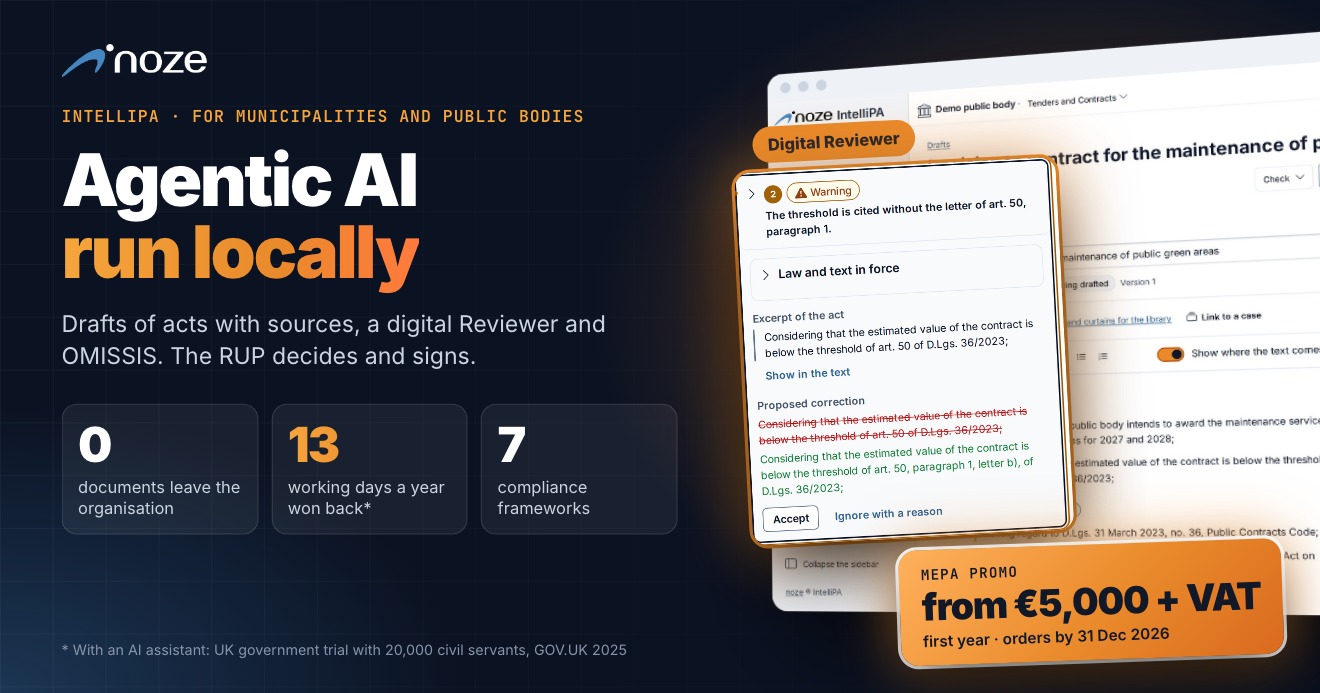
IntelliPA is noze’s product for bringing sovereign generative AI into the offices of municipalities and public bodies. It runs on a dedicated workstation on the organisation’s LAN, with artificial intelligence models running locally: no document leaves the organisation. The AI prepares and proposes; the RUP, the officer responsible for the procedure, or the manager decides and signs.
MePA promo for orders by 31 December 2026. IntelliPA base version at €5,000 + VAT for the first year, with 1 office and up to 8 concurrent sessions: licence, installation and support, workstation not included. Request a quote.
Since 23 October Italy’s Legislative Decree 179/2026 has been in force. Together with Article 14 of Law 132/2025 it completes the Italian framework for AI in public administration: AI supports, the decision stays with a person, use must be knowable and traceable and those who use it must be trained. In the offices, generative AI has often already arrived through public chatbots, which do not know the organisation’s rules, do not cite the law in force and take texts into a provider’s cloud with no record of what was asked. IntelliPA does the same work inside the organisation’s perimeter.
In the UK government trial with 20,000 civil servants, participants reported saving an average of 26 minutes a day with an AI assistant, with drafting documents at the top of the list: projected over a year, that is about 13 working days a public servant can win back (GOV.UK, 2025).
The workstation on site
The dedicated workstation sits on the organisation’s LAN and installs with a single command from the installation media, which checks its fingerprint, together with the artificial intelligence models validated by noze. The web Console opens in the browser, with nothing to install on staff PCs. Guided setup takes five screens: activation, organisation details prefilled from the IPA public registry, access through LDAP, Active Directory or OIDC, licensed offices and go-live with acceptance testing.
Each office has its own knowledge base alongside the organisation’s shared documents, with OCR of scans, antivirus, quality checks and duplicate detection. Regulations in force and ANAC acts are already in the catalogue.
Read more: how IntelliPA works.
Assistant with sources
The Assistant answers on the office’s documents, the organisation’s shared documents and the regulations in force, with numbered citations to the exact passage and a Sources panel. “Why this answer?” shows sources, level and whether they are in force. If the sources are not enough it says so and does not make things up. ANAC model tenders, resolutions and notices are in the catalogue; pre-litigation opinions are cited as interpretation.
On an attachment it offers “Summarise”, “Plain language”, “Extract deadlines” and “Reply note”, and a draft can be opened straight from an answer. It answers in Italian, English or French. Requests outside the intended uses are refused: scoring bids, excluding companies, assessing people.
In the use cases: regulations and ANAC acts for every office and an internal assistant for staff.
Drafting acts
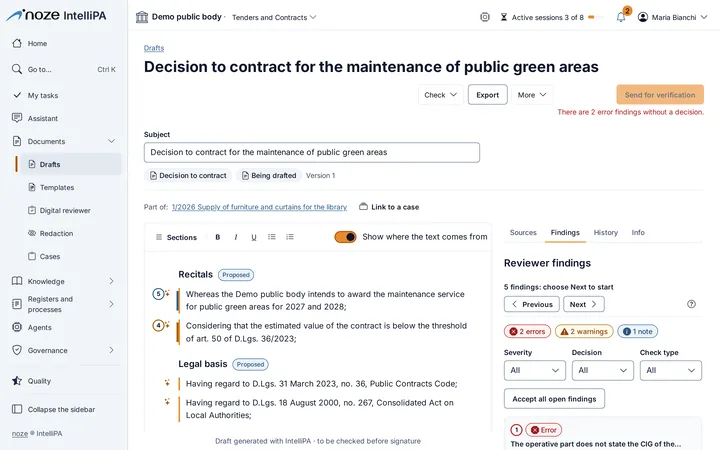
Guided drafting has five steps: type, template, data, sources, generation. Determinations to contract, award determinations, tender specifications, procurement rules, minutes and measures are generated in full, with an outline, sections with sources, a consistency check and automatic review. Awards, appointment of the evaluation board, contracts, resolutions and invitation letters start from a skeleton.
The draft is created on the organisation’s DOCX template with the case file data already filled in, the organisation’s library of clauses and comparison between versions. It moves from “drafting” to “awaiting verification” to “verified”, and verification belongs to the officer in charge. Drafts export to DOCX, ODT or PDF/A with a draft marking.
In the use cases: tender acts ready for verification.
Digital Reviewer
The digital Reviewer raises findings with severity and legal references on drafts and DOCX, PDF and ODT files: structure of the act, CIG and CUP codes, thresholds, rotation, personal data in versions to be published and superseded rules. Each finding opens the exact point in the draft and is accepted or dismissed with a reason. “Compare” checks consistency across 2 to 6 documents of the same procedure. The outcome downloads as DOCX with Word comments or tracked changes, or as PDF.
Repealed rules stay in the catalogue precisely to flag outdated references.
Read more: the guarantees built into the product.
Case files and deadlines
Case files are tenders with lots, CIG codes and amounts or general case files, with phases, parties and members, checklists of documents, email reminders and a daily summary. CIG, amounts, RUP and subject in the drafts are compared with the case file, and “Fix” proposes the value from the case file. The draft starts from the case file.
OMISSIS
OMISSIS finds personal data in DOCX files and drafts, with profiles for the online noticeboard, Transparent Administration, access to records and FOIA. A person reviews and approves every redaction. The file exports to DOCX, ODT or PDF/A without metadata or residues. The references are the GDPR, Legislative Decree 33/2013 on transparency, Law 241/1990 on access to records and the Italian Data Protection Authority’s guidelines of 15 May 2014 on online publication.
In the use cases: acts published without personal data.
Compliance
Seven frameworks sit in one place, applied to the organisation’s procedures: the AI Act, GDPR, NIS2, CRA, DORA, ISO/IEC 42001 and OISG. IntelliPA keeps the AI Act inventory with obligations, deadlines and algorithm sheet, the GDPR registers and DPIAs. DPIAs, FRIAs and replies to data subjects start as drafts. The AI literacy training for staff required by Article 4 of the AI Act has its own register, and the Transparency page covers models, intended uses, where data goes, retention, accessibility and governance.
In the use cases: GDPR, NIS2 and AI Act registers at work. Read more: trust and control.
Offices and roles
Offices are licensed individually: Tenders and Contracts, Records, Civil Registry, Tax and Urban Planning, each with its own templates, checks and regulations and isolated from the others. For Tax, no automatic tax decisions. The roles are operator, reviewer, officer in charge or manager, organisation contact, technical administrator and DPO.
Two-step verification is mandatory for administrators and the organisation’s referents and can be extended to every user; with the organisation’s single sign-on, its own second factor applies. The technical administrator cannot see office content and the audit log has a verifiable hash chain. The organisation’s documents and data are used only to answer requests from its offices and are not used to train the models.
Admina and OISG
IntelliPA is built on Admina, the open-source AI governance framework under the Apache 2.0 licence, a project by Stefano Noferi sponsored by noze. Every request to the models goes through Admina, which blocks prompt injection and keeps a forensic chain of the interactions. DataGovern, VerdePilot and AgenticHealth are built on the same framework.
The product follows OISG (Open, Intelligent, Secure, Governed), the paradigm for autonomous AI systems proposed by Stefano Noferi and adopted by noze. In IntelliPA the four pillars are features: governance on inspectable code and the Transparency page for Open, on-site AI grounded in documents with the source of every answer for Intelligent, data inside the organisation and isolated offices for Secure, and verifiable audit, registers and the RUP’s signature for Governed. The installation assesses itself against the paradigm and issues a self-assessment PDF certificate.
What the rules require
Law 132/2025, Article 14. Public administrations use AI to make their activity more efficient, shorten procedure times and improve services, ensuring that those concerned can know how it works and that its use is traceable. AI plays an instrumental, supporting role: the decision-maker remains solely responsible for measures and procedures. Organisations adopt technical, organisational and training measures.
Legislative Decree 179/2026, Article 40. The Minister for Public Administration sets out in guidelines the minimum set of AI skills required of staff and coordinates training paths with the National School of Administration, Formez PA and, through agreements, universities, ANCI, UPI and the Conference of Regions.
AI Act. Since 2 February 2025 anyone using AI systems must ensure AI literacy among their staff (Article 4). For high-risk systems listed in Annex III, public bodies will have to carry out a fundamental rights impact assessment before putting them into use (Article 27): under the digital omnibus the obligation applies from 2 December 2027.
| What the rules require | How IntelliPA responds |
|---|---|
| The decision stays with a person (Law 132/2025, Art. 14(2)) | The AI prepares drafts and findings; the officer in charge verifies, the RUP or the manager signs. Signature, registry, online noticeboard and certified email stay in the organisation’s own systems, by design |
| Knowable and traceable use (Art. 14(1)) | Citations to the exact passage, “Why this answer?” with sources and validity, a Transparency page, an audit log with a hash chain |
| Technical measures (Art. 14(3)) | Everything on site, two-step verification mandatory for administrators and extendable to everyone, isolated offices, every request to the models filtered by Admina, open source |
| Training measures (Art. 14(3); AI Act, Art. 4) | Office training and a training register |
| Personal data in published acts | OMISSIS with approval by a person |
IntelliPA does not make an organisation compliant on its own: organisational choices, assessments and decisions remain the organisation’s. What it does is provide the tools to do this in everyday work.
How it is adopted
- Promo for orders by 31 December 2026: the base version at €5,000 + VAT for the first year, with 1 office and up to 8 concurrent sessions (licence, installation and support; workstation not included).
- Procurement via MePA, the Italian public e-procurement marketplace, as a single project covering hardware, software, installation and support, with an annual licence per office and concurrent sessions.
- Guided setup: organisation details prefilled from the IPA public registry, access through LDAP, Active Directory or OIDC, activation of the offices and acceptance testing before go-live.
- Training and support: office training with a register, ongoing support with “Report a problem” from the Console and signed updates of models and regulations. The licence extends to new offices, modules and concurrent sessions without reinstalling.
The organisations that have chosen IntelliPA include the Municipality of Sesto Fiorentino.
An online demo
We run online demos for municipalities, provinces, regions, chambers of commerce, local health authorities and public bodies: on a video call we show the Assistant on a regulatory question, the drafting of a tender act, the digital Reviewer and OMISSIS on an act to be published.
Book an IntelliPA demo, or explore the use cases, how it works and the guarantees on data and accountability.
Sources
- Normattiva, Law 23 September 2025, no. 132, Article 14
- Gazzetta Ufficiale, Legislative Decree 7 October 2026, no. 179
- Regulation (EU) 2024/1689 (AI Act)
- GOV.UK, Microsoft 365 Copilot Experiment: Cross-Government Findings Report (2025)
- Decree 179/2026: AI authorities, fines, work and training
- AI Act: the Digital Omnibus postpones high-risk rules and adds new prohibitions
- Admina
- IntelliPA