
Contents

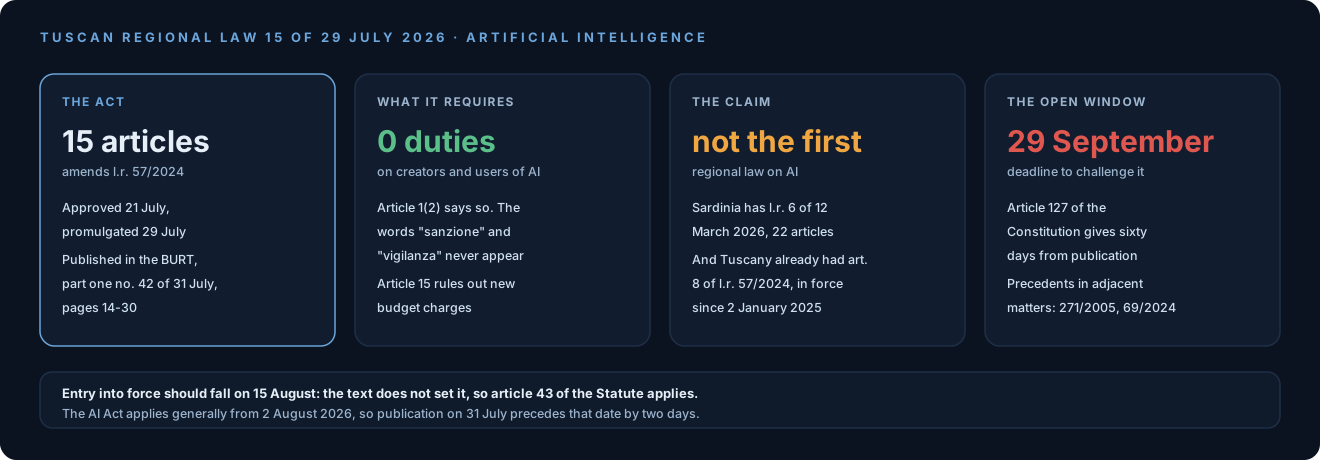
The Regional Council of Tuscany approved the law on the responsible use of artificial intelligence on 21 July. President Giani promulgated it on 29 July, and it appeared in the Official Bulletin of the Region of Tuscany, Part One no. 42 of 31 July 2026, at pages 14-30, as regional law 29 July 2026, no. 15, “Uso responsabile e consapevole dell’intelligenza artificiale. Modifiche alla l.r. 57/2024”.
The text sets no date of entry into force, so article 43 of the Statute applies: the fifteenth day after publication, which should be 15 August. As of 11 August the law is published and not yet effective.
Article 1(2): no new obligations
Article 1(2) provides that the Region implements the law “senza produrre nuovi obblighi per i creatori e gli utenti dei sistemi di IA”, without creating new obligations for creators and users of AI systems.
The words sanzione and vigilanza appear in none of the fifteen articles. Article 15 is a financial neutrality clause: implementation produces “no new or increased charges on the regional budget”.
Who it applies to
Article 2 limits the scope to the Region and its dependent bodies, private-law entities the Region controls, the enterprises and bodies of the regional health service, local authorities and their organisations. Any other public or private party using regional digital services falls within it only after signing an agreement within the Tuscan regional telematic network.
A Tuscan SME stays outside the scope, absent an agreement. A regional health enterprise or a local authority fall inside it, and the instruments that will reach them are the charter of rights under article 7 and the guidelines under article 15 bis, neither of which carries a sanction.
The Observatory and the selection of reports
Article 8 establishes an AI Observatory at the Giunta, appointed by decree of the President. Paragraph 2 lists twenty members at fixed number: four experts employed by the Region, six designated by the Regional Council, four by the Council of Local Authorities, one each from the regional competence centre, the regional consumers committee, CORECOM and the CNR, plus one representative of technology companies and one from healthcare. To these is added one representative for each of the most representative trade union confederations, in a number the text does not predetermine.
Paragraph 5 provides that participation is “a titolo gratuito e non dà luogo a rimborsi, indennità o gettoni di presenza”, unpaid and without reimbursements or attendance fees. The paragraph does not refer to article 15.
On reports from users the Observatory “formulates recommendations” and “directs the user for possible transmission to the competent authorities and administrations, monitoring the outcome”. Paragraph 4(e) assigns it the approval of a set of rules “per la selezione dei casi da prendere in esame”, for selecting which cases to examine: the admission criteria are set by the same body that receives the reports, and examination is not guaranteed.
The Tuscan charter of digital rights under article 7 is approved by the Giunta on the Observatory’s proposal, within twelve months of entry into force. The guidelines under the new article 15 bis of l.r. 57/2024 are approved “in accordance with the Observatory’s directions”. In both cases the body’s role goes beyond recommendation.
For the appointment of the Observatory the law sets no deadline.
The five rights in the charter
Article 7(2) lists what the charter is to contain: clear and prior information on the use of an AI system, an administrative decision not based solely on automated processing, a comprehensible explanation of the system’s logic, complaint and review including human intervention “ove previsti dalla normativa in vigore”, and protection of personal data.
That last clause, “where provided for by the legislation in force”, confines complaint and review to cases where another source already provides for them, without establishing them independently.
Not the first regional law on AI
Two acts precede the Tuscan law: the Sardinian law of 12 March 2026 and Tuscan l.r. 57/2024.
In Sardinia the Regional Council approved the consolidated text in the sitting of 10 March 2026, promulgated as regional law 12 March 2026, no. 6, “Disposizioni in materia di promozione, sviluppo sostenibile e sistema di governo dell’intelligenza artificiale in Sardegna”, twenty-two articles. It precedes the Tuscan law by four and a half months, with twenty-two articles against fifteen, and covers regional governance of AI, a hub at CRS4, an observatory, a platform, healthcare, schools and business.
L.r. 9 December 2024, no. 57, in force since 2 January 2025, devotes the whole of article 8 to AI, takes the definition in article 3 from article 3 of the AI Act, and provides for regulatory sandboxes in article 25 under article 57. Paragraph 2 of that article 8 has already been implemented by Giunta resolution no. 60 of 2 February 2026, which approved the guidelines for adopting AI in Tuscany. The July law amends 57/2024, as its title says.
In Lombardy the Giunta approved a bill on research, innovation and AI on 2 March 2026. The approval is the Giunta’s, so it concerns a bill and not a text voted by the Council, and at the last reachable institutional source it was still in committee.
The relationship with the AI Act and with law 132/2025
Article 113 of Regulation (EU) 2024/1689 sets the general application of the AI Act at 2 August 2026, and from that day the transparency obligations of article 50 apply among others, chapter IV not being among the exceptions and therefore following the general date. Publication of the Tuscan law in the BURT precedes that date by two days, and entry into force, which should fall on 15 August, follows it by thirteen.
Regulation (EU) 2026/1744 of 8 July 2026, the AI branch of the digital omnibus, was published on 24 July and has been in force since 27 July: it amends the AI Act on some deadlines and adds prohibited practices to article 5. At national level law 132 of 23 September 2025 has been in force since 10 October 2025, and its article 20 designates AgID and ACN as national authorities for artificial intelligence, alongside the implementing decrees approved on 4 August.
The preamble of the Tuscan law cites the European regulation among the Visto. An EU regulation is directly applicable and needs no transposition by any Region.
The limit of competence
Article 127(1) of the Constitution gives the Government sixty days from publication to challenge before the Constitutional Court a regional law exceeding the Region’s competence. With publication on 31 July, the deadline falls on 29 September 2026.
Two precedents in adjacent matters. In judgment 271/2005 the Court declared article 12 of Emilia-Romagna law 11/2004 on regional development of the information society unconstitutional. In 69/2024 it declared unconstitutional article 3 of Puglia law 13/2023, the article regulating video surveillance and privacy protection in facilities for elderly people and people with disabilities.
Article 1(2) also bears on the challenge under article 127: a regional law that creates no obligations towards private parties offers less ground for a challenge on competence.
What we think
What the law binds the administration to do to itself sits in three instruments: a charter of digital rights carrying the right to a decision not based solely on automated processing and to an explanation of the system’s logic, a body that receives reports, and a service charter on whose observance article 10 conditions the payment of contributions to digital facilitation centres. Article 10 is the only provision tying a requirement to funding.
The twelve-month deadline binds approval of the charter, not the appointment of the Observatory that has to propose it, for which the law sets no date. Until the body is appointed, the deadline runs against no one. The same Observatory then writes the rules determining which reports get examined.
For anyone working in a Tuscan public administration or a regional health enterprise, transparency on the use of an AI system and explainability of an administrative decision are already required by article 50 of the AI Act, applicable from 2 August, and by article 22 of the GDPR on automated decisions. Article 7 gives twelve months from entry into force to approve the charter, so the entire window falls after 2 August: implementing transparency and explainability now leaves the regional charter already satisfied when it arrives.
Sources
- BURT, Part One no. 42 of 31 July 2026 (text of l.r. 15/2026, pp. 14-30)
- Regional Council legislative database: l.r. 9 December 2024, no. 57
- Regional Council of Sardinia, laws approved in the XVII legislature (l.r. 12 March 2026, no. 6)
- Regulation (EU) 2024/1689 (AI Act), art. 113
- Law 132 of 23 September 2025, on Normattiva
- Constitution, art. 127, on Normattiva