
Article

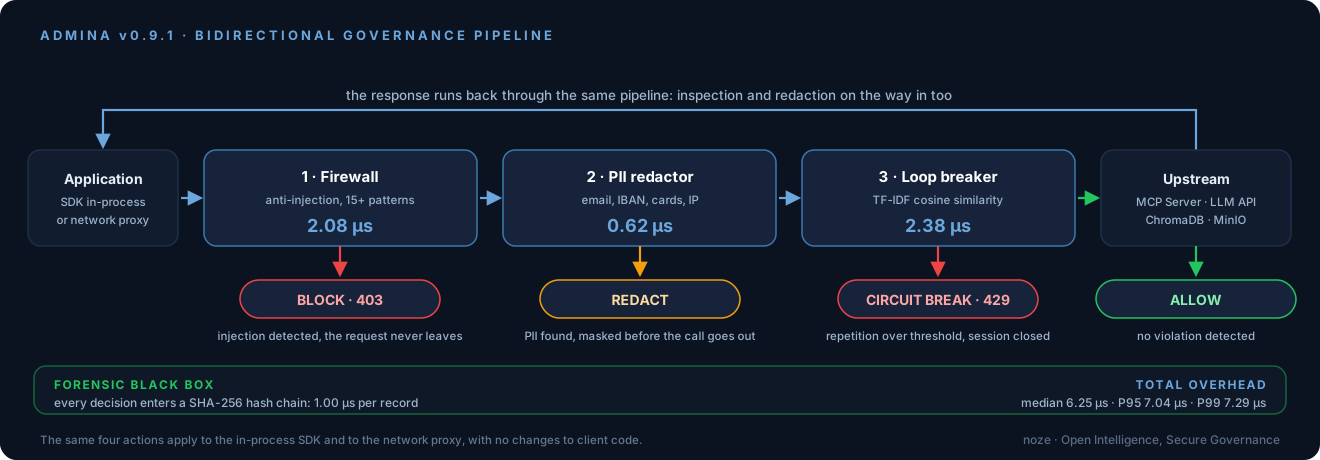
The release
On 20 May 2026, Admina v0.9.1 (pre-1.0) is released — an Open Source framework for AI governance created by Stefano Noferi and sponsored by noze. The project is distributed under the Apache 2.0 license, published on github.com/admina-org/admina, with official site at admina.org.
The stated goal is to enable building AI applications that are governed by design: a single install bundles SDK, proxy, CLI, dashboard and a plugin system to apply bidirectional governance on every interaction between the application and the models.
The architecture
Admina runs in two complementary modes:
- Python SDK (in-process): imported as a library via
GovernedModel, intercepting model calls directly in application code — no network overhead. - Network proxy (Rust + Python): a transparent proxy applicable to any client with no code changes; it talks to MCP Server, LLM API (Ollama, vLLM), ChromaDB and MinIO.
Both modes apply bidirectional policies — on both request and response — with four actions: ALLOW, BLOCK, REDACT, CIRCUIT BREAK. Supported sources include the SDK, generic AI agents, OpenClaw and frameworks like LangChain and CrewAI.
The four governance domains
- Data Sovereignty — PII redaction, data residency enforcement, data classification. Rust-accelerated at 0.62µs per scan.
- AI Infrastructure — LLM engine (Ollama, vLLM), RAG pipeline (ChromaDB), web UI, hot model switching. Opt-in.
- Agent Security — anti-injection firewall (15+ patterns, 2.08µs), loop breaker via TF-IDF cosine similarity (2.38µs). Bidirectional.
- Compliance — EU AI Act classification (Art. 6-15), forensic black box with SHA-256 hash chain on MinIO, native OpenTelemetry integration.
Performance
Typical governance overhead across the full 4-domain pipeline: median 6.25µs, P95 7.04µs, P99 7.29µs (Rust engine, Python fallback). The v0.9.1 release ships with 700+ tests in the automated suite.
OISG adequate by default
Admina is built around the OISG paradigm — Open, Intelligent, Secure, Governed — published on oisg.ai. The adequacy score is computed at runtime from the live installation state, not from static checklists: a default install reaches the adequate band.
Technology stack
The core is written in Python (SDK, integrations) and Rust (proxy, scanners, firewall). The local dev stack includes dashboard (:3000), proxy (:8080) and Grafana (:3001). Distribution details (package and CLI commands) will be announced at release.