
Article

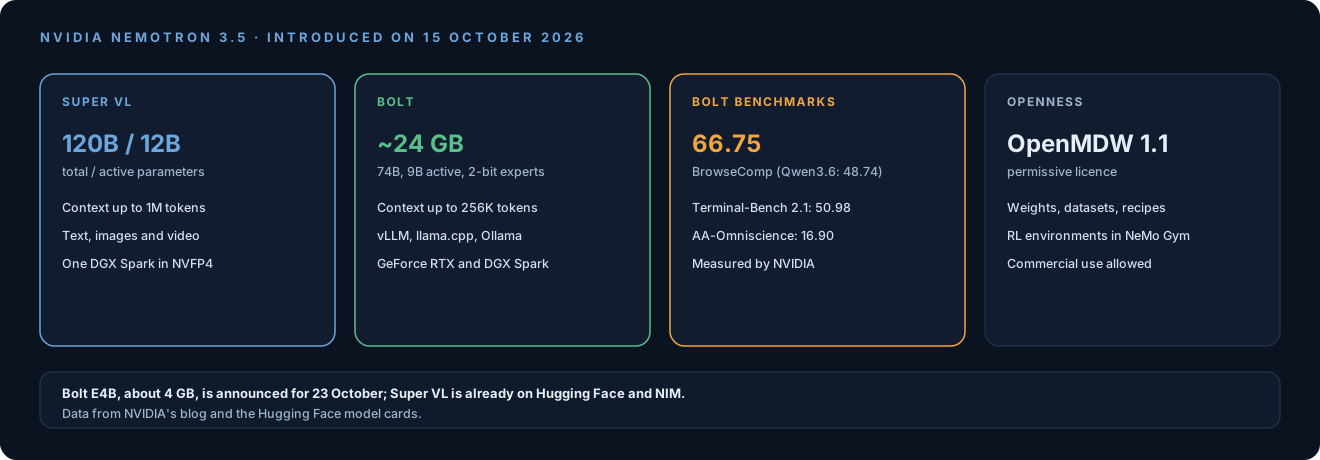
On 15 October NVIDIA introduced three new models in the Nemotron 3.5 family, designed to run AI agents from the data centre down to PCs:
- Nemotron 3.5 Super VL, 120 billion parameters with 12 billion active, multimodal;
- Nemotron 3.5 Bolt 74B-A9B, 74 billion parameters with 9 active, compressed to about 24 GB;
- Nemotron 3.5 Bolt E4B, about 4 GB, announced for 23 October.
Alongside the weights NVIDIA publishes open datasets (tool use, finance, long context, vision and more), the training recipes and the reinforcement learning environments in NeMo Gym. The models are released under the OpenMDW 1.1 licence, which allows commercial use.
Super VL
From the Hugging Face model card:
- Hybrid Mamba-2 and Transformer architecture with Mixture of Experts (512 experts per MoE layer), a C-RADIO vision encoder and multi-token prediction for speculative decoding.
- Context of up to 1 million tokens; text, images and video up to 2 minutes as input, text as output. Reasoning is switched on or off from the chat template.
- NVFP4 weights, obtained through quantisation-aware distillation from the BF16 model.
- Listed hardware: one DGX Spark, one H200, two H100s or one GB200.
- Training: about 26 trillion tokens of pre-training, then about 3.8 million post-training samples with reinforcement learning across dozens of environments, according to NVIDIA’s blog.
The model card only compares the NVFP4 version with the BF16 one: GPQA Diamond 89.9, SWE-bench Verified 71.07, Terminal-Bench 2.1 62.78, OSWorld-Verified 52.3, values almost unchanged from BF16. Quantisation does weigh on WebVoyager (from 77.72 to 66.31) and DeepSWE (from 24.65 to 18.2). Comparisons with other models are in NVIDIA’s blog but without figures.
Bolt 74B-A9B
Bolt is derived from Super VL to fit in the memory of a single GPU:
- Same hybrid architecture, with 9 active experts per token instead of 22.
- Mixed quantisation: experts at about 2 bits (IQ2-XXS), Mamba layers in NVFP4, embedding and output in Q8_0, with quantisation-aware distillation to recover accuracy. The compressed model takes about 24 GB, sized for batch size one and 128,000 tokens of context.
- Context of up to 256,000 tokens, text, image and video input.
- Runtimes: vLLM (the model card recipe needs a nightly image), SGLang and the GGUF version for llama.cpp, Ollama and LM Studio. NVIDIA targets GeForce RTX, RTX PRO and DGX Spark.
The model card benchmarks, measured by NVIDIA, compare 2-bit Bolt with similarly sized models in BF16:
| Benchmark | Bolt (2-bit) | Qwen3.6 35B-A3B | Gemma4 26B-A4B |
|---|---|---|---|
| GPQA Diamond | 86.43 | 83.40 | 79.61 |
| Terminal-Bench 2.1 | 50.98 | 44.38 | 37.22 |
| BrowseComp | 66.75 | 48.74 | 26.30 |
| PinchBench | 87.82 | 88.07 | 74.70 |
| AA-Omniscience (accuracy) | 16.90 | 19.47 | 22.17 |
Bolt is ahead on most tests, roughly level on PinchBench and behind on the factual knowledge measured by AA-Omniscience. NVIDIA’s blog presents it as the top open model in its class on PinchBench, while in the model card table Qwen3.6 35B-A3B is slightly ahead. The model card also notes that for MCP-Atlas the Qwen3.6 score measured by NVIDIA (51.2) is lower than the one reported by Alibaba (62.8): comparisons depend on how the tests are run.
The licence
OpenMDW 1.1 allows using, modifying and distributing the model materials with no use restrictions or revenue thresholds. Anyone redistributing them must keep the licence text and copyright notices; rights terminate for anyone who sues claiming the materials infringe a patent or copyright. It is a simpler arrangement than Meta’s Muse Model License, which requires attribution and a separate agreement for those offering the model as a service above a revenue threshold.
What changes for on-premise agents
A week ago we wrote about an open-weight model that needs at least 700 GB of GPU memory. These two go the other way: Super VL is listed for a single DGX Spark, a machine with NVIDIA GB10 and 128 GB of unified memory, and Bolt fits in about 24 GB. For an organisation that wants to run agents on documents, terminal and browser without sending data outside, the hardware bar drops to a workstation.
Two caveats. First, the figures are NVIDIA’s and 2-bit quantisation has to be tested on one’s own tasks, because Super VL’s own model card shows losses on some agentic tests. Second, a model designed to use terminal and browser should sit inside a perimeter with explicit permissions, action logs and human approval of operations with impact.
What we think
The most useful novelty is not a score but the combination: open weights, datasets and recipes, a permissive licence and models sized for hardware a company can keep in house. The GB10 is among the platforms we use for on-premise projects, and a 120-billion-parameter multimodal model that fits entirely on it widens what can be done locally. Independent evaluations and real performance with long contexts and several users are still to come.
What to watch
- The release of Bolt E4B, announced for 23 October.
- Independent evaluations of Super VL and Bolt, starting with Artificial Analysis.
- Stable vLLM support, currently tied to a nightly image for Bolt.
- Real performance on DGX Spark with long contexts and several sessions.
Sources
- NVIDIA Blog, Open from data center to desktop: Nemotron 3.5 Super VL and Bolt
- NVIDIA Developer, Nemotron 3.5 Super VL
- Hugging Face, Nemotron 3.5 Super VL 120B-A12B NVFP4 model card
- Hugging Face, Nemotron 3.5 Bolt 74B-A9B 24GB model card
- NVIDIA Research, Nemotron 3.5 Bolt 24GB
- OpenMDW License 1.1
- Meta’s Muse Spark Open: weights, licence and benchmarks
- NVIDIA GB10: local AI arrives on the desktop with 128 GB unified memory