
Article

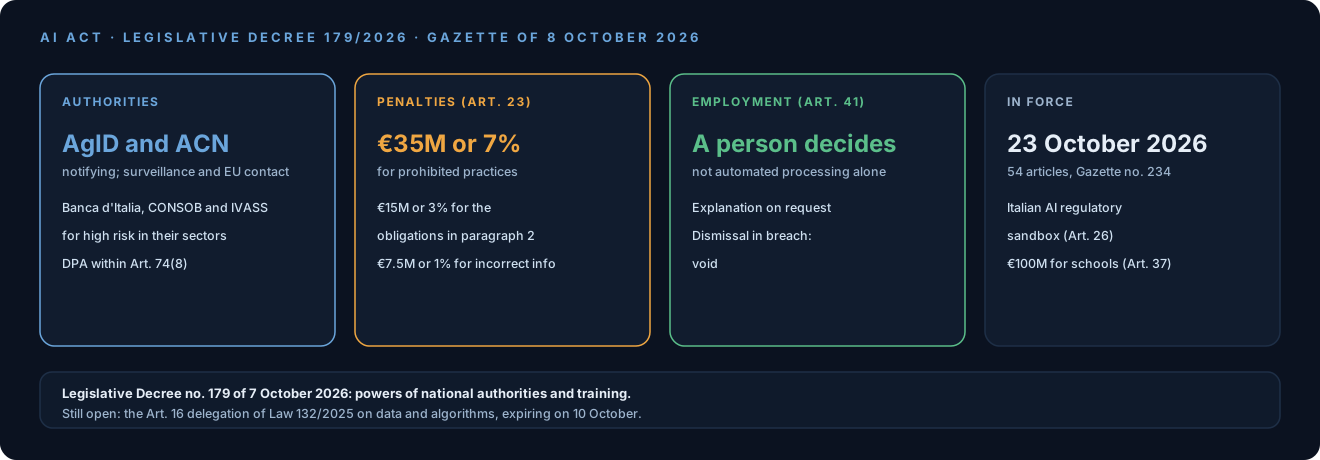
The Italian Official Gazette, General Series no. 234 of 8 October 2026 publishes Legislative Decree no. 179 of 7 October 2026, adapting national law to Regulation (EU) 2024/1689 “on the powers of the national authorities and the use of artificial intelligence in training”. It has 54 articles and enters into force on 23 October 2026.
It is the second of the two decrees given final approval in August. The first, on police and biometrics, has been in the Gazette since 15 September.
Who supervises
- AgID is the national notifying authority: it assesses, designates, notifies and monitors conformity assessment bodies (Art. 4).
- ACN is the market surveillance authority for AI systems (Art. 5) and the single point of contact with the Union (Art. 6). It also handles the national registration of the high-risk systems in Annex III, point 2, i.e. critical infrastructure (Art. 14).
- Banca d’Italia, CONSOB and IVASS are market surveillance authorities for high-risk systems used, respectively, in lending and services under the Consolidated Banking Act, in financial services under the Consolidated Law on Finance and in insurance (Art. 5), with their own supervisory and inspection powers (Art. 17).
- The Italian data protection authority (Garante per la protezione dei dati personali) supervises within the limits of Article 74(8) of the regulation (Art. 5).
The decree provides for agreements between authorities, coordination with sector authorities and a coordination committee (Arts. 7-12).
Penalties
Article 23 sets the maximum amounts, unless the conduct is a criminal offence:
- up to €35 million or 7% of worldwide annual turnover, if higher, for the practices prohibited by Article 5 of the regulation;
- up to €15 million or 3% for the obligations listed in paragraph 2, including those of providers, importers, distributors and deployers;
- up to €7.5 million or 1% for incorrect, incomplete or misleading information supplied to notified bodies or authorities;
- up to €1 million or 0.5% for the obligations of Articles 27 and 86 of the regulation.
Penalties are imposed by AgID and by the market surveillance authorities within their respective remits (Arts. 20 and 21).
The regulatory sandbox
Article 26 establishes the Italian AI regulatory sandbox, provided for by Article 57 of the regulation, under the direct supervision of the national AI authorities. Its stated aims are cooperation with the authorities, innovation, regulatory learning based on the evidence from experimentation and faster access to the EU market, in particular for SMEs and start-ups. The following articles govern its management, cross-border cooperation and outcomes, and provide for further regulatory sandboxes.
Employment
Article 41 covers employment decisions taken with the help of AI systems:
- final decisions on hiring, changing and ending the employment relationship, including disciplinary measures and performance evaluations, cannot rest solely on automated processing: the final decision belongs to a natural person with effective and autonomous power;
- searching for and screening candidates is not a final decision, even when it excludes someone from later stages;
- the worker’s consent is not an exception to the prohibition;
- before processing starts, the employer provides the information required by Legislative Decree 152/1997;
- the worker can obtain, through a person, an intelligible explanation of the decision, including any influence of the AI systems and the main parameters considered;
- dismissals and decisions taken in breach of these rules are null and void.
Training
Articles 36-51 cover the use of AI and training in schools, universities, public administration, employment, the professions, the financial sector and continuing education. Two provisions carry figures and deadlines:
- for the educational emergency linked to the use of social media and AI-based environments, up to €100 million from the national programme “PN Scuola e Competenze 2021-2027” (Art. 37);
- teacher training follows criteria set by a decree of the Minister of Education and Merit within ninety days of entry into force (Art. 38).
Trade secrets
Article 52 adds a paragraph 1-bis to Article 98 of the Italian Industrial Property Code: where the conditions for trade secrets are met, they also include the data, algorithms and mathematical methods used to train AI systems. Algorithms and mathematical methods are defined as model architectures, optimisation functions, training procedures and configurations, and any other technical-computational element used to develop AI systems.
What we think
The decree completes the designation of the Italian authorities for the AI Act: AgID for notified bodies, ACN for surveillance and contact with the Union, the financial authorities for banking, finance and insurance. ACN has a similar role in the draft decree on the Cyber Resilience Act given preliminary approval on 2 October: for those building AI systems that are also digital products, the counterpart will often be the same. Article 41 is the part with the most direct effect on companies: in personnel decisions taken with the help of AI the final decision must remain with a person, or it is void. The worker can ask for an explanation.
What to watch
- The implementing decrees the text refers to, starting with the one on teacher training and the procedures for national registration of high-risk systems.
- The operating rules of the Italian AI regulatory sandbox.
- The delegation in Article 16 of Law 132/2025, on data and algorithms for training, which expires on 10 October. Decree 179 implements the Article 24 delegation, but through Article 52 it already covers part of that subject.
Sources
- Official Gazette, Legislative Decree no. 179 of 7 October 2026
- Official Gazette, General Series no. 234 of 8 October 2026 (PDF)
- Regulation (EU) 2024/1689
- AI Act: the police and biometrics decree is published
- Italian AI Act decrees: final approval, tighter biometrics and automated dismissals void
- Cyber Resilience Act: Italian decree, ACN and penalties