
Article

Artificial Intelligence
On-premise AI architectures, local LLMs, RAG and autonomous agents. The intelligence that matters should be owned, not rented from someone else’s switch.
Explore →
Open Source Enterprise
Enterprise adoption, governance and compliance of open source and open weights, with data sovereignty as the through-line.
Explore →
Admina
AI governance: audit trail, PII redaction and bidirectional policies on any model, open-weight or proprietary, local or remote.
Explore Admina →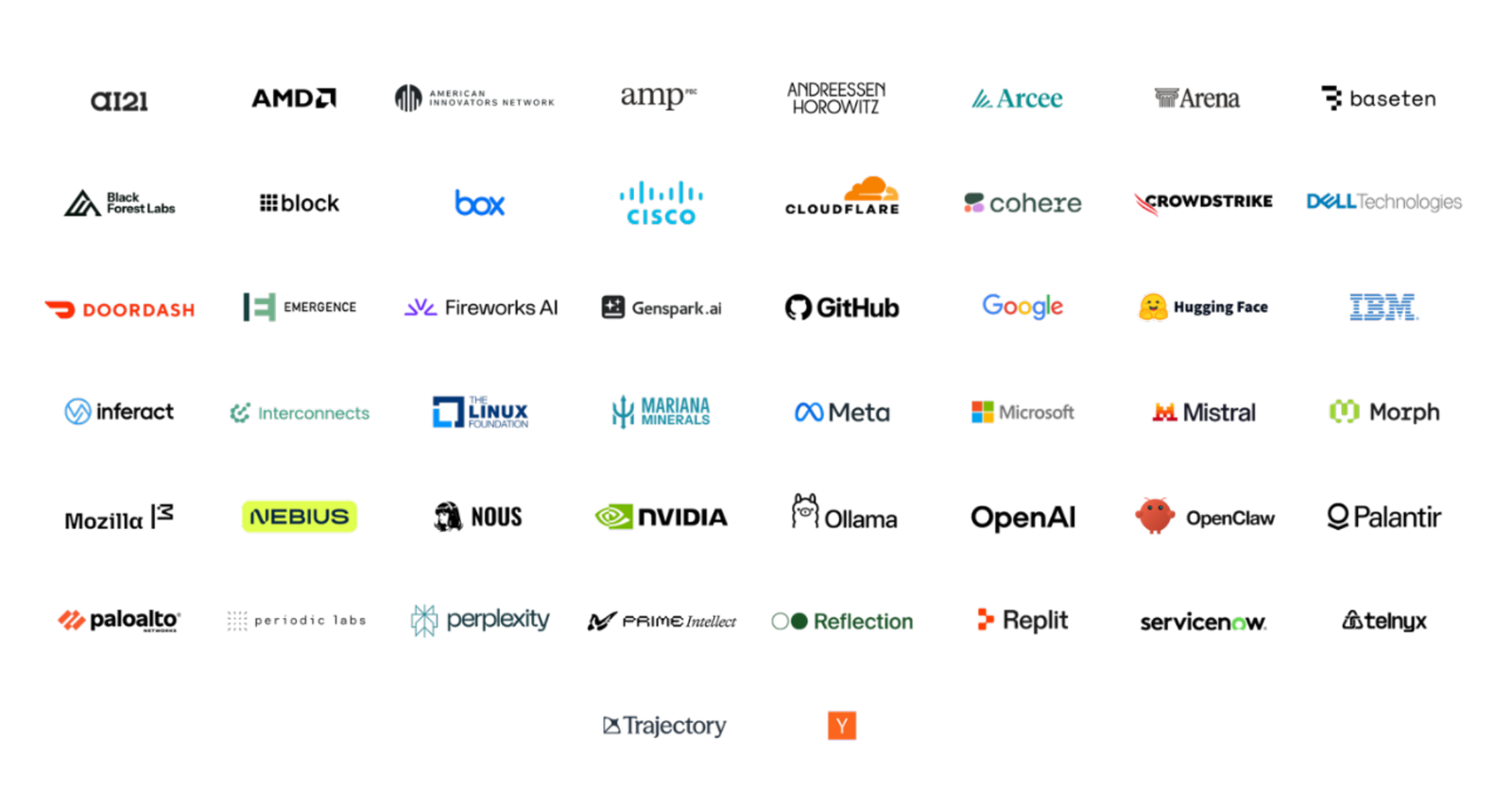
What appeared on 24 July
On 24 July 2026, “Open Weights and American AI Leadership” appears online, a two-page document hosted on NVIDIA’s site. It is not a technical paper: it is a policy statement. At its foot it carries the names and logos of a coalition of around twenty-five companies and organisations, including NVIDIA, Meta, Microsoft, IBM, Dell, CrowdStrike, Palantir, ServiceNow, Perplexity, Hugging Face, Mistral AI, Mozilla, the Linux Foundation, Andreessen Horowitz and Y Combinator.
Update, 27 July. The document has kept gathering signatures: the version now online at images.nvidia.com runs to three pages and carries fifty names at its foot. Two of the newcomers weigh more than the rest, Google and OpenAI, the two labs that keep their flagship models closed. Also added are AMD, Cisco, Cloudflare, GitHub, Palo Alto Networks, DoorDash, Nebius, Nous Research, Ollama, Replit and Prime Intellect. The cover image on this article shows the updated grid.
The thesis is sharp: US leadership in artificial intelligence will be judged not by a single frontier model, but by the ability to build an open ecosystem that diffuses into every sector. Within this frame, open-weight models, the models anyone can download, inspect, modify and run on their own infrastructure, are described as an essential building block.
The open-source analogy
The document opens with a historical parallel: in the 1980s, open-source software pioneers challenged the belief that software could advance only under tight corporate control. Today free software underpins much of the internet and is used by the largest technology companies, by the US military and by federal agencies. For the authors, open source did more than lower costs: it created a shared foundation of knowledge on which an “institutional sovereignty” was built. The United States, they argue, faces a similar choice with AI.
From here, four arguments in favour of open weights.
- Access. Startups, businesses, universities and public institutions can build on advanced models without training one from scratch or paying frontier-model prices for every task. You match the right model to each use case, reserving frontier-scale capability for the problems that genuinely need it.
- Competition. By letting many organisations adapt and deploy models, open weights create rivalry not only among model developers, but also across cloud, chips, applications and services. More competition, the document argues, means more innovation and lower costs.
- Control. Organisations do not stay locked into a single provider: they keep their own data, evaluate and adapt models, run them where it makes sense. And they can own the value they create, from specialised models to accumulated knowledge.
- Security. Here the argument is more delicate. The authors hold that relying solely on closed models is not inherently safe, because they too can be breached or fail in ways outsiders cannot see, and that concentrating advanced capability behind a few closed models creates a small number of single points of failure. Open models, by contrast, let a broad community examine their behaviour, find vulnerabilities and develop safeguards.
Open weights and open source are not the same thing
The document is precise on this term, where press coverage often is not. “Open weights” is not a synonym for “open source”. An open-weight model makes the trained weights available, so it can be downloaded and run, but not necessarily the training code, the data and the full recipe. Open source in the strict, software sense implies the availability and modifiability of the source. The distinction matters because it changes what you can really inspect, reproduce and verify. It is the same distinction we apply when we talk about models: open weights for the models, open source for the code.
An advocacy document: who signs it and why
The value of the arguments has to be weighed together with who is making them. This is an industry statement, and the signatories have direct and legitimate economic interests in an open, widely diffused AI ecosystem. NVIDIA sells the chips AI runs on, and the more AI spreads the more chips are needed. Meta, Mistral, Black Forest Labs and others release open-weight models; Hugging Face hosts them. Andreessen Horowitz and Y Combinator invest in the ecosystem. Microsoft, IBM, Dell and ServiceNow sell AI to enterprises. This does not make the arguments false, but it places them: it is the viewpoint of those who benefit from the diffusion of open models, not of a neutral referee.
The document, to its credit, does not hide the risks. It admits that open weights carry “real and distinct risks”: once released, the weights are beyond the control of those who created them, and modified versions are hard to trace or reverse. The proposed response is not to ban them, but to govern them, with rigorous benchmarking, red teaming and protections tied to real and demonstrated harms rather than to the assumption that closed systems are safer by default. On security the debate remains open: some note that open weights also lower the barrier for misuse, and that the irreversibility of release is a serious limit. The authors are aware of this and still choose openness, with the argument that in cybersecurity defenders need models with capabilities comparable to those of the attackers.
The policy asks
The document closes with four asks to US policymakers: expand access to compute for startups and researchers; invest in shared training assets (datasets, tools, evaluation frameworks); keep the frontier plural, avoiding premature restrictions on open models that would stifle competition or push innovation overseas; strengthen application layers to expand sovereign use of AI across the economy.
There is also an explicit defence of distillation, the practice of using one model’s outputs to train or evaluate another. The authors ask policymakers not to conflate a legitimate, widely used technique with misappropriation: abuses should be addressed with targeted legal and commercial tools, not with sweeping bans on development techniques.
And Europe?
The document speaks of American leadership, and the frame is avowedly national, even if one European exception sits among the signatories, France’s Mistral. But the underlying logic of open weights (inspectability, absence of lock-in, on-premise execution, control over data) has no passport. For a European organisation the same tools serve a different purpose: European and Italian sovereignty, with its own rules (AI Act, NIS2, GDPR) and the need for data to stay inside the perimeter. The real question, for Europe, is whether to frame the issue on its own terms or let it be defined elsewhere: the same openness the United States claims as a lever of leadership is, seen from here, the most concrete way not to depend on someone else’s switch.
It is the ground we work on: bringing open-weight AI into production locally, with the governance that makes it reliable. Read from Europe, the American document is a useful reminder that the choice between an open ecosystem and capability concentrated in a few closed providers is not technical but strategic, and worth making deliberately.