
Article

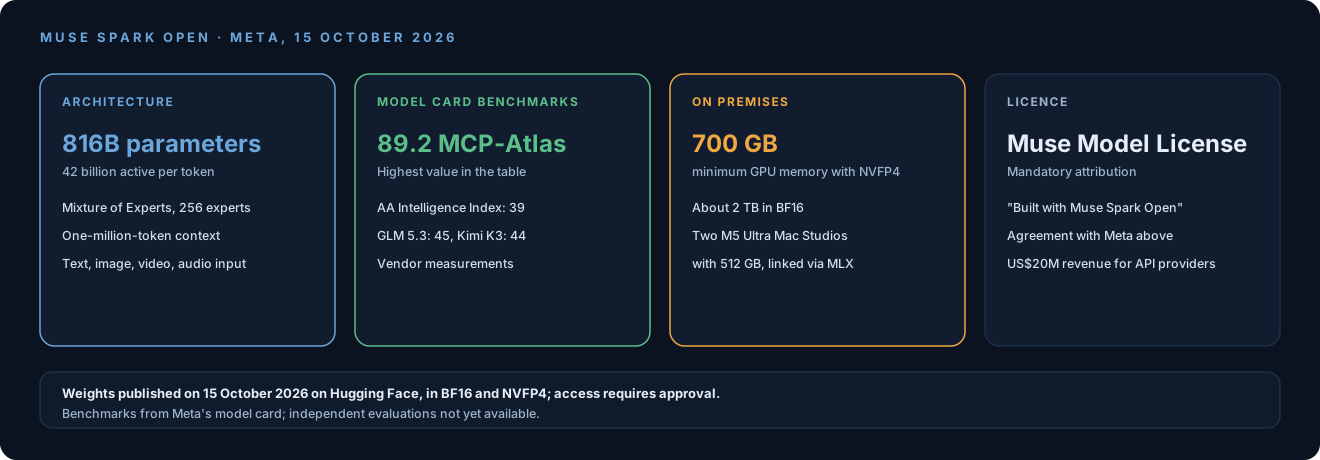
On 15 October Meta published the weights of Muse Spark Open, developed by Meta Superintelligence Labs. Meta presents it as “the most capable US open-weight model to date”, built for coding and agentic work: long-horizon tasks, complex software engineering and multi-step reasoning.
Three days earlier Meta had introduced Muse Wonder, its new frontier model, available through the Meta Model API and Muse Code. In August it had published the weights of Muse Glimmer, a 30-billion-parameter model under the Apache 2.0 licence. Muse Spark Open is an order of magnitude larger and has a licence of its own.
Architecture
From the model card on Hugging Face:
- Mixture of Experts with 816 billion total parameters and 42 billion active per token: 256 experts, 8 active per token, 62 layers.
- Context of up to one million tokens at inference.
- Natively multimodal input (text, images, video, audio) with text output; images go through a 1.8-billion-parameter Perception Encoder.
- Training data in more than 100 languages, not all of them evaluated.
- Reasoning level adjustable across four values, from
lowtoxhigh(the default).
Weights are published in BF16 and NVFP4.
The model card benchmarks
The model card compares Muse Spark Open, measured at the xhigh level, with seven other models, including GLM 5.3, Kimi K3 and Mistral Large 4, whose weights Mistral has announced for the end of October. Some figures:
- MCP-Atlas (tool use via MCP): 89.2, the highest in the table, against 84.5 for Qwen3.8 and 84.2 for GLM 5.3.
- Artificial Analysis Intelligence Index: 39, against 45 for GLM 5.3, 44 for Kimi K3, 40 for Qwen3.8 and 38 for Mistral Large 4.
- Terminal-Bench 2.1: 76.4, against 83.9 for GLM 5.3 and 85.0 for Kimi K3.
- DeepSWE 1.1: 60, against 62 for Mistral Large 4, 67 for GLM 5.3 and 68 for Kimi K3.
- StrongREJECT v2 (adaptive jailbreak attacks, lower is better): 0.5, against values between 62.9 and 86.4 for the other models.
In Meta’s own table, then, the Chinese models GLM 5.3, Kimi K3 and Qwen3.8 stay ahead on the overall index, and the first two also on several coding benchmarks: the stated lead applies to US models. Muse Spark Open stands out on tool use and jailbreak resistance. These are the vendor’s figures: as of 15 October there are no independent evaluations, and Meta describes the full evaluation report as “available soon”.
The licence
Muse Spark Open is released under the Muse Model License, which Meta describes as having limited commercial terms. From the text published with the model:
- it allows you to use, modify, fine-tune, distil, distribute and sell the model and its derivatives;
- users must display “Built with Muse Spark Open” in the product interface, documentation, website or settings, derivatives included;
- anyone offering third parties access to AI models as a product or service (model as a service) whose aggregate gross revenue, with affiliates, exceeds US$20 million in twelve months must notify Meta and sign a separate agreement before offering the model in that service. Internal use, research and integration into one’s own products fall outside this threshold;
- a usage policy lists prohibited uses;
- for those based in Europe the counterparty is Meta Platforms Ireland.
On Hugging Face access to the weights requires approval, through a form asking for full legal name, date of birth and organisation.
What it takes to run it on premises
In a Mixture of Experts the active parameters reduce compute per token, but the whole model must fit in memory. The model card indicates at least 700 GB of GPU memory with the NVFP4 weights and 2 TB in BF16.
Meta worked with Apple so that the model runs on two Mac Studios with M5 Ultra, each with 512 GB of unified memory, linked through the MLX framework; Apple published an article on distributed inference with MLX. According to Apple, the 512 GB configuration arrives in late October. The alternative is servers with several data-centre GPUs. A workstation with NVIDIA GB10 and 128 GB of unified memory is sized for much smaller models.
The model is supported by vLLM, SGLang, TensorRT-LLM, Transformers, llama.cpp and MLX. For those not hosting it, it is available via API from Baseten, Fireworks AI, Groq, Modal, Nebius, OpenRouter and Together AI. The weights are also in the Amazon SageMaker, Google Cloud and Microsoft Foundry catalogues.
Safety
Meta writes that it added safety post-training specific to an open-weight model and evaluated it under its Superintelligence Scaling Framework, which covers the most severe risks. The model card still recommends system-level guardrails, your own safety testing and human confirmation for irreversible agent actions; the evaluations apply only to the released checkpoint, not to derivatives.
What we think
With Muse Spark Open Meta publishes the weights of a large-scale model for the first time since Llama 4, in an open-weight landscape where the most capable models have so far been mostly Chinese and where the weights of Mistral Large 4 are expected at the end of October. For a company that wants to keep data and inference in house it is one more option, with two points to assess before adopting it: the hardware requirements, from multi-GPU servers or Mac clusters, and the licence, permissive for internal use but with mandatory attribution and a threshold for those reselling it as a service. On quality the available figures are Meta’s: in that table the model leads on tool use and trails GLM 5.3 and Kimi K3 on coding.
What to watch
- The full evaluation report announced by Meta.
- Independent evaluations, starting with Artificial Analysis.
- Community quantisations and their effect on quality.
- How other US labs respond on open weights.
Sources
- Meta, Muse Spark Open
- Hugging Face, Muse-Spark-Open-816B-A42B model card
- AI at Meta, announcement on X
- Meta, Introducing Muse Wonder
- Apple, new Mac Studio with M5 Max and M5 Ultra
- Artificial Analysis, Muse Glimmer
- Apple Machine Learning Research, distributed inference with MLX
- 9to5Mac, Muse Spark Open optimised for Mac Studio
- Mistral Large 4: architecture, benchmarks and open weights
- Open weights and American AI leadership: and Europe?
- NVIDIA GB10: local AI arrives on the desktop with 128 GB unified memory