
Clinical data under GDPR and MDR
Strict constraints on residency, audit trail, clinical validation, CE marking.
On-premise AI for clinical research, with data kept at the provider.
Hospitals, health authorities, research hospitals (IRCCS), private clinics and biomedical research centres that want to use AI on research and quality documents and on pseudonymised cohorts without letting them leave the perimeter. noze comes from years of projects with Meyer, CNR and European research centres. Public bodies with no clinical activity will find their page under Public Administration.
Strict constraints on residency, audit trail, clinical validation, CE marking.
Reports, discharge letters, imaging, PDFs: data scattered and hard to query.
AI has to cite its sources every time and leave a verifiable trail for every answer, for research and quality.
 Product
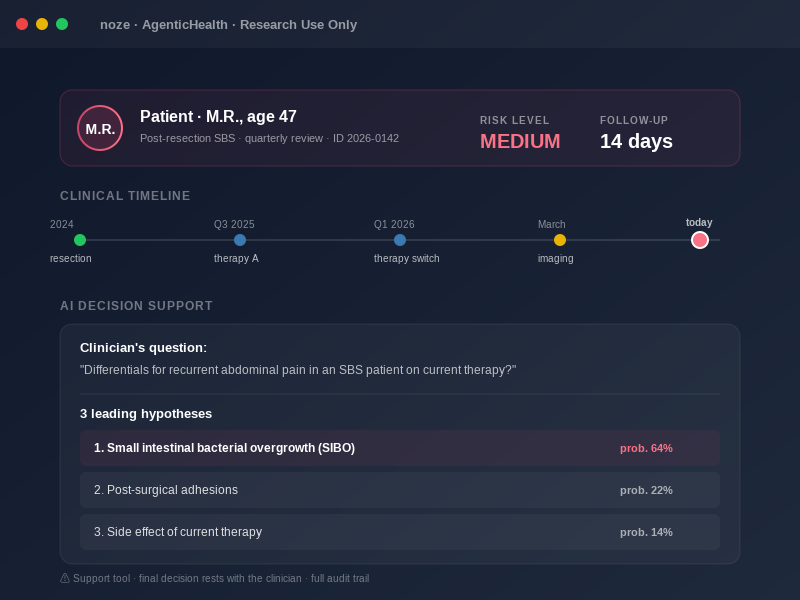
On-premise AI for clinical research: source-cited research, draft study and quality documents, data redaction, with Compliance included: GDPR, NIS2 and AI Act registers for the provider. It is not medical software: it does not support diagnosis or patient-care decisions.
 Product
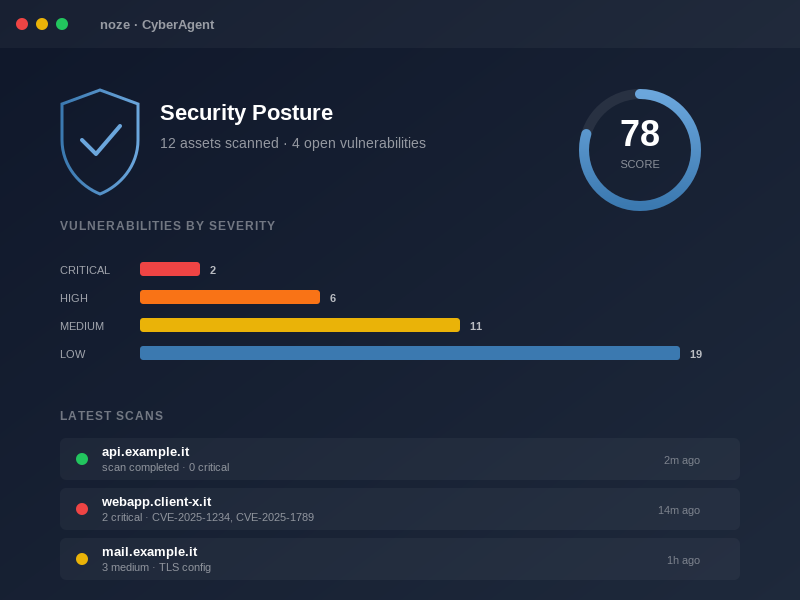
Vulnerability assessment and automated pentesting of the provider's network, web apps and APIs.
 Solution
Hospital network security, network segmentation and NIS2 compliance.
 Solution
Consulting on clinical roadmap, validation and CE pathway.
 Solution
25+ years of applied biomedical research, European projects.
Joint R&D INPECO + BioRobotics Sant'Anna Pisa (EUR 3.5M, 30 researchers): automation and robotics for clinical labs, deep learning on skin lesions.
2008–2010noze system for ISTI-CNR: bioinformatics workflows on an existing computational grid, drag-and-drop Visual Workflow Designer and Web 2.0 CMS.
On 12 November the EU Official Journal published the Commission's guidelines on Article 50 of the AI Act: who is a provider and who a deployer, what chatbots and agents must disclose, marking and detection of generated content, deepfakes and texts on matters of public interest, and the 2 December deadline.
The NIS2 baseline measures deadline passed in October 2026 for most entities listed since 2025. Who is in scope and who is not, the 2027 dates for those listed in 2026, 24 and 72-hour notification, penalties and a checklist for SMEs in Italy.
On 29 October about 6.3 billion dollars left Binance hot wallets across several blockchains. Binance points to a DevOps engineer's compromised laptop as the starting point and has found no evidence of stolen private keys. On Ethereum the attacker used 50 EIP-7702 authorizations signed by the wallet itself. About 2.8 billion is frozen; TRM Labs and Chainalysis attribute the attack to TraderTraitor. The reconstruction is preliminary.
Yes, with AI installed on-premise at the healthcare provider: data stays local. AgenticHealth works on the provider's research and quality documents (protocols, literature, procedures), with cited sources; for approved studies a read-only FHIR R4 connector brings in pseudonymised cohorts, with answers that give counts and never lists of patients. Real cohorts are enabled after the provider's DPIA; until then, work is done on synthetic data. AgenticHealth is for clinical research, quality and documentation. It is not medical software: it does not support diagnosis or patient-care decisions. It includes Compliance: GDPR, NIS2 and AI Act for the provider as an organisation, with registers, deadlines, AI system classification and audit trail, all on-premise.
If it qualifies as a medical device, yes, and it has to follow the SaMD pathway under MDR. AgenticHealth is not medical software: it is for clinical research, quality and documentation and does not support diagnosis or patient-care decisions. For software that needs it, the healthcare consulting covers clinical roadmap, validation and the CE pathway.
You need AI that cites its sources every time and leaves a verifiable trail for every answer, for research and quality. AgenticHealth cites its sources, keeps the audit trail on-premise and includes Compliance for the AI Act, NIS2 and GDPR.