

What GLM 5.2 is
Between 13 and 17 June 2026, Z.ai (formerly Zhipu AI) released GLM 5.2 in stages: first on the GLM Coding Plan (13 June), then by publishing the open weights on Hugging Face (16 June), and finally with documentation and benchmarks (17 June). It is the direct successor to GLM-5.1 in the GLM line (4.5 → 4.6 → 5 → 5.1 → 5.2).
The headline characteristics, derivable from the model card and the config.json shipped with the weights:
- Mixture-of-Experts architecture (not dense): around 753 billion total parameters, of which ~40 billion active per token. The weight files are roughly 1.5 TB in BF16 (about 750 GB in the FP8 variant).
- 1-million-token context (it was 200K in GLM-5.1), with output up to ~128-131K tokens.
- A reasoning model with two “thinking effort” levels; text-only (no multimodal input).
- MIT licence, verified on the repository’s
LICENSEfile, with weights downloadable from Hugging Face (zai-org/GLM-5.2, plus an FP8 variant). Permissive: commercial use, modification, fine-tuning, redistribution and self-hosting, with no fees and no use restrictions. - API and pricing on z.ai: roughly $1.40/million input tokens and $4.40/million output (the same as GLM-5.1), with the GLM Coding Plan starting at a few tens of dollars a month.
The stated positioning is clear: high-performance coding and long-horizon agentic tasks, with an Anthropic-compatible endpoint, so it works day one in environments like Claude Code, Cline and OpenCode.
How strong it is (and who says so)
This calls for a distinction we always make: separate the numbers reported by the vendor from independent measurements.
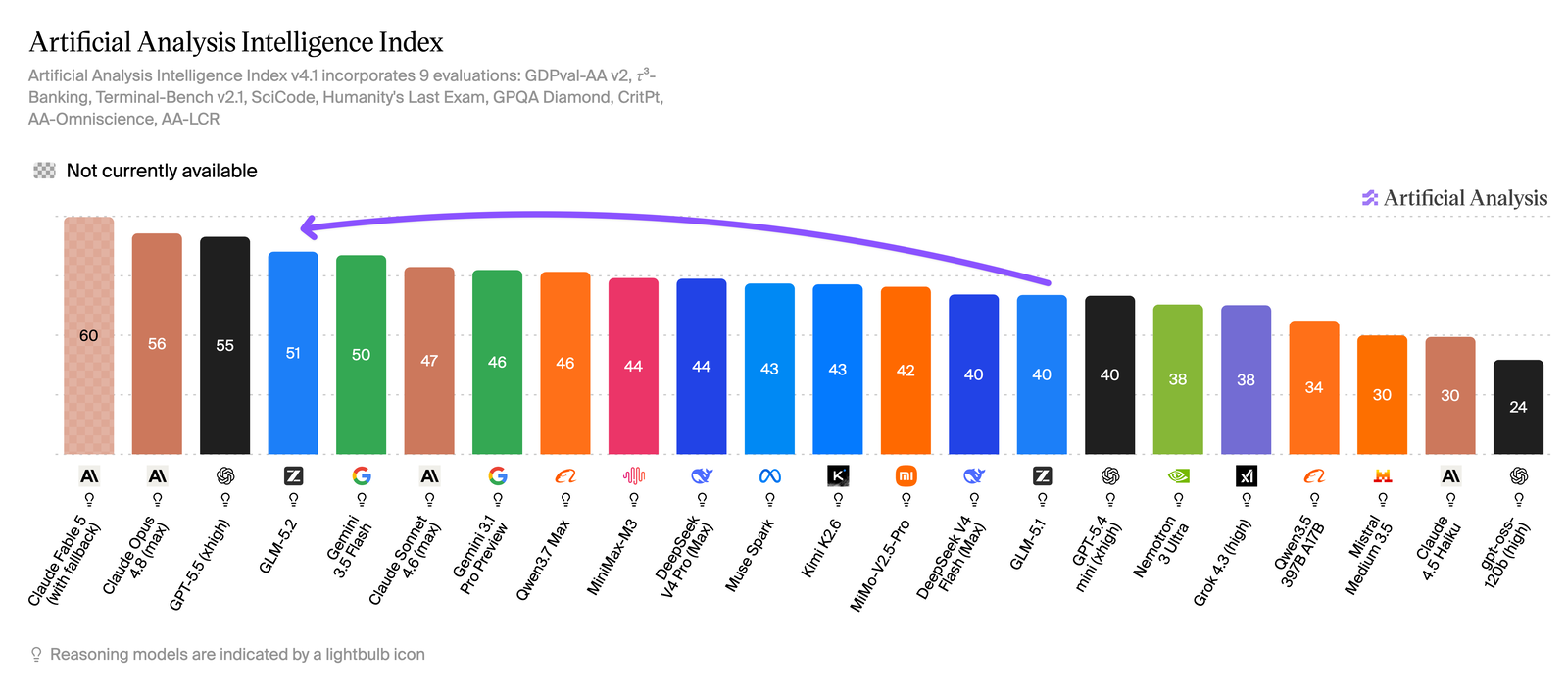
The strongest independent data point comes from Artificial Analysis: in their Intelligence Index, GLM 5.2 scores 51, making it the best open-weight model on the board, seven points clear of the next open model (MiniMax-M3 and DeepSeek V4 Pro at 44, Kimi K2.6 at 43) and an +11-point jump over GLM-5.1. Overall it lands fourth, behind only three closed models: Claude Fable 5 (60), Claude Opus 4.8 (56) and GPT-5.5 (55). Also from independent evaluations, it ranks second on Code Arena for frontend development tasks, and analyst Simon Willison calls it “probably the most capable open-weight text-only LLM”.
Z.ai then publishes its own benchmarks (for example SWE-bench Pro 62.1, GPQA-Diamond 91.2, Terminal-Bench 81.0), but these read as self-reported figures: Artificial Analysis’s independent re-runs return lower values (GPQA-Diamond around 89%, Terminal-Bench around 78%), owing to different scaffolding and test configurations. Two honest caveats from those same independent sources: the model is “token-hungry” (it burns far more reasoning tokens per task than its predecessor), and it shows some regression on creative tasks versus GLM-5.1. The picture, in short, is a very strong coding-and-agentic model, not blanket supremacy on every metric.
What made the headlines stands: coding performance in the same bracket as Western frontier models at a fraction of the cost (the press cites roughly one-sixth of GPT-5.5 on some long-horizon benchmarks).
The real point for us: a frontier you can own
The detail that truly matters isn’t a benchmark, it’s the licence. GLM 5.2 is an open-weight frontier model under MIT: you download the weights, run them wherever you want, and nobody can switch them off. That is exactly the argument we made a few days ago, recounting how a government was able to disable a commercial model overnight. The model at the top of that independent ranking, Claude Fable 5, is the one that was disabled. Weights held locally are not exposed to that decision.
A bit of technical honesty, though: “open-weight” doesn’t mean “runs on a laptop”. It needs datacentre-class resources: about 8 H200 GPUs for the FP8 version (~750 GB), twice that in BF16. Community quantisations (GGUF for llama.cpp, Ollama, LM Studio) lower the bar at the cost of quality, but full self-hosting is realistic for those with a GPU cluster or rented cloud capacity. For many teams the managed API stays the pragmatic choice; self-hosting earns its keep when you have compliance, data-residency or sustained-throughput requirements. It’s the same reasoning behind our on-premise AI workstations and our use of runtimes like vLLM and Ollama.
Sovereignty and compliance: local weights ≠ a China-hosted API
There’s a distinction a European business or public body must hold firm, because it’s legal in nature, not about model quality.
- Running the weights locally or in an EU private cloud means prompts, context and data stay on your own infrastructure: no sub-processor to vet, no cross-border transfer to document. Data residency becomes a property of the architecture. The MIT licence, moreover, imposes no regional or use restrictions.
- Using the Z.ai-hosted API (in China) is a different risk profile: data transits a Chinese jurisdiction subject to the National Intelligence Law (2017) and the PIPL transfer regime. For an EU controller this is an extra-EU transfer to assess under the GDPR (Articles 44 ff.), with a DPIA and an adequate legal basis. It’s also worth recalling that Zhipu AI has been on the US Department of Commerce Entity List since January 2025: it doesn’t prevent running MIT weights locally, but it’s a due-diligence factor for anyone routing data to the API.
This is exactly the kind of assessment we run in AI governance projects. The operational takeaway is that, with open weights, the choice goes back into the organisation’s hands.
What to do
- Evaluate it where it excels. For coding and agentic workflows, GLM 5.2 is now a serious candidate, especially on price/performance. Test it on your tasks, not on benchmarks.
- Decide weights vs API by compliance. Sensitive data, public sector, regulated industries → self-host or an EU-residency endpoint. Non-critical workloads → the managed API may suffice, with the due diligence above.
- Don’t tie yourself to a single model. A gateway with multi-vendor fallback makes GLM 5.2 a routing choice, not a hard dependency.
- Ride the open-weight wave. GLM sits alongside DeepSeek V4, Qwen and Gemma: a plurality of downloadable, competitive models is itself a hedge against any single provider’s kill-switch. It’s the difference between being subject to a roadmap and governing one: the point of our work on artificial intelligence and of products like Admina and IntelliPA.
Where we are
As of this writing, 20 June, GLM 5.2 is the open-weight reference point of the moment: the best independent score in its category and the first open model to close in on the closed frontier. Some independent evaluations on benchmarks Z.ai hasn’t yet published (SWE-bench Verified, LiveCodeBench, Aider) still need to settle; as always, the numbers should be confirmed in the field. But the underlying point is already clear: frontier intelligence, now, is something you can also own.
Link: Z.ai: GLM 5.2 blog · Hugging Face: zai-org/GLM-5.2 · Artificial Analysis · Simon Willison