

Artificial Intelligence
EU AI Act consulting: system classification, policies, AI governance, training.
Discover →
Linux Services & Systems
Domains, hosting, PEC, email infrastructure, network services and Linux systems. Open Source infrastructure support and management.
Discover →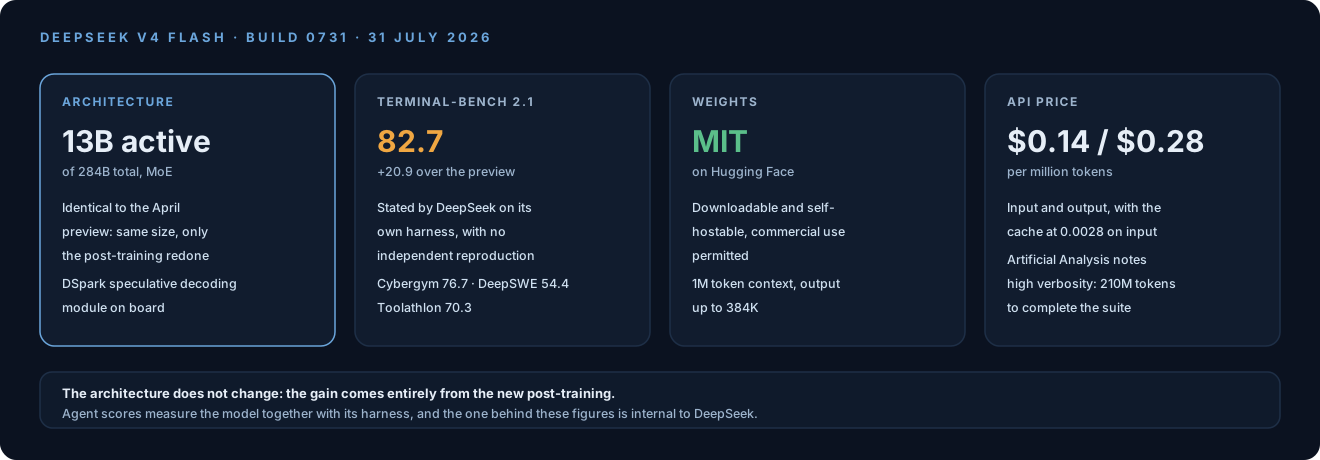
On 31 July DeepSeek moved V4 Flash out of preview with the 0731 build. The way the API is called does not change, and neither does the architecture: same size and same structure as V4 Preview, which we looked at in April. What was redone is the post-training, and the whole stated gain sits there.
What changes with the 0731 build
The model remains a Mixture of Experts with 284 billion parameters and 13 billion active, with a one-million-token context and output up to 384K tokens. The Hugging Face card lists 304B total parameters. DeepSeek does not explain the difference from April’s 284B; our reading is that the count most likely includes the weights of the speculative decoding module bundled into the checkpoint.
The checkpoint ships with DSpark, a speculative decoding module that can be switched on at serving time, and inference exposes three reasoning_effort levels (low, high, max) to control how much the model deliberates before answering. The update concerns the V4-Flash API only: app, website and the V4-Pro API are unchanged, with the latter still in preview.
The stated numbers
The model card reports nine benchmarks, measured by DeepSeek on its own harness and set against the April preview, V4-Pro Preview, GLM-5.2 and Claude Opus 4.8:
| Benchmark | Flash 0731 | Flash Preview | V4-Pro Preview | GLM-5.2 | Opus 4.8 |
|---|---|---|---|---|---|
| Terminal-Bench 2.1 | 82.7 | 61.8 | 72.1 | 81.0 | 85.0 |
| Cybergym | 76.7 | 38.7 | 52.7 | – | 83.1 |
| Toolathlon-Verified | 70.3 | 49.7 | 55.9 | 59.9 | 76.2 |
| DSBench-FullStack | 68.7 | 37.0 | 41.8 | 61.8 | 71.6 |
| DSBench-Hard | 59.6 | 25.8 | 31.1 | 54.5 | 71.7 |
| DeepSWE | 54.4 | 7.3 | 12.8 | 46.2 | 58.0 |
| NL2Repo | 54.2 | 39.4 | 38.5 | 48.9 | 69.7 |
| Agents’ Last Exam | 25.2 | 15.8 | 16.5 | 23.8 | 25.7 |
| AutomationBench Public | 25.1 | 10.8 | 12.8 | 12.9 | 27.2 |
On Terminal-Bench 2.1 the jump over the preview is 20.9 points, and across all nine rows the 0731 build sits above V4-Pro Preview, the flagship-scale model of the same family. If that holds up to third-party verification, it is 13 billion active parameters beating a much larger model on agent tasks, within the same family and on the same data.
In the same table Claude Opus 4.8 stays ahead on all nine rows, by margins running from 2.3 points on Terminal-Bench to 15.5 on NL2Repo. DeepSeek publishes that comparison in its own card, and reporting it in full says more than any selection would.
The only measurement not produced by DeepSeek at the moment comes from Artificial Analysis, which puts the reasoning build at 50 on the Intelligence Index, well above the median for open weight models. The same assessment flags high verbosity, with around 210 million output tokens to complete the evaluation suite against a distinctly lower median, and a cost of a little over seventy dollars to run it in full at list prices. For a model billed per token, verbosity moves the real cost away from the list price.
API prices are $0.14 per million input tokens and $0.28 per million output tokens, with cached input at $0.0028. The dynamic peak and off-peak pricing announced earlier does not appear to be active yet.
How to read the agent scores
The six rows in the table are agent benchmarks, and on this kind of measurement the point we made in harness engineering applies: an agent score measures the model together with the scaffolding around it, meaning how tools are presented, how context is managed, how many attempts are allowed and what happens when a command fails. The same model, with two different harnesses, produces two different numbers.
The figures above were obtained by DeepSeek on its own harness and no independent reproductions appear to exist yet. It is standard practice in every model announcement, and it is the reason these numbers should be read as an indication of order of magnitude rather than a ranking.
The weights and what it takes to run it
For anyone building systems, what counts is that the weights are published on Hugging Face under the MIT licence, so they can be downloaded, self-hosted and used commercially. It is an open-weight model, with the training code and data staying with DeepSeek, the distinction we drew when writing about open weights and American AI leadership.
V4 Flash is also the model that antirez’s DwarfStar 4 was built around, the native C inference engine that runs it locally on a machine with 96-128 GB of unified memory thanks to asymmetric 2-bit quantisation on the experts of the MoE part. ds4 was written against the preview weights and no source yet confirms it runs the 0731 checkpoint; if support lands, the post-training gain comes with no change of hardware.
We have already covered the other routes to keeping it in house, and they all apply to this build as well: colibri keeping the experts on disk and loading them only when needed, KTransformers with hybrid CPU and GPU inference, and weight and KV cache quantisation with TurboQuant. The lever is always the same: an MoE is large but sparse, and each token needs only a fraction of it active.
What we think
The scores are stated and will need verifying. What moved, at constant architecture, is the post-training. It suggests that on this generation of models the headroom on agent tasks still sits in how they are trained to use tools, more than in size. For anyone weighing adoption that is good news on cost, because a model with 13 billion active parameters stays manageable on hardware a company can actually afford.
Practically, the two things to look at before putting it into production are verbosity, which weighs on the monthly bill more than the unit price does, and the fact that the agent numbers come from the vendor. To evaluate it we start from three or four real tasks in the domain, measured on our own harness and compared against the model we use today.
Then there is the reason releases like this interest us. An open-weight model under an MIT licence, running on local hardware through engines like ds4, keeps the data inside the perimeter and makes the choice of supplier reversible. It is the same reasoning we set out in Open Intelligence, Secure Governance: owning the operational floor counts as much as the quality of the model running on it.
Sources
- DeepSeek V4 Flash 0731 on Hugging Face (weights, MIT licence)
- Artificial Analysis: DeepSeek V4 Flash model page
- Digital Applied: DeepSeek V4 Flash 0731, official release and agent benchmarks
- BenchLM: DeepSeek V4 Flash 0731, benchmarks, MIT weights and pricing
- antirez: A few words on DS4
- GitHub repository: antirez/ds4