
Contents
Artificial Intelligence
EU AI Act consulting: system classification, policies, AI governance, training.
Discover →
Admina Enterprise
AI governance: audit trail, PII redaction and bidirectional policies on any model, open weight or proprietary, local or remote.
Discover Admina →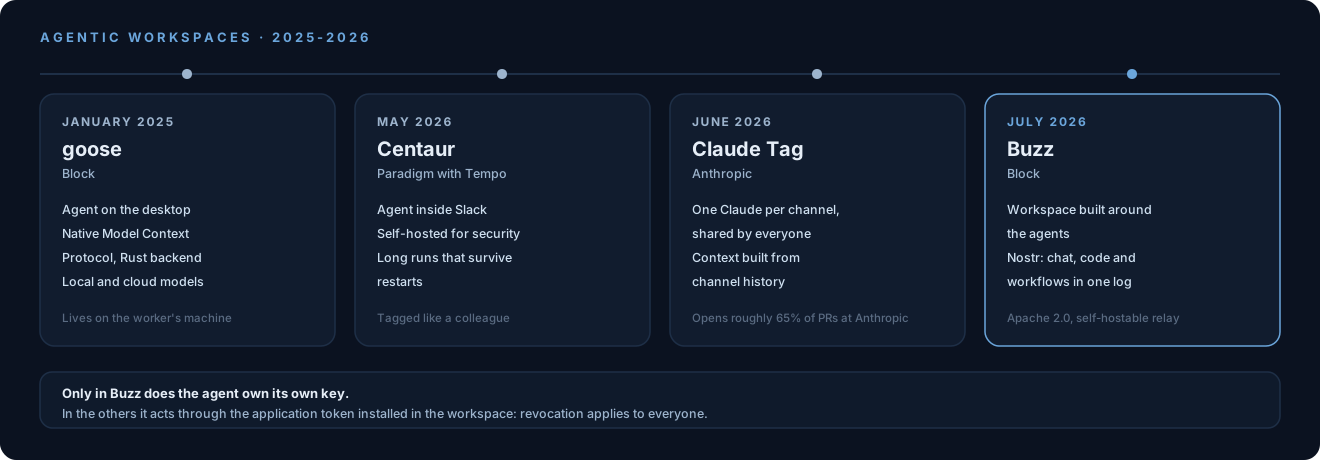
What was announced
On 21 July 2026 Block released Buzz, an open source workspace for teams made of people and agents. The announcement came as a post by Jack Dorsey on X:
we’re launching BUZZ! a new groupchat platform for teams of people and agents of all sizes, built to reduce our dependency on slack and github. model-agnostic, decentralized, self-sovereign, and open source.
The motivation is stated unusually plainly for a launch: reduce Block’s dependency on Slack and GitHub. The code is on GitHub under the Apache 2.0 licence, desktop clients for macOS, Windows and Linux are available immediately, and Block also runs a hosted relay at buzz.xyz, free and without usage limits during the beta.
The launch version is 0.4.21, and the repository does not hide how far along the work is: it lists separately what works, what is in progress and what has not been written yet.
How it works
Buzz is built on Nostr, the signed-event protocol that came out of decentralised social. The choice shifts the identity model: every participant owns a cryptographic keypair instead of an account granted by the platform. Messages, code patches, workflow steps and git events all land in the same log as signed events, carrying the same identity.
Underneath there is a relay written in Rust, PostgreSQL for events and full-text search, Redis for pub/sub and presence, and S3 or MinIO object storage for media. The desktop client is Tauri with TypeScript and React; the mobile ones are Flutter and still incomplete.
Agents connect through the Agent Client Protocol, the open standard that originated at Zed in August 2025 to connect any agent to any editor and has since moved to community governance. Anything that speaks ACP works in Buzz: the repository names Claude Code, Codex and goose, the agent Block open-sourced in January 2025.
The most interesting piece concerns agent identity. The agent does not borrow its owner’s credentials: it gets a key of its own plus a second signature binding it to the person who authorised it. Block’s engineering blog puts it this way:
Authorization does not erase authorship. The agent remains the author.
In practice that means authorisation can be revoked without touching the human identity, and every action stays attributed to whoever performed it, alongside the record of who allowed it.
Nostr comes out of the cryptocurrency world, and the README states the necessary clarification in writing: “Not blockchain. Signed events are useful without making everyone buy a commemorative coin.” Here the cryptographic signatures exist to make an event log verifiable, nothing more.
The wider trend
Buzz did not appear out of nowhere. Eighteen months of products moving the same way help place it.
goose, Block, 28 January 2025. An Open Source desktop agent with native Model Context Protocol, a Rust backend and a React frontend. The agent lives on the worker’s machine.
Centaur, May 2026, open-sourced by Paradigm together with Tempo. A self-hosted “virtual employee” living inside Slack: you tag it the way you would tag a colleague, it uses real tools, sustains long runs and survives restarts. Georgios Konstantopoulos, Paradigm’s CTO, describes it as something enterprises will want to self-host for security and control while keeping it where people already talk.
Claude Tag, Anthropic, public beta on 23 June 2026. One Claude per channel, shared by everyone, building context from channel history and picking up where the last person left off. Anthropic states that internally it opens roughly 65% of pull requests.
Meanwhile Linear opened an API that makes agents assignable workspace members with a profile and a work queue, and the main coding agents arrived inside Slack and inside ticketing systems.
The shared direction is clear: the agent moved from the individual’s machine to the place where the team talks, and until Buzz every one of those places was a proprietary platform.
What sets Buzz apart
Slack-based integrations, however well built, inherit the identity model of the host platform. The agent acts through the token of an application installed in the workspace: the log says that application acted, the scope is whatever the app was granted, and revocation is an administrative switch that applies to everyone.
Buzz changes exactly that point. The key belongs to the agent, the delegation is a signed event, and the chain of custody reads backwards to a person. Nobody holds the keys on anyone else’s behalf, not even whoever hosts the relay, and the history stays verifiable outside the platform that produced it.
The other difference is scope. Conversation, code, reviews and workflows sit in the same event log instead of two products kept in sync by hand. Block’s engineering blog puts it this way: “The bottleneck moved from intelligence to coordination. That is a workspace problem.” Engineers were spending their time ferrying context between isolated agent sessions and Slack, acting as human glue between tools that do not talk to each other.
What is missing
As of 25 July, going by the repository and the documentation:
- Decentralisation is narrower than it sounds. Each workspace runs on a single authoritative relay, with no gossip between relays. That means you can host your own relay and own your data, not that the network resists censorship through redundancy.
- Mobile clients are unfinished. The Flutter apps for iOS and Android are declared work in progress.
- Substantive pieces are absent: git hosting backends, web-of-trust reputation, workflow approval gates and push notifications are listed as not yet implemented or in progress.
- There is no public adoption data outside Block, which runs on it internally.
The project is a declared beta, and the version number confirms it. It is worth watching for the model it proposes more than for the product it ships today.
What we think
Our judgement here is not neutral: Buzz pushes in the same direction we have been arguing for some time. Open Intelligence, Secure Governance says two things: that the intelligence your work rests on should be owned and inspectable, and that owning it is not enough without a control plane that records and filters what it does. A workspace where the agent holds its own key and every action is a signed event is that control plane put into the infrastructure rather than into a policy document.
What convinces us is the idea that an agent’s authorisation should be a recorded fact rather than a configuration setting. In most installations we see, the answer to “who allowed this agent to write to production” lives in somebody’s memory or in a ticket closed months ago. When the agent gets it wrong, as in the case of the agent that breached Hugging Face, the reconstruction starts from there.
Two operational questions follow, and they hold regardless of Buzz. First: for every agent running in your systems, can you say who authorised it, with what scope and what it did yesterday? Second: if you have to revoke that agent tonight, how much else breaks? If revocation is a switch shared by the whole company, the scope was too broad to begin with.
The same questions arrive from the regulatory side. The automatic record-keeping obligations the AI Act places on high-risk systems, and the traceability duties maturing between NIS2 and the Cyber Resilience Act, ask in different words for the same thing Buzz writes into the protocol.
On the product itself we are more cautious. Migrating a company’s chat is one of the hardest moves there is, because the value of that tool is the history it holds and the habits that have settled on top of it. A 0.4 beta with incomplete mobile clients is not the moment to move a working team onto it. The sensible way to look at it today is as a test bench: a self-hosted relay on an internal project, an agent with a key of its own, and a check of how readable that log really is when you need it.
In the meantime the control plane is available on the tools you already use: that is what Admina Enterprise brings, with audit trails and bidirectional policies on any model, local or remote, on top of the Open Source Admina framework by Stefano Noferi. It is the OISG paradigm, proposed by the same author and adopted by noze, applied to autonomous agents.
Bradley Axen, who leads AI capabilities at Block, framed it correctly: “Every company is going to need a place where humans and agents work together. The question is whether that place is proprietary or open.” Which project reaches a 1.0 first will decide in practice whether that place is proprietary or open.
Sources
- Block: Introducing Buzz, where humans and agents work together
- Block Engineering Blog: Buzz!
- GitHub: block/buzz
- TechCrunch: Jack Dorsey is taking on Slack with Buzz, a group chat platform for teams and their AI agents
- Decrypt: Jack Dorsey’s Block Launches Buzz, a Nostr-Based Slack and GitHub Rival for AI Agents
- TFTC: Block Ships Nostr-Native AI Agent Workspace Buzz in Apache 2.0 Launch
- Paradigm: Open Sourcing Centaur, multiplayer self-hosted secure agents
- Fortune: Anthropic releases Claude Tag, a virtual employee that works within Slack
- Zed: Agent Client Protocol