Article
A protocol for heterogeneous agents
On 9 April 2025, at Google Cloud Next ‘25, Google announced A2A (Agent-to-Agent), an open protocol for interoperability between agents developed on different platforms and by different vendors. The chosen licence is Apache 2.0 and the specification is published on GitHub with multi-language reference SDKs. A2A is launched with the initial backing of over 50 partner signatories, including Salesforce, SAP, ServiceNow, Atlassian, Workday, LangChain and numerous system integrators.
Agent Card and task lifecycle
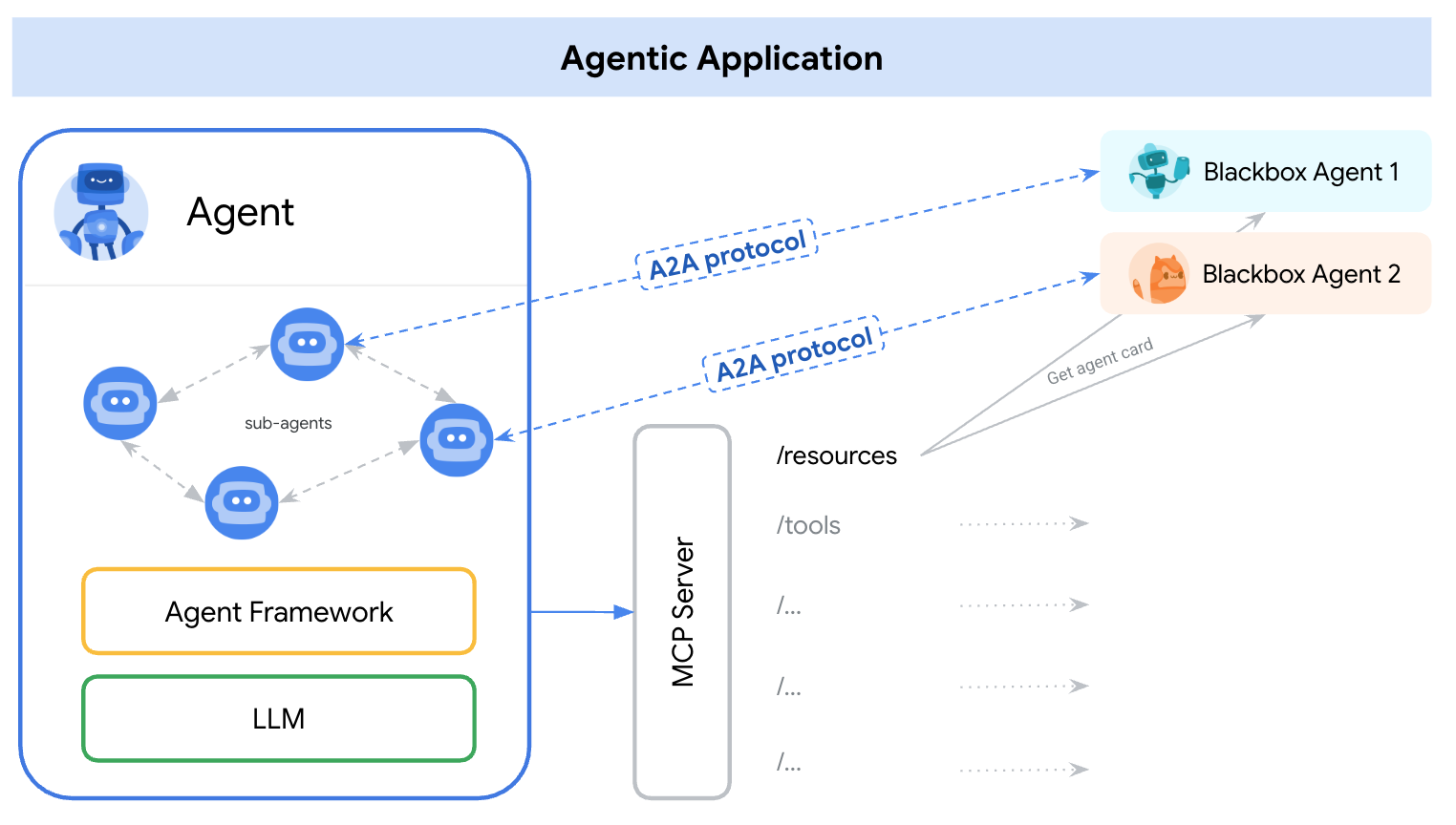
The core element of A2A is the Agent Card, a JSON document that each agent publishes to describe its identity, offered capabilities, supported authentication methods and communication endpoints. An agent can therefore automatically discover the capabilities of another agent by reading its card, without knowing its internal implementation in advance.
The protocol defines an explicit task lifecycle with states (submitted, working, input-required, completed, failed, canceled) that allows agents to orchestrate asynchronous operations of arbitrary duration, with the possibility of requesting intermediate input during execution.
Transport
Messaging happens over HTTP with a traditional request/response pattern, complemented by Server-Sent Events (SSE) for streaming incremental updates and progressive results. This choice preserves interoperability on standard web infrastructure, without requiring custom or binary protocols.
Relationship with MCP
A2A is explicitly complementary to Anthropic’s Model Context Protocol: MCP governs agent ↔ tool communication (an agent accessing resources and functions), while A2A governs agent ↔ agent communication (autonomous agents coordinating with each other to complete composite tasks). The two protocols can coexist in the same system. For the 2025 agent ecosystem, A2A represents the first serious, multi-vendor attempt to standardise horizontal interoperability between agents on different platforms.
Link: google.github.io/A2A