
Contents
Article
AgenticHealth
On-premise AI for clinical research: source-cited research, draft study and quality documents, data redaction. Research Use Only (RUO): it is not a medical device and does not support decisions on patient care; MDR pathway planned.
Discover AgenticHealth →
Digital Health
Medical software compliant with CE and MDR standards. Clinical decision support systems and AI integration in clinical workflows.
Discover →
Artificial Intelligence
On-premise AI architectures, local LLMs, RAG, autonomous agents. Consulting, design and development.
Discover →
Research & Development
Applied research and prototyping, from biomedical imaging to AI, in partnership with universities and clinical centres.
Discover →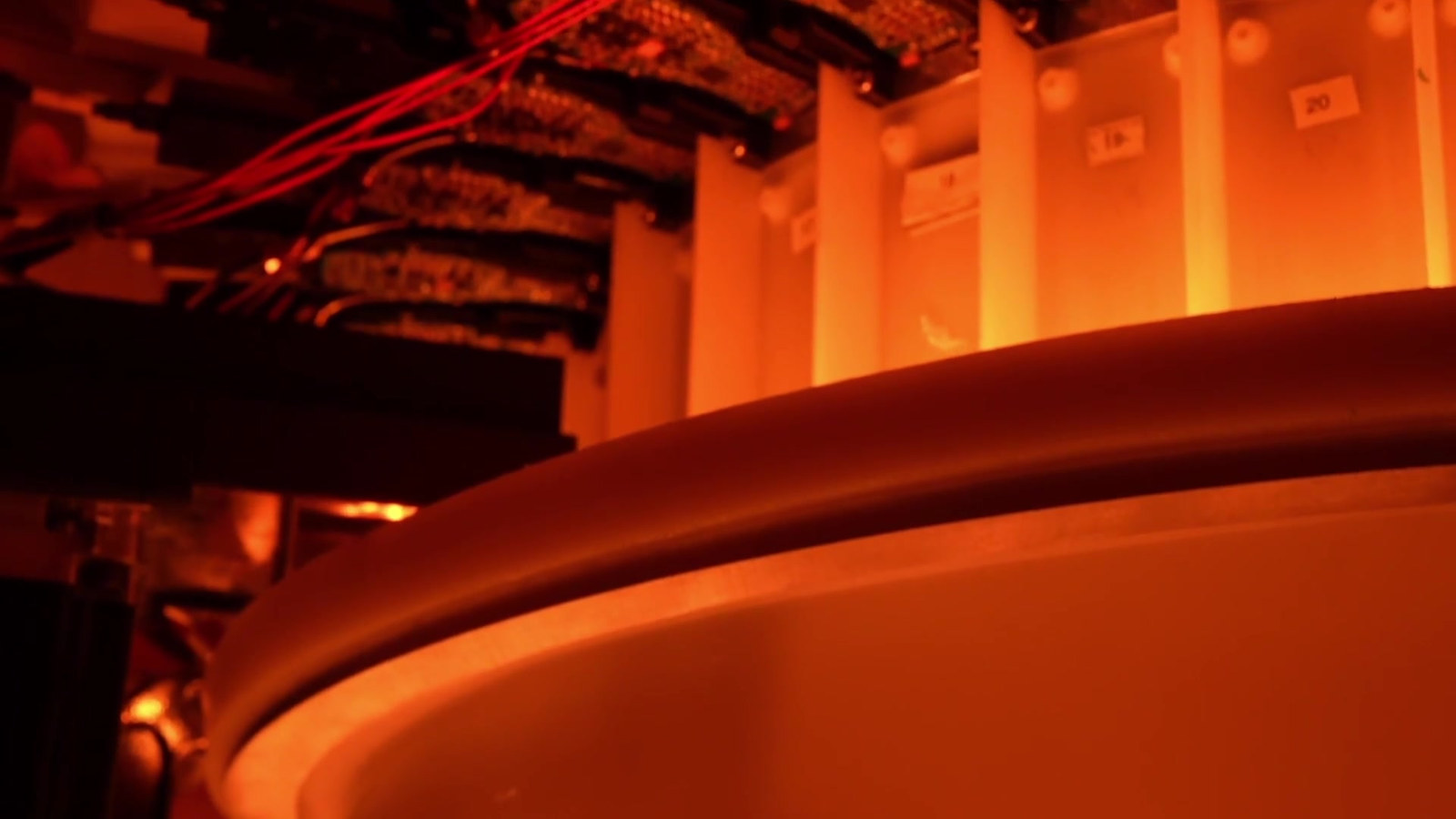
What Midjourney announced
On 18 June 2026 Midjourney, the company known for AI image generation, unveiled a project with nothing to do with generative graphics: Midjourney Medical, described as “full-body Ultrasonic CT imaging” paired with the Midjourney Spa. The idea, in the company’s words, is “something as powerful as MRI, and as casual as a trip to the spa”.
At its core is a scanner that aims to reconstruct the whole body with ultrasound in a target of 60 seconds. You step into a shallow pool of warm water (“golden light”, in the concept’s telling) and descend slowly, about 5 cm per second, through a ring of roughly half a million elements, each the size of a grain of sand and able to act as both a tiny speaker and a tiny microphone. The elements emit ultrasonic waves from every angle (like a dolphin’s echolocation) and record the returns millions of times per second: terabytes of data for every second of scan.
How it works: the physics and the AI
Reconstructing the image is the heavy computational task. As the waves travel through the water and the tissues, they change shape at every change in density and stiffness (from water to skin, fat, muscle, bone). By analysing how millions of waves deform, a compute cluster reconstructs a 3D map of the body down to a fraction of a millimetre, which according to Midjourney “looks a lot like today’s MRIs, but at nearly a hundred times the speed”.
This is where artificial intelligence comes in: each slice crossfades between the raw reconstruction and its AI segmentation, the automatic identification of what is inside the body. The output, at least to begin with, are detailed body-composition maps, not diagnostic reports.
The Spa, the roadmap and the bet
The distribution model is unusual. The scanner is born inside the Midjourney Spa: the first will open in San Francisco around the end of 2027, with hot tubs, saunas, cold plunges and rooms with the “pools of golden light” that perform the scan. Open 24/7, with a precise idea: “the scans are a side-effect”, you go because it is a nice place to be, and meanwhile you build up a library of data about your body.
The stated roadmap is aggressive: twelve months to refine algorithms and hardware, research trials and a “research spa”, then second- and third-generation scanners (with fully custom silicon from 2028) and the goal, by 2031, of a fleet of over 50,000 scanners capable of delivering up to a billion scans a month. On regulation the company is explicit: it starts as a “wellness” product, providing body-composition maps, and will progressively submit results to the FDA to unlock diagnostic capabilities. The underlying vision, stated bluntly: with enough early imaging “the world could avoid 30% of all deaths and 50% of all healthcare costs”.
There is also a detail about the company’s model: Midjourney calls itself a “community-backed research lab”, with no investors, funded by everyday people. A governance and funding model all its own, resting entirely on its own community.
The objections to expect
It is easy to predict the objections that will come from the clinical and radiological world, and many of them are well founded. The main ones are these.
- Overdiagnosis and incidental findings. Scanning the whole body of asymptomatic people surfaces a great many incidental findings, the large majority benign. Each one, though, triggers anxiety, work-ups and sometimes invasive procedures (biopsies) that carry risks of their own. It is the well-known problem of any blanket screening.
- Evidence of benefit. For total-body screening of a healthy population there is today no solid proof of benefit on mortality or outcomes; guidelines do not recommend it across the board. More images does not automatically mean healthier people.
- The “wellness, not diagnosis” framing. Starting as wellness lets you skip the full regulatory pathway, but the line between a “body-composition map” and a “diagnosis” is thin: the user will perceive the results as clinical anyway, and the question of who is accountable will arise.
- The physical limits of ultrasound. Air and bone remain hard (lungs, bowel gas, deep structures): “MRI-like” quality across the whole body is a strong promise, to be demonstrated with independent data, not with the concept renders.
- Who reads it, and what happens next. The bottleneck is not just producing the image, but interpreting it, managing follow-up and the medico-legal implications. Generating a billion scans a month without a clinical pathway downstream risks shifting the burden, not reducing it.
- Equity, cost and data. Access and price, and the handling of sensitive health data at enormous scale, are anything but secondary.
- The extraordinary figures. The “30% of deaths” and “50% of costs” are, as things stand, vision statements, not validated clinical results.
The signal, beyond the scanner
Beyond the single device, the announcement is above all a signal. A company born in AI image generation is entering medical imaging: a symptom of a broader movement in which AI-native companies move from digital content to physical healthcare products, medical devices become increasingly software-defined, and imaging becomes computational. Wearables, remote monitoring and conversational assistants have already made it normal to collect body signals continuously: full-body imaging, if made safe and validated, would be another layer of the same shift. And the boundary between wellness, diagnostics and clinical care becomes harder to manage.
But a prototype is not a medical product, and that is where the hard part begins. In healthcare the device is never just the device: it is the ecosystem around the device. A solution like this needs reliable signal capture, high-volume data pipelines, edge and cloud processing, AI reconstruction and segmentation, longitudinal comparison across scans, identity and consent management, privacy-aware storage, clinical review workflows, device observability, regulatory traceability, validation-ready documentation, and integration with health records and physician workflows. This is the stack that separates a spectacular demo from a reliable product, and where the next generation of devices will be decided: not by industrial design or algorithmic performance alone, but by how well hardware, software, AI, data and clinical workflow come together.
Our take
The objections above are serious and deserve to be taken seriously: the history of screening teaches caution, and between a spectacular announcement and a certified medical device lies a distance made of clinical studies, independent validation and care pathways.
That said, the underlying trajectory is clear and, for us, that is the most important thing. On-chip ultrasound hardware gets cheaper every year, AI can now reconstruct and segment images, and compute is abundant. When the marginal cost of imaging collapses, diagnostics becomes mostly a software and data problem, not a matter of exotic machinery.
Our thesis is simple: we will see innovations like this more and more often, and not only from big corporations. The same technology stack (commodity sensors, models, the cloud) that lets one company attempt such a leap also enables small research groups and startups to try, with budgets that until yesterday were reserved for a handful of giants. This is the democratization of biomedical imaging: more players, more attempts, faster iteration.
This is exactly the space we work in: medical software compliant with CE/MDR, AI built into clinical workflows, governance of patient data. With Digital Health and AgenticHealth we build the layers these technologies need to truly become clinical: traceability, compliance, data control, integration into care pathways. We keep the enthusiasm and channel it with rigour.