
Artificial Intelligence
On-premise AI architectures, local LLMs, RAG, autonomous agents. The intelligence you can’t afford to see switched off should be owned.
Discover →
Admina Enterprise
Open Source AI governance: audit trail, PII redaction, bidirectional ALLOW/BLOCK/REDACT policies on any model.
Discover Admina →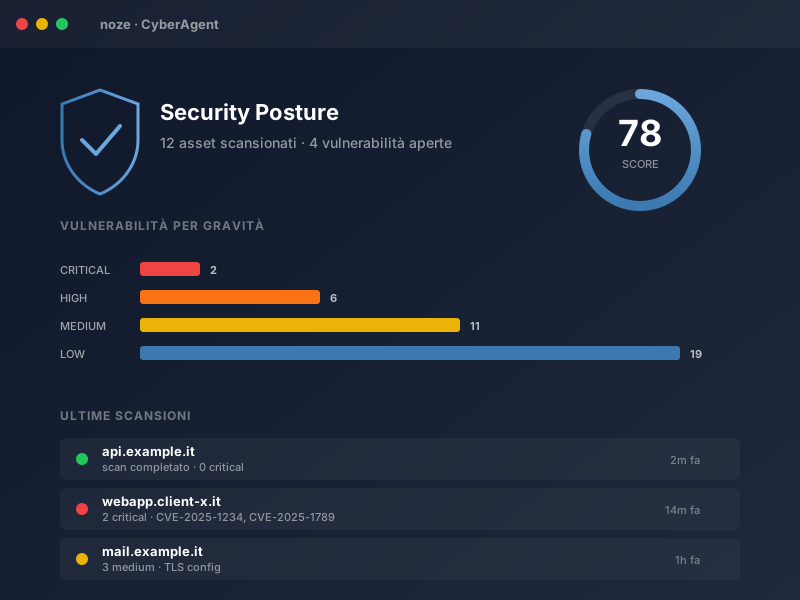
CyberAgent
AI-assisted vulnerability assessment and pentest. Continuous asset discovery, risk prioritization, NIS2.
Discover CyberAgent →
Cybersecurity
Offensive and defensive security, vulnerability management, NIS2 compliance. Skills and tools for those who protect systems.
Discover →
What OpenAI announced
On 26 June 2026 OpenAI began a limited preview of the GPT-5.6 series: Sol, the flagship; Terra, balanced for everyday work (competitive with GPT-5.5 at about half the price); and Luna, fast and affordable. The naming scheme changes too: the number marks the generation, while Sol, Terra and Luna identify three durable capability tiers (intelligence, speed, cost) that can advance at their own cadence.
On the technical side, OpenAI claims agentic improvements in coding, biology and cybersecurity. Two new usage features arrive: a max reasoning effort (more time to reason deeply) and an ultra mode that goes beyond a single agent by leveraging subagents to accelerate complex work. On coding, Sol sets a new state of the art on Terminal-Bench 2.1. Pricing per million tokens: Sol $5/$30 (input/output), Terra $2.50/$15, Luna $1/$6. Sol on Cerebras, up to 750 tokens per second, is expected in July.
The real news isn’t technical: it’s access
The most interesting point is not a benchmark. It is how the model is released. GPT-5.6 starts as a preview for a small group of trusted partners whose participation, OpenAI writes, has been shared with the US government, and precisely at the government’s request before a broader release. General availability is expected “in the coming weeks”.
OpenAI itself distances the company from the mechanism: “we don’t believe this kind of government access process should become the long-term default. It keeps the best tools from users, developers, enterprises, cyber defenders, and global partners who need them.” It describes this as a short-term step while it works with the Administration on a “cyber Executive Order framework” and a repeatable process for future model releases. In other words: access to a frontier model is no longer just a decision of the company that builds it.
Cyber: the reason for the gate
The reason for the gate is written plainly into the capabilities. GPT-5.6 Sol is OpenAI’s most capable model yet for cybersecurity: it shifts the performance-efficiency frontier on long-horizon tasks such as vulnerability research and exploitation. On ExploitBench it is competitive with Mythos Preview while using about one third of the output tokens.
OpenAI spells out the limits: the model does not cross the “Cyber Critical” threshold of its own Preparedness Framework. In tests on Chromium and Firefox it found bugs and exploitation primitives (the building blocks of an attack) but did not autonomously produce a full-chain exploit under the conditions tested, and it is more effective at finding and fixing vulnerabilities than at carrying out an end-to-end attack, with an explicit lean toward defenders. As protection, a stack of layered safeguards and over 700,000 GPU-hours (A100-equivalent) of automated red-teaming aimed at universal jailbreaks. These are real dual-use capabilities: that is what drew the government’s attention.
Two weeks after Fable 5
To grasp the weight of the choice you need the context. Just two weeks earlier, on 12 June, the US government ordered the suspension of Anthropic’s Fable 5 and Mythos 5, forcing the company to disable them worldwide within hours: the first forced “shutdown” of a frontier model already in production, over concerns about cyber capabilities unlockable via jailbreak. We covered it in When a government switches off an AI model.
In two weeks, the story took a step forward. In the Fable case the sequence was “release, then get switched off”. With GPT-5.6 the order reverses: “agree first, then release”. OpenAI previewed its plans and the models’ capabilities to the government upstream and accepted a restricted preview. The form changes, not the substance: access to the frontier passes through an authority that is neither the company nor the user. It is no accident that the cyber-capability comparison is now explicit, with OpenAI measuring Sol against Mythos Preview.
Our take
For anyone operating in Italy and the EU the signal is clear, and it adds to the Fable 5 one: closed frontier AI is becoming a dual-use technology under government control, and that government is a foreign one. Two risks become concrete and plannable. The first is access: you might simply not be among the few approved partners, and Europe does not sit at the table that decides. The second is continuity: what is available today can be restricted tomorrow, for reasons you do not control.
The answer is the one we have argued for some time: own the operational floor. Open-weight models (we wrote about this regarding GLM 5.2), run on-premise or on controlled infrastructure, cannot be switched off or filtered by a letter. They don’t have to do everything: they have to guarantee continuity and governance when the external vendor changes the rules. This is the Open Intelligence, Secure Governance thesis, and the point of products like Admina for governed AI on any model, of our work on on-premise AI, and of the cybersecurity tools that put these capabilities in defenders’ hands.
A note of balance: the gating has a defensible logic, because the cyber and biological capabilities of frontier models are real, and even OpenAI calls it temporary. But “temporary” and “at a government’s discretion” are words that weigh heavily for anyone planning over years. What counts most, on that horizon, is not depending on a switch you do not control.