
From rediscovery on every query to knowledge that accumulates
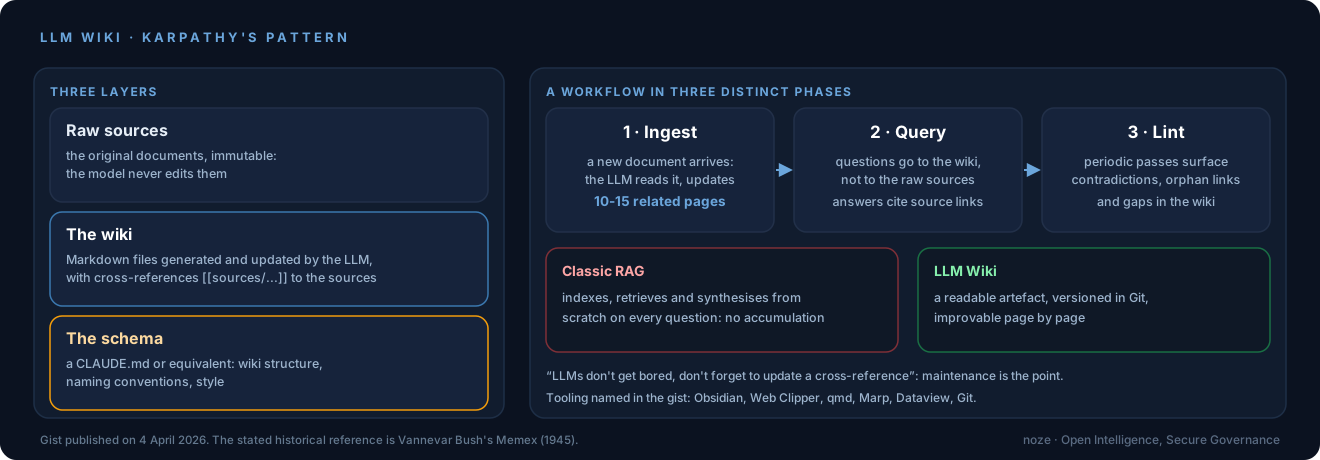
In classic RAG, every new question makes the LLM start over: indexing, retrieval, synthesis. The model, Andrej Karpathy writes in a gist published on 4 April 2026, “rediscovers knowledge from scratch on every question. There’s no accumulation.” The LLM Wiki pattern shifts the centre of gravity: instead of regenerating answers from raw documents, the model builds and maintains a persistent Markdown wiki that grows over time. Karpathy explicitly references Vannevar Bush’s Memex (1945): a personal knowledge store with associative trails between documents.
Three layers: sources, wiki, schema
The architecture has three parts:
- Raw sources — immutable documents, never modified by the model.
- The wiki — a directory of Markdown files generated and updated by the LLM, with cross-references (e.g.
[[sources/...]]) pointing back to the sources. - The schema — a configuration document (typically a
CLAUDE.mdor equivalent) that encodes the wiki’s structure, naming conventions and style.
The operational workflow has three distinct phases: ingest (a new document arrives, the LLM reads it and updates 10-15 related wiki pages), query (questions go to the wiki, not to raw sources; answers cite source links), lint (periodic passes that surface contradictions, orphan links and gaps).
Tooling: nothing exotic
Karpathy lists tools available today and well known to developers: Obsidian as editor with graph view, Obsidian Web Clipper for web ingest, qmd for local search, Marp to generate slides from the wiki, the Dataview plugin for structured queries inside Obsidian, Git for versioning. The gist comments list a number of community-driven implementations (SwarmVault, WeKnora, Keppi, llmwiki-cli, OmegaWiki, Lore…) — a signal that the pattern landed on fertile ground among people experimenting with LLM-driven knowledge management.
What this means in practice
The operational point of the pattern is maintenance: personal wikis historically fail because updating cross-references is tedious, so it doesn’t get done. “LLMs don’t get bored, don’t forget to update a cross-reference,” Karpathy writes. For anyone designing a corporate or personal knowledge base built on local LLMs, the pattern is a concrete alternative to vanilla RAG: instead of an opaque index, a readable artefact, version-controlled in Git, inspectable by a human and improvable page by page.
Link: Karpathy “LLM Wiki” gist · Memex (Vannevar Bush, 1945)