
Article
What was announced
In late May 2026 Anthropic released Claude Opus 4.8 (model id claude-opus-4-8) and, at the same time, introduced Dynamic Workflows in Claude Code. The two announcements are best read together: a more capable model, and a new way of putting it to work — no longer with a single prompt, but with an orchestration of multiple agents described in code.
Opus 4.8 is available on Claude.ai and Cowork, via the Claude API and through the main cloud providers (Amazon Bedrock, Google Cloud Vertex AI, Microsoft Foundry). Pricing is unchanged from Opus 4.7: $5/million input tokens and $25/million output tokens ($10/$50 in fast mode).
What changes in Opus 4.8
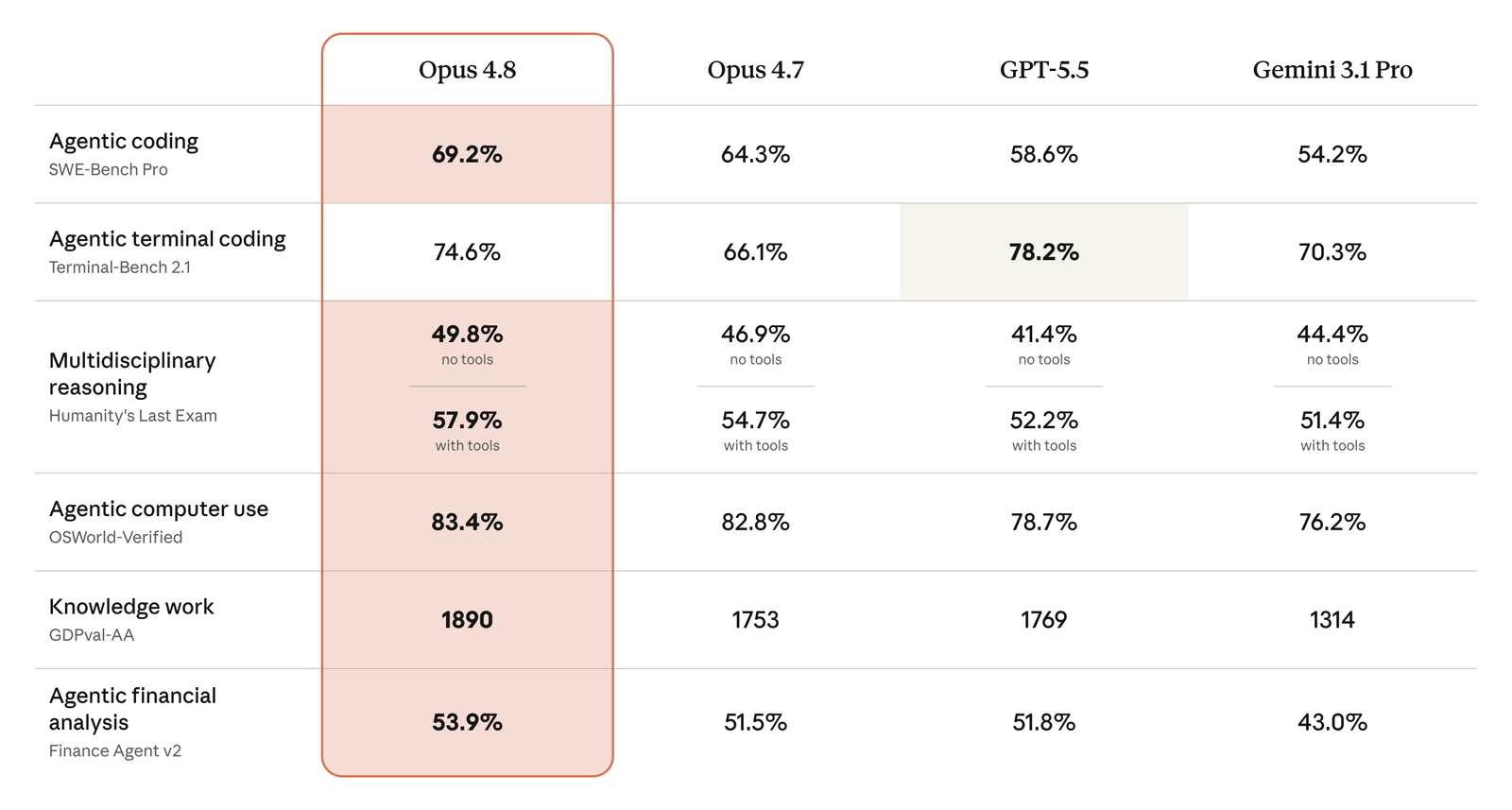
Anthropic positions Opus 4.8 as its most capable generally available model, with stated improvements on two fronts: coding (fewer defects slipping through in generated code) and honesty — a greater tendency to flag uncertainty rather than make unsupported claims. It also fixes two Opus 4.7 behaviours: overly verbose comments and some imprecision in tool-calling.
For anyone building AI applications, the interesting part is not just the quality of a single output, but the fact that a more reliable model is the precondition for delegating longer, less supervised tasks to it — exactly the scenario of multi-agent workflows.
Dynamic Workflows
A Dynamic Workflow is a JavaScript script that Claude writes and the runtime executes to coordinate many subagents. While the script runs in the background, the session stays responsive; intermediate results live in script variables, not in the model’s context window. This is the key architectural point: you can process large amounts of work without saturating the context.
Two primitives are documented:
pipeline()— flows each item through multiple stages with no barrier: one item can be at stage 3 while another is still at the first.parallel()— runs multiple tasks concurrently but acts as a barrier: it waits for all of them before moving on.
Structured output is handled by a schema: passing it to an agent forces the subagent to return an object validated at the tool-call level, with automatic retries on mismatch — more robust than simply “return JSON”. The runtime enforces hard limits: up to 16 concurrent agents and a maximum of 1,000 agents per run, with runs resumable in the same session. Claude Code also ships a ready-made workflow, /deep-research, which fans out searches, cross-checks sources, subjects each claim to an adversarial majority vote and returns a cited report with non-surviving claims already filtered out.
Dynamic Workflows are in research preview, not generally available: they require a recent version of Claude Code and are accessible on paid plans, as well as via the API and on the Bedrock/Vertex/Foundry clouds. Primitives, activation keywords and limits may still change.
Not “deterministic”, but repeatable
Dynamic Workflows do not make the output deterministic. The subagents are still language-model calls, hence non-deterministic. What becomes repeatable and legible is the orchestration: which agents are launched, in what order, with which verification stages, under which constraints. It is the difference between an improvised result inside a prompt and a process codified in a script that can be versioned, reviewed and run again.
The angle: the risk shifts to the process
When work moves from a prompt to an orchestration of dozens of agents, the risk shifts from the model to the process. The relevant questions are no longer only “did the model answer well?”, but: which tools can the agents use? how much can they spend? what is being logged? who can stop them?
Dynamic Workflows offer some of these controls at the root — subagents inherit the session’s tool allowlist, run in a defined approval mode, the agent-count limits cap the cost of a runaway script, and the feature can be disabled centrally across an organisation. But the principle is more general, and it is what at noze we call Secure Governance: in an agentic infrastructure, policies, audit trails, data redaction and kill switches are not a layer to bolt on afterwards, but a property by design.
It is the same thesis behind Admina, the Open Source AI-governance framework sponsored by noze, and behind the OISG — Open, Intelligent, Secure, Governed paradigm: the more agents become autonomous and orchestrated, the more governing the orchestration becomes the real enabler for taking them to production.
Links: Introducing Claude Opus 4.8 — Anthropic · Orchestrate subagents at scale with dynamic workflows — Claude Code Docs