
Contents
Article
IntelliPA
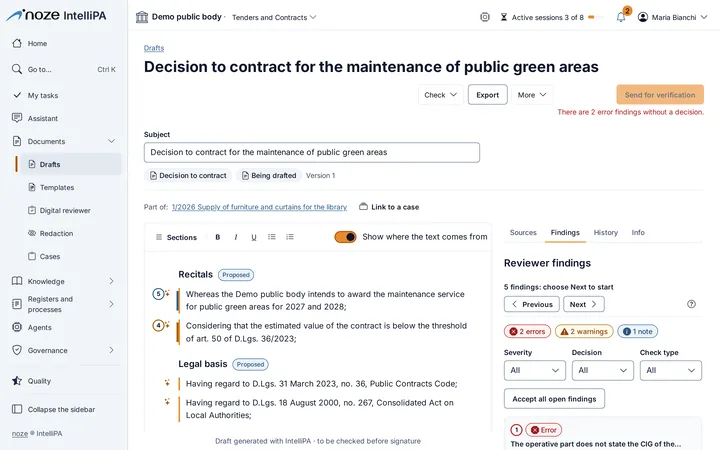
Turnkey local agentic AI for municipalities and public bodies: drafts of administrative acts, answers with their source and compliance registers on a workstation on site.
Discover IntelliPA →
Artificial Intelligence
Local AI with open-weight models, agentic AI with human approval and governed AI, on-premise or in a private cloud.
Discover →
Linux Services & Systems
Domains, hosting, PEC, email infrastructure, network services and Linux systems. Open Source infrastructure support and management.
Discover →
On Friday 20 November Thinking Machines, the lab founded by Mira Murati, released Inkling 2 Mini with open weights on Hugging Face under the Apache 2.0 licence. It is a Mixture of Experts with 26.4 billion total parameters and 3.4 billion active per token, with one distinctive feature: it is a looped transformer that runs its middle layers three times for every token. It weighs about 20 GB and, according to Thinking Machines, runs on a Mac with at least 32 GB of memory and on a DGX Spark.
It comes two weeks after Inkling 2 Small, the 594-billion-parameter model (17 billion active) introduced on 5 November, and four months after the first Inkling. Alongside Mini, the lab released a research variant, TML-d24-varloop-research, with the same parameter count and licence, which accepts between one and five passes through the loop.
What “looped” means
Inkling 2 Mini has 24 layers split into four blocks of six. The first and last blocks run once; the two middle blocks run three times with the same weights. That gives 48 layer applications per token from 24 stored layers. Each extra pass adds about one billion effective active parameters: with three passes the model reaches 5.4 billion per token.
The idea is that the middle layers carry the more abstract reasoning, while the first and last ones translate between embeddings and internal representations. In Thinking Machines’ tests, looping the middle layers beat looping the last ones on 27 out of 28 evaluations. On cost, the lab compared two test models before the experts were pruned: the non-looped one was 7.5% cheaper to train, but needed 140% more inference compute to reach the same loss on 512,000-token agentic traces.
Looping improves reasoning but does not add knowledge. How many facts a model retains depends mostly on its total parameters, and on knowledge benchmarks such as AA-Omniscience Inkling 2 Mini is in line with models of its size. Thinking Machines makes up for it with search and tools: on BrowseComp, DeepSearchQA and MCP Atlas it reports the best results among open models of the same size.
The reported numbers
Thinking Machines compares Inkling 2 Mini with open-weight models below 100 billion parameters. The closest comparison is Qwen3.8-27B, released by Alibaba in August under Apache 2.0.
| Benchmark | Inkling 2 Mini | Qwen3.8-27B | Gemma 4 31B |
|---|---|---|---|
| AA Index v5.0 | 20.1 | 20.1 | 4.4 |
| DeepSWE v1.1 | 48.2% | 42.2% | 0.3% |
| SWE-bench Verified | 79.2% | 77.8% | 46.1% |
| Terminal Bench v2.1 | 71.6% | 73.0% | 43.4% |
| BrowseComp | 79.0% | 61.6% | 37.0% |
| MCP Atlas | 82.7% | 77.3% | 54.2% |
These are the lab’s own numbers, with evaluation setups that vary from model to model. Thinking Machines itself lists the limitations: Inkling 2 Mini is not the strongest small model for multi-turn chat (50.0% on MultiChallenge) or for instructions with many constraints, and it trails larger models on the hardest reasoning benchmarks. The model card also notes that its reasoning sometimes gets stuck in repeated self-checking loops, especially when debugging, and that quality can drop outside English: in Chinese testing the lab observed clipped phrasing and mixed languages.
NVFP4 from training to deployment
The weights were trained and are distributed in the same precision: 20 layers in NVFP4 and the last 4 in MXFP8. So there is no need to quantise them after training and no quality loss from doing so. For local use, quantised GGUF versions are also available through Unsloth and llama.cpp.
The model started out bigger. It began with 384 experts, 8 active per token; during midtraining Thinking Machines pruned two thirds of the experts, keeping the 128 most used in each layer, and recovered performance with one trillion tokens distilled from a larger internal Inkling. Supervised fine-tuning and 2.2 trillion tokens of reinforcement learning followed.
There is a third-party data point on efficiency, reported by Thinking Machines. The Stanford researchers who measure intelligence per joule had early access to the model: on a DGX Spark Inkling 2 Mini scored 0.703, against 0.430 for Qwen3.6-35B-A3B and 0.159 for Gemma 4 26B A4B. Inkling ran in MXFP8 with low reasoning effort, the others in NVFP4 or INT4.
The two demos point the same way. On a 48 GB MacBook Pro M5 Pro in airplane mode, during a flight, the model wrote a playable flight simulator in a few minutes. On the same kind of laptop, offline, it runs the 20 residents of Thinkyville, a pixel-art village the model built itself.
Looping and reasoning monitorability
The most interesting part of the release concerns safety. Part of the oversight of reasoning models relies on reading their chain of thought: in a standard transformer each token goes through the layers only once, so long reasoning has to be written out. A looped model does more computation inside each token and could reason more without writing it down.
Thinking Machines used the variable-loop variant to measure this, and the results are preliminary:
- More capability without a chain of thought. The longest task the model solves without writing its reasoning goes from 16 seconds of human work with one pass to 37 seconds with three, then levels off. On a chained lookup task across several tables the model keeps improving up to ten passes, twice as many as it saw in training.
- Shorter but legible chains. On GPQA Diamond the reasoning at five passes is less than half as long as at one (1,661 tokens against 3,703), with the same average sentence length and the same share of dictionary words. The model hesitates and backtracks less.
- Little control over the chain of thought. When asked to reshape its own reasoning, for example by avoiding a word, Inkling 2 Mini manages it at most 0.1% of the time, on chains of 750 to 1,250 tokens.
- No clear trend in attacks. In LinuxArena, where the model has to covertly carry out a malicious task inside a development job (using a version of Inkling 2 Mini trained not to refuse and the research variant), the share of undetected attacks does not rise clearly with the number of passes.
Thinking Machines concludes that at this scale looping increases what the model can do without writing its reasoning, without meaningfully reducing the legibility of what it does write. The lab itself asks for this to keep being measured on larger models. Access has also been opened to Goodfire, which works on mechanistic interpretability, and to the National Deep Inference Fabric.
Our take
A 20 GB model with a context of up to one million tokens, an Apache 2.0 licence and agentic performance close to those of 27-billion dense models is a good candidate for local AI at the client’s site. On a 128 GB DGX Spark it leaves plenty of room for the KV cache and for several agents in parallel, as in our DGX Spark recipes.
The knowledge limit matters little in projects where the model works on the client’s documents and cites its source, as in IntelliPA. Language matters more: the model card reports drops outside English, and Italian has to be tested on real cases before any adoption.
The part on internal reasoning concerns us directly: for anyone building agents, the chain of thought is one of the tools for checking the model’s choices. An architecture that moves computation inside the tokens improves efficiency and opens a question for auditing. The weights of the research variant make it possible to measure this outside the lab as well.
Sources
- Thinking Machines, “Introducing Inkling 2 Mini”
- Thinking Machines, Inkling 2 Mini model card
- Thinking Machines, TML-d24-varloop-research model card
- Hugging Face, thinkingmachines/Inkling-2-Mini
- Hugging Face, thinkingmachines/TML-d24-varloop-research
- Thinking Machines, “Introducing Inkling 2 Small”
- Goodfire, “Interpreting Inkling 2 Mini”
- Thinking Machines on X, 20 November announcement