
Article
IntelliPA
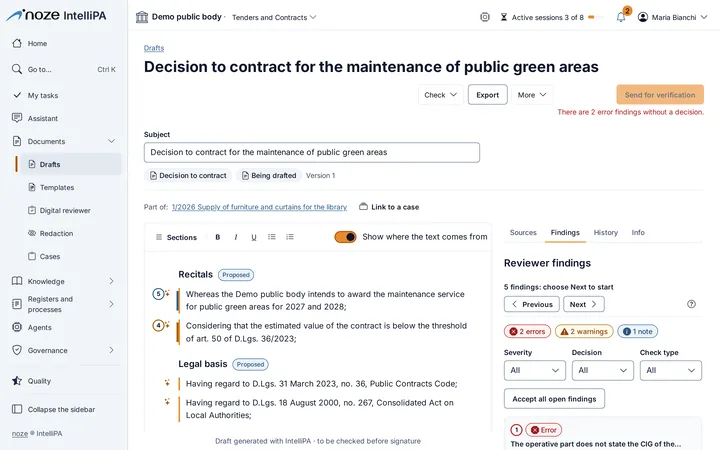
Turnkey agentic AI run locally for municipalities and public bodies: drafts of acts, answers with their source and compliance registers on a workstation on site.
Discover IntelliPA →
Artificial Intelligence
Local AI with open-weight models, agentic AI with human approval and governed AI, on-premise or in a private cloud.
Discover →
Linux Services & Systems
Domains, hosting, PEC, email infrastructure, network services and Linux systems. Open Source infrastructure support and management.
Discover →
At SC26, the supercomputing conference running in Chicago from 15 to 20 November, NVIDIA presented the DGX Spark HPC Developer Kit: four DGX Spark units linked directly over ConnectX-7 networking, each to its two neighbours, “with no network switch to buy or set up”. The kit scales from one node to four. It is aimed at researchers and developers in HPC and AI who want to prepare their code before moving it to larger systems.
What is in it
The kit is made up of four DGX Spark units and the cables, which according to NVIDIA can be bought from OEM partners (Acer, ASUS, Dell Technologies, GIGABYTE, H3C, HP, Lenovo, MSI and xFusion) or from the NVIDIA Marketplace.
| One DGX Spark | The kit, four nodes | |
|---|---|---|
| LPDDR5x unified memory | 128 GB, 273 GB/s | 512 GB |
| NVMe storage | 4 TB | 16 TB |
| Models in NVFP4, according to NVIDIA | up to 200 billion parameters | up to 700 billion |
| Network | ConnectX-7, two QSFP ports, 200 Gb/s per port | ring, four cables |
Each node has the GB10 superchip, with a 20-core Arm CPU and a Blackwell GPU sharing the memory. There is also a 64 GB version, sold only by partners, but reaching 512 GB takes four 128 GB units.
No price is given for the kit. In October The Register reported $6,950 for NVIDIA’s own 128 GB DGX Spark: four units come to about $27,800, before cables, duties and VAT.
How the ring is cabled
NVIDIA’s Connect Multiple DGX Sparks playbook has documented the four-node ring since 20 October, almost a month before SC26. The layout is simple: port 0 of each unit goes to port 1 of the next, with QSFP112 DAC cables in Ethernet mode; the fourth cable closes the ring. It needs the April 2026 DGX OS release or later.
- Opposite nodes do not talk directly. The playbook says so: Spark 1 and Spark 3 are not connected, and neither are Spark 2 and Spark 4. Traffic between opposite nodes goes through a neighbour.
- Setup is manual. NVIDIA Sync does not configure the four-node ring: you use the Configure Manually tab and the
setup-cluster.shscript from the third-party spark-vllm-docker repository. - The documentation is not yet consistent. The product page FAQ still says four systems need a 200 GbE switch, while the same page presents the ring kit. The NCCL playbook covers two nodes, three in a ring and four with a switch, not yet four in a ring.
NVIDIA publishes no bandwidth figures for the ring. In its October 2025 review ServeTheHome measured about 96 Gb/s over TCP with one port and with two, and put it down to the ConnectX-7 card’s PCIe x4 link. It was a TCP test, not RDMA. NVIDIA’s documentation, however, describes two independent PCIe Gen5 x4 links, and the playbook configures both: the ring’s real bandwidth is still to be measured.
DeepSeek V4.1 on four nodes
NVIDIA’s example is DeepSeek V4.1. On Hugging Face the published model is DeepSeek-V4.1-Flash, with a 552-billion-parameter backbone and a 196-billion-parameter Engram conditional memory, which together exceed the 700 billion NVIDIA gives as the ceiling. The NVFP4 version NVIDIA released on 30 October weighs about 429 GB.
Split across four nodes that is about 107 GB per unit, out of 128. Around 20 GB per node is left for the system, the KV cache and activations: on paper the model fits, but long context and concurrent requests have little room. NVIDIA tested that version on four GB300 GPUs; there are no published measurements on four DGX Spark units yet.
Everyday local inference needs fewer nodes: in August’s DGX Spark recipes two units were given as the sweet spot for DeepSeek V4 Flash, and three ran GLM-5.2.
Not only LLMs
The kit is built for scientific computing. NVIDIA announces as “coming soon” an HPC SDK playbook, with GPU-accelerated C, C++ and Fortran compilers, libraries and MPI tools. On four systems it demonstrated LAMMPS with Kokkos and NAMD; the community has already validated GROMACS, OpenFOAM, WRF and the OpenFold3 and Boltz-2 NIM microservices on DGX Spark.
The lab examples NVIDIA cites use a single unit. At UC Berkeley the Hartwig Group runs LoRA fine-tuning of Nemotron 3 Super 120B in NVFP4 on one DGX Spark, with training runs of 8 to 24 hours. The Rubin Lab at the IGI uses Evo 2 to predict bacterial traits from genome sequences, with results arriving “15x sooner” and no 11-hour queues.
Our view
The ring takes a 200 GbE switch off the bill, which costs money and has to be configured. For universities, labs and R&D teams that want a small MPI cluster under their own control, four units and four cables are a clear entry point.
It is the same configuration we showed students on 10 November at Homo Agenticus: two units over one cable, three or four in a ring, more through a switch. For us DGX Spark is the reference hardware for local AI on the client’s premises. A GB10 also runs Codendum, which serves the coding agents of a whole class.
With a 700-billion-parameter model on four units, the headroom depends on the context required, the concurrent requests and the bandwidth between nodes, which NVIDIA has not yet published for the ring.
Sources
- NVIDIA Blog, “NVIDIA DGX Spark Developer Kit Turns a Desk Into a Supercomputing Lab”
- NVIDIA Developer Forums, DGX Spark HPC Developer Kit announcement
- NVIDIA DGX Spark, product page and FAQ
- NVIDIA, “Connect Multiple DGX Sparks for Distributed Workloads” playbook
- NVIDIA, NCCL playbook for DGX Spark
- NVIDIA, DGX Spark playbooks repository
- DeepSeek-V4.1-Flash on Hugging Face
- NVIDIA, DeepSeek-V4.1-Flash-1017 in NVFP4
- The Register, 64 GB DGX Spark and pricing, 2 October 2026
- ServeTheHome, NVIDIA DGX Spark review
- SC26, Chicago