
Article
Artificial Intelligence
On-premise AI architectures, local LLMs, RAG, autonomous agents. Intelligence you cannot afford to see switched off must be owned.
Explore →
Admina
Open Source AI governance: audit trail, PII redaction, bidirectional ALLOW/BLOCK/REDACT policies on any model, local or remote.
Explore Admina →
Linux Services & Systems
Design, deployment and management of on-premise Linux infrastructure: from servers to AI hardware, with data that stays yours.
Explore →
Research & Development
Applied research and prototyping, from AI to infrastructure, in collaboration with universities and research centres.
Explore →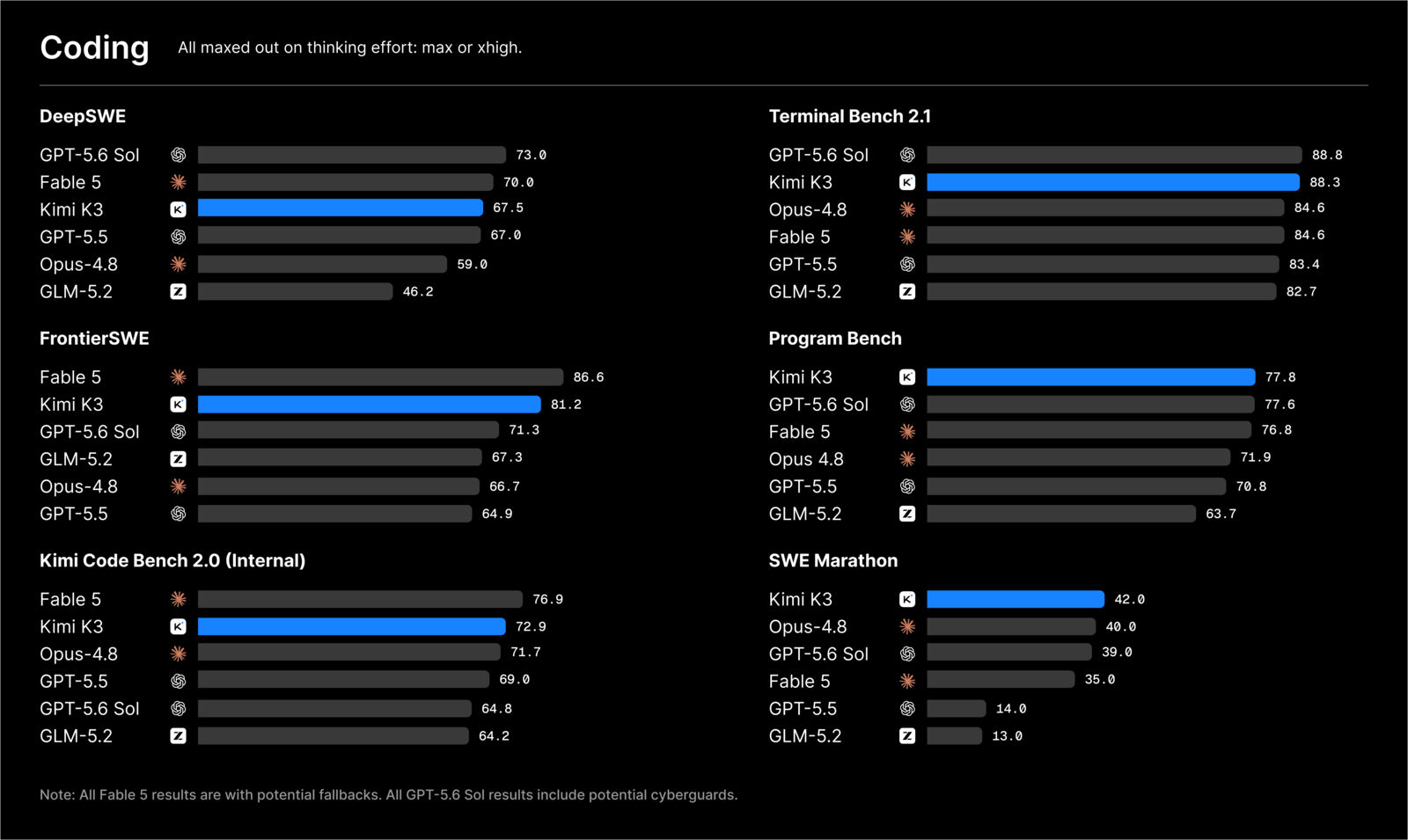
What Kimi K3 is
Moonshot AI has unveiled Kimi K3, which it calls “the world’s first open 3T-class model.” It is a Mixture of Experts with 2.8 trillion total parameters, of which it activates only 16 out of 896 experts per token, with a context window of 1 million tokens and native vision. The positioning is clear: frontier intelligence for long-horizon coding, knowledge work and reasoning.
Note. The benchmarks, figures and prices here come from Moonshot AI’s announcement, not from independent testing by noze; the benchmark results are the vendor’s own claims. As of July 17, 2026 the model is usable via API and apps, but the open weights have not been released yet: where that matters, we say so.
Under the hood
The architecture is all about efficiency at this scale. Moonshot claims roughly a 2.5× improvement in scaling efficiency over Kimi K2, thanks to several choices:
- Kimi Delta Attention (KDA), an attention form designed to scale efficiently over long contexts.
- Attention Residuals (AttnRes), to selectively retrieve representations across the model’s depth.
- A Stable LatentMoE framework and Gated MLA (multi-head latent attention).
- Quantization-aware training, with weights in MXFP4 and activations in MXFP8: quantization is part of training, not a fallback bolted on afterwards.
The theme is the one we have been tracking for a while: huge models made runnable through compressed attention and aggressive quantization, as with DwarfStar 4 and colibri. Here the scale is another matter, though: 2.8 trillion parameters are a lot even just to store.
What it can do
Kimi K3 is built for long-horizon agentic use: sustained engineering sessions with little oversight, repository navigation and terminal orchestration. The examples Moonshot shows are ambitious: a GPU compiler (MiniTriton) written from scratch, autonomous 48-hour runs on chip design, game development with vision-in-the-loop iteration, and on the research side a 42-year analysis of the ASIC industry with over 2,800 web searches and 11,000 pages read, or a gravitational-wave analysis with more than 20 subagents in parallel.
On benchmarks (at maximum thinking effort, figures reported by Moonshot) the numbers are high: Terminal-Bench 2.1 at 88.3, GPQA-Diamond at 93.5, DeepSWE at 67.5, MMMU-Pro (vision) at 81.6, CharXiv at 84.8. Moonshot is candid, though: “overall performance still trails the most powerful proprietary models,” namely Claude Fable 5 and GPT-5.6 Sol. On some tests, like Terminal-Bench, K3 closes on or beats them; on others it stays a step behind.
From today it is available via web (Kimi.com), a desktop app (Kimi Work, Windows and Apple Silicon Macs), the terminal (Kimi Code) and the API (platform.kimi.ai). API prices: $0.30/Mtok for cache-hit input, $3.00/Mtok for cache-miss input, $15.00/Mtok for output, with a claimed cache-hit rate above 90% in coding workloads. At launch the model defaults to maximum thinking effort; low and high modes will come later.
The limits it discloses
Credit to Moonshot for listing the flaws. The first is technical and interesting: sensitivity to thinking history. If the harness does not pass back to the model all the thinking content produced in previous turns, “generation quality may become highly unstable.” It is a reminder that, with agents, the environment around the model matters as much as the model itself, which is exactly the point of harness engineering. The other two disclosed limits: excessive proactiveness, with unexpected autonomous decisions, and a gap in user experience compared with Fable 5 and GPT-5.6 Sol.
The catch: the weights land on July 27
And here is the point that matters most to us. Kimi K3 is announced as an open-weight model, but as of July 17, 2026 the weights are not downloadable yet: Moonshot states that “the full model weights will be released by July 27, 2026.” Until then K3 is, in practice, a cloud API like any other, with the same questions about what leaves your perimeter when you hand it code and data, as we showed for AI coding CLIs.
The sovereignty payoff arrives when the weights are truly in your hands and you run them yourself. But two concrete issues remain: a 2.8-trillion-parameter MoE is enormous to run in-house, and it will need the kind of quantization and expert-streaming that engines like colibri provide to fit on reasonable hardware; and a release date, as always, is a promise until it materialises.
Update, 28 July: the weights are out. Moonshot published Kimi K3 on Hugging Face on 26 July, a day ahead of the deadline it had set itself. The weights live at huggingface.co/moonshotai/Kimi-K3 in safetensors format, and the MoonshotAI/Kimi-K3 repository hosts the technical report. There was no separate release post: the announcement is still the one from 16 July, and the weights simply appeared.
The sizes confirm the problem we flagged: roughly 594 GB in the native MXFP4 format, up to 1.4 TB depending on quantization. At that size, downloading and running it takes planned storage and hardware.
One clarification we care about, because it is exactly the distinction we keep insisting on. The licence is titled the Kimi K3 License and is an MIT with two added clauses: anyone operating a language-model service with aggregate revenue above USD 20 million over twelve months must agree commercial use separately, and products above 100 million monthly active users or USD 20 million in monthly revenue must display “Kimi K3” prominently in the user interface. Internal use and access through Moonshot’s official products are exempt from both. For the vast majority of organisations these thresholds are irrelevant, and the weights remain downloadable and runnable without asking permission. It is still an open-weight licence with commercial conditions, though, not an OSI-approved open source licence: the two should not be conflated.
What we think
Kimi K3 confirms a trajectory we have been following piece by piece: the open-weight frontier keeps closing on the best proprietary models, after GLM 5.2, Ornith 1.0 and Inkling just two days ago. An open 3T-class model, competitive on coding and agents, is important news for those who want to own intelligence rather than rent it.
With two caveats we always repeat. First: a model is open when the weights are downloadable, not when it is announced; until July 27, for us, it stays an API to be judged as such. Second: owning the model is half the job, the other half is governing it, with an audit trail and policies over any model, local or remote, as Admina does. That is the sense of Open Intelligence, Secure Governance, and the direction we work in: on-premise AI, sovereign and governed, on Linux infrastructure that stays yours. If the weights really arrive on July 27, it will be another brick in that operational floor.