
Article
Artificial Intelligence
On-premise AI architectures, local LLMs, RAG, autonomous agents. Intelligence you cannot afford to see switched off must be owned.
Explore →
Admina Enterprise
Open Source AI governance: audit trail, PII redaction, bidirectional ALLOW/BLOCK/REDACT policies on any model, local or remote.
Explore Admina →
Research & Development
Applied research and prototyping, from AI to infrastructure, in collaboration with universities and research centres.
Explore →
Open Source
noze’s contribution to the Open Source ecosystem: projects, tools and publications released under permissive licenses.
Explore →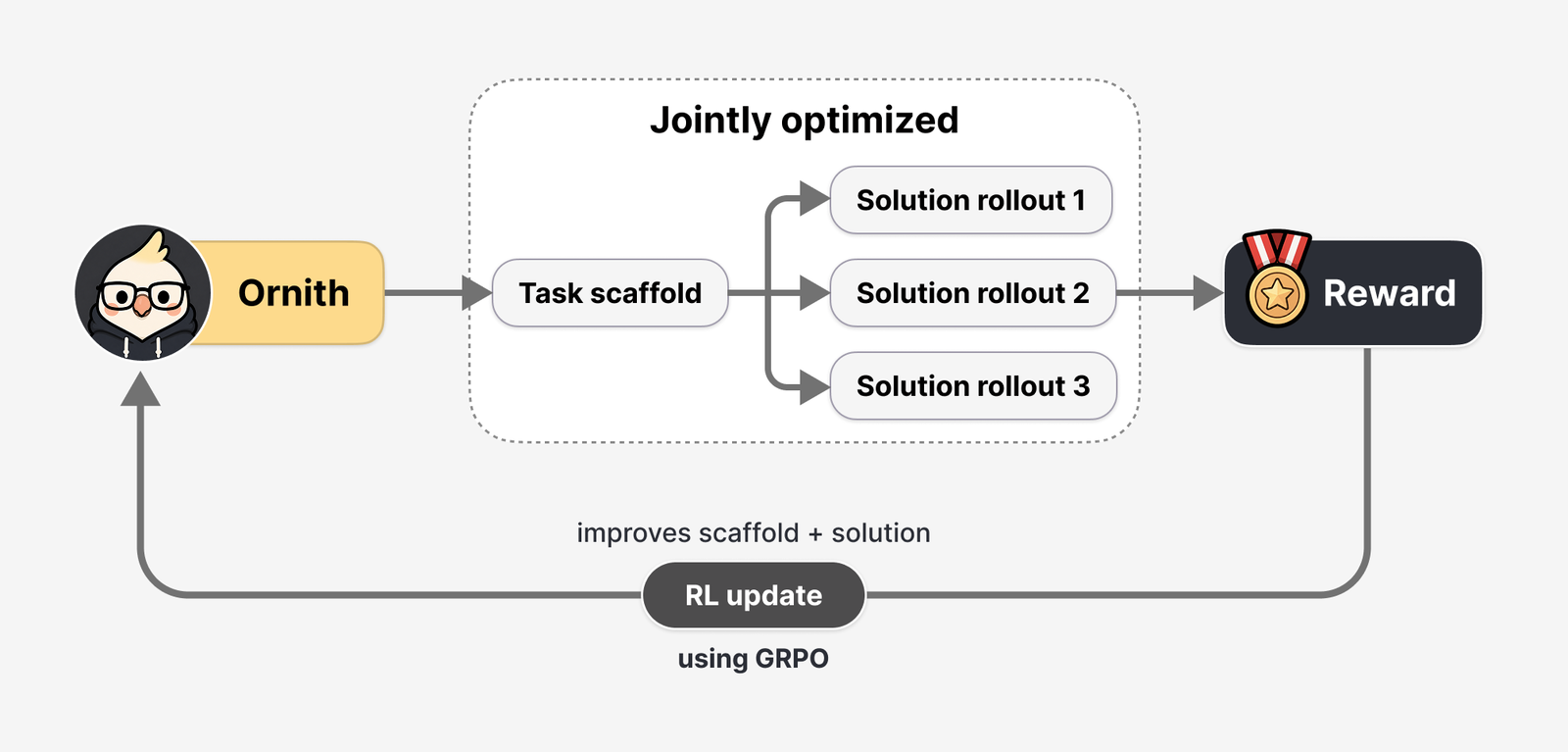
What Ornith 1.0 is
DeepReinforce has introduced Ornith 1.0, an open-weight family of models built specifically for agentic coding: not a generalist model, but one that operates inside a work loop (read a repository, run commands, fix and retest) until the task is solved. As with the other open-weight models we cover, “open weight” here means released, downloadable weights, not necessarily full training code and data.
The family spans the full spectrum, from a 9B Dense suitable for edge deployment to a frontier-scale 397B MoE, with a 31B Dense and a 35B MoE in between. It is built on top of the pretrained weights of Gemma 4 and Qwen 3.5, and it is available on Hugging Face. On coding benchmarks, DeepReinforce claims state-of-the-art results among open models of comparable size.
The innovation: the model learns its own scaffold
What makes Ornith interesting is not scale but its training method, which the authors call self-scaffolding. In reinforcement-learning training for coding, the harness (the scaffold that orchestrates how the model explores the problem, manages memory and errors, decides the steps) is usually hand-designed by engineers and stays fixed across a whole task category. It is delicate work, and we covered it when writing about harness engineering.
Ornith flips that setup: it treats the scaffold as a learnable object that co-evolves with the policy. Each RL step happens in two stages. First, given the task and the scaffold used before, the model proposes a refined scaffold; then, given that scaffold and the task description, it generates the solution. The reward from the result is propagated to both stages: the model learns not only to produce better answers but to author the orchestration that elicits them. Repeated across training, the mechanism lets per-category strategies emerge on their own, with no hand-written harness.
Defending against reward hacking
Letting a model write its own scaffold opens the door to reward hacking: a self-generated scaffold can learn to satisfy the verifier without actually doing the task, for example by reading the visible test files and writing the expected output directly, or copying a solution already present in the environment. Ornith defends on three layers:
- Fixed trust boundary: the environment, the tool surface and test isolation are immutable and out of the model’s reach; the model evolves only the inner logic (memory, error handling, orchestration).
- Deterministic monitor: it flags any attempt to read withheld paths, modify verification scripts or act outside the sanctioned tools, and assigns zero reward to those trajectories.
- Frozen LLM judge: a judge model, kept fixed, acts as a veto on top of the verifier, to catch the gaming that stays formally within the rules.
On the training side, to handle long rollouts Ornith adopts an asynchronous pipeline-RL strategy, with a staleness weight that downweights tokens generated by now-stale policies and drops them entirely beyond a threshold.
The numbers: on par with Opus 4.7, but open
These are figures reported by the project, measured on its own benchmarks and to be taken as indicative, but the picture is clear. The flagship, Ornith-1.0-397B, reaches 77.5 on Terminal-Bench 2.1 and 82.4 on SWE-Bench Verified: it matches Claude Opus 4.7 (70.3 and 80.8), a closed frontier model, and beats the best open models of similar size.
| Model | Terminal-Bench 2.1 | SWE-Bench Verified |
|---|---|---|
| Ornith-1.0-397B (open) | 77.5 | 82.4 |
| Claude Opus 4.7 (closed) | 70.3 | 80.8 |
| DeepSeek-V4-Pro (open) | 67.9 | 80.6 |
| MiniMax M3 (open) | 66.0 | 80.5 |
| Ornith-1.0-9B (open, edge) | 43.1 | 69.4 |
As interesting as the large model is what happens at the smaller sizes. Ornith-1.0-35B beats similarly sized models like Qwen 3.5-35B, Qwen 3.6-35B and Gemma 31B, and on Terminal-Bench 2.1 it even beats Qwen 3.5-397B (64.4 vs 53.5), a model ten times larger. And the 9B edge version reaches 43.1 on Terminal-Bench 2.1 and 69.4 on SWE-Bench Verified, matching or exceeding much larger models like Gemma 4-31B. It is the demonstration that agentic capability depends not only on parameters but on method.
The open landscape has grown dense
Ornith does not arrive in a vacuum. The models it competes with (and often beats at comparable size) are almost all open: Qwen 3.6, DeepSeek V4, GLM 5.2, MiniMax M3 and the Gemma 4 base itself. By mid-2026 this ecosystem has become competitive with the closed frontier precisely on the ground that matters most to developers: solving real tasks inside an agentic loop.
What we think
For us Ornith is one piece of the same thesis we have argued for a long time: the parts of AI you cannot afford to see switched off must be owned. An open-weight model that matches Opus 4.7 on agentic coding, and that scales from a 9B on the edge to a frontier 397B, moves the question from “whether” to “when” for anyone who wants development automation under their own control.
The timing helps read it. We have covered how a closed model can be switched off by government decision (the Fable 5 case) and how frontier access is becoming a process filtered upstream (GPT-5.6 Sol). On the opposite front, models like Ornith, GLM 5.2 and engines like DwarfStar 4 make independence not just desirable but practical. It is the sense of Open Intelligence, Secure Governance: own the operational floor and govern the stack, including with Admina, which brings audit and policy to any model, local or remote.
There is also a second, more technical layer that touches us closely. Ornith shows that the agentic scaffold is not only something you design by hand around the model: it can be learned by the model itself. It is an idea that intertwines with how we think about agentic loops and harness engineering, and one worth watching: when the model co-designs its own orchestration, the line between the engineer’s work and the model’s work shifts.
The limits are worth keeping in mind: the numbers are self-reported on the project’s benchmarks, and agentic coding benchmarks remain an imperfect proxy for real work. Precisely for that reason it is significant that Ornith tackles reward hacking explicitly, the flaw that makes many RL metrics unreliable. The direction, for those of us working on on-premise AI and governed AI, is the right one.