
Article
IntelliPA
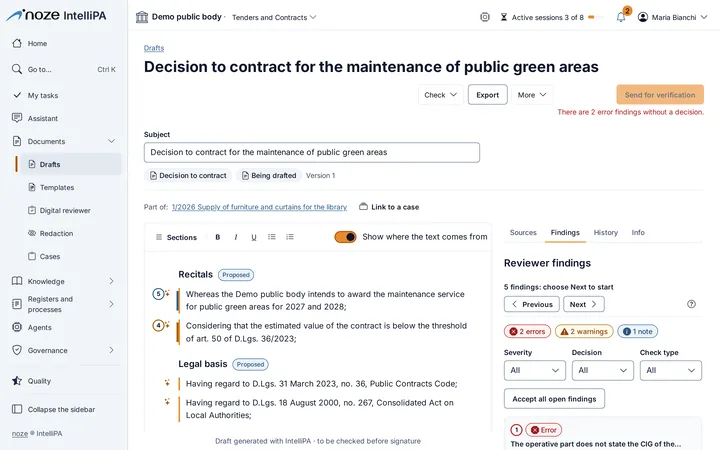
Turnkey agentic AI run locally for municipalities and public bodies: drafts of acts, answers with their source and compliance registers on a workstation on site.
Discover IntelliPA →
CyberAgent
Continuous vulnerability assessment and automated pentesting: validated risks and reports aligned with NIS2, to review before handing them over.
Discover CyberAgent →
AgenticHealth
On-premise AI for clinical research: source-cited research, draft study and quality documents, data redaction. It is not medical software: it does not support diagnosis or patient-care decisions.
Discover AgenticHealth →
Artificial Intelligence
Local AI with open-weight models, agentic AI with human approval and governed AI, on-premise or in a private cloud.
Discover →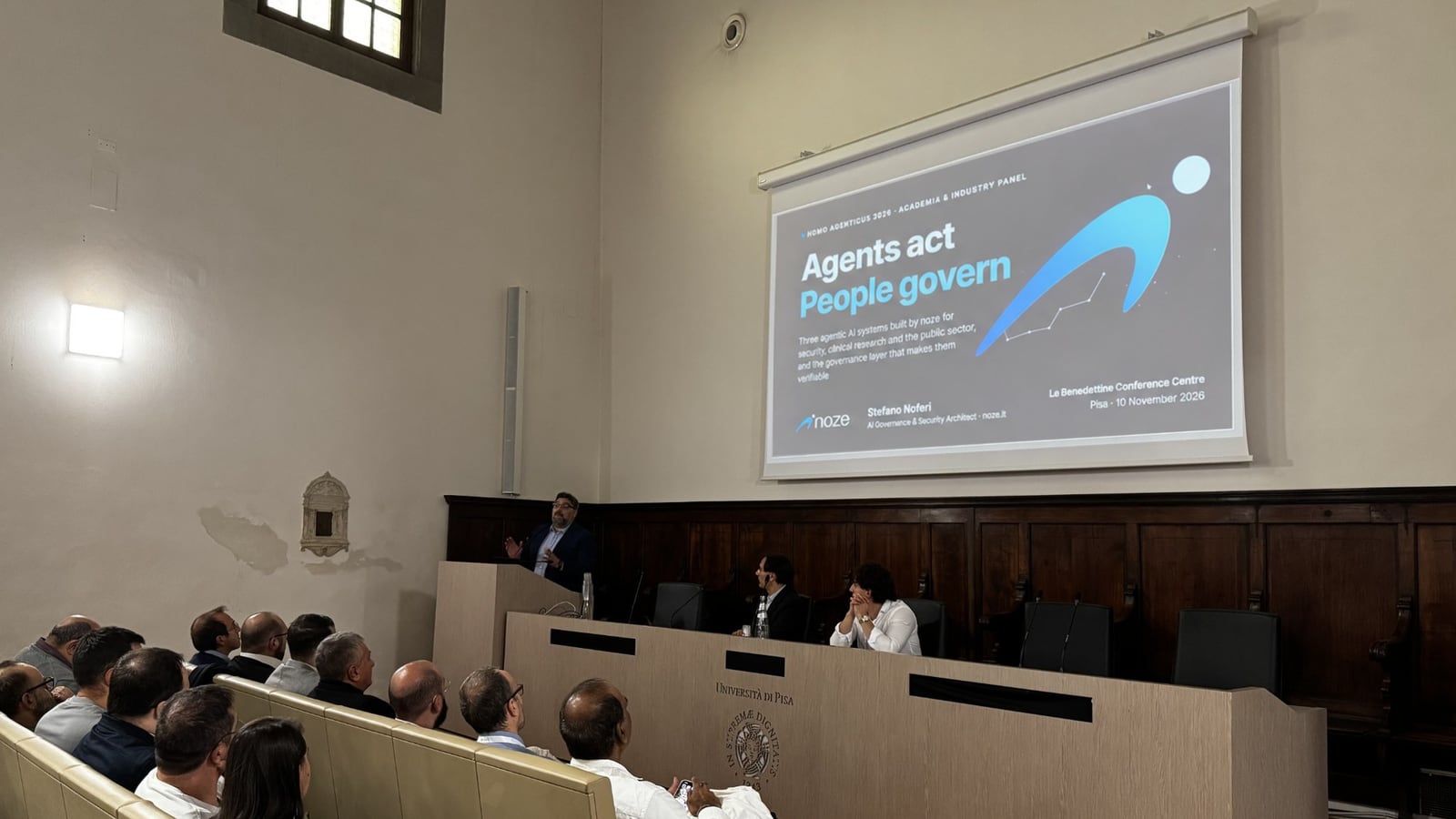
On 10 November the Le Benedettine Conference Centre in Pisa hosted Homo Agenticus, the University of Pisa’s Academia & Industry Panel on agentic artificial intelligence projects, under the scientific coordination of Mario G.C.A. Cimino. The day brought together companies, faculty and students from the Artificial Intelligence and Data Engineering and the Computer Engineering degree programmes. Stefano Noferi sat on the industrial committee.
The day
The morning opened with the Entrepreneurs Workshop led by Sudeendra Koushik, President of the IEEE Technology and Engineering Management Society. Two industry sessions followed, in which companies presented ideas and projects in agentic AI. In the two student sessions, 88 students in 20 teams (50 in 12 teams from AI and Data Engineering, 38 in 8 teams from Computer Engineering) presented their project ideas to a committee of companies and faculty. The day closed with the awards.
Our talk
In the industry session Stefano Noferi presented “Agents act, people govern”: three agentic systems built by noze in different domains, with the same design rule. The agent acts and a person governs, inside a boundary the system cannot cross.
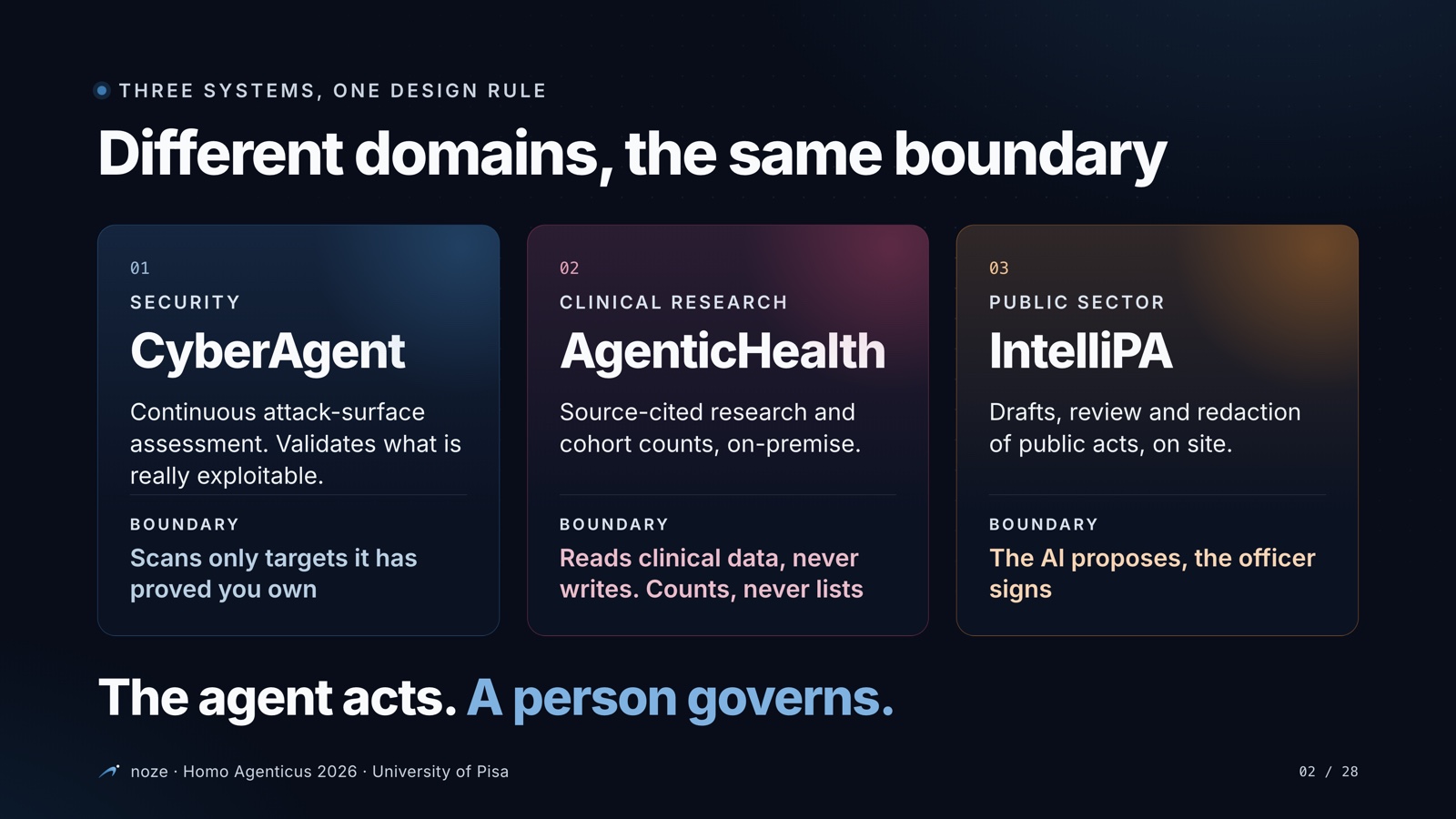
CyberAgent monitors the attack surface and uses automated pentesting to confirm what is really exploitable. Before any scan it proves control of the domain, so it only works on the customer’s own assets. The pipeline starts with reconnaissance and runs only the engines the target’s profile needs, out of thirteen available including Nmap, Nuclei, OpenVAS and ZAP. It ranks risks with CVSS, EPSS and CISA KEV and prepares evidence for NIS2, DORA and ISO/IEC 27001. Fixes remain the team’s decision. The case presented was 01 Sistemi, supporting the ISO/IEC 27001 cycle.
AgenticHealth brings source-cited research and counts on pseudonymised cohorts inside the healthcare provider. It reads clinical data in FHIR R4 without writing it, pseudonymises it before the model sees it and returns counts, never lists of patients. Real cohorts open only after the DPIA and while the study is active. It is not a medical device and does not support diagnosis or care decisions. The case presented was a trial starting with Meyer Children’s Hospital on paediatric short bowel syndrome.
IntelliPA drafts acts, passes them to the digital Reviewer and redacts personal data before publication, on a workstation installed in the organisation. The Reviewer proposes, the officer signs. It is in production at the Tenders and Contracts office of the Municipality of Sesto Fiorentino.
The governance layer
The three systems share the same governance layer. OISG (Open, Intelligent, Secure, Governed) is the architectural paradigm for autonomous AI systems proposed by Stefano Noferi: four pillars, each with a metric, and a 20-criteria adequacy test.
Admina is the open source framework that puts it into practice. Every model and tool call goes through a single pipeline: loop breaker, injection firewall, personal data redaction, policy, SHA-256 chained audit and OpenTelemetry tracing. Version 0.15.4 has been on PyPI since 2 November, under the Apache 2.0 licence, and it also runs offline.
Models, harness and hardware
The last part covered the open weight models available in November 2026, including GLM-5.2, DeepSeek V4 Flash, Qwen3.6, Nemotron 3.5, Mistral Large 4 and gpt-oss. The agent’s behaviour lives in the harness around them, that is, in the context the model sees, in the loop with its limits and in the graph of agents and tools: the model can be swapped when a better one comes out for the task. For local execution the reference hardware is NVIDIA DGX Spark, at the customer’s site or in a cluster.
We also showed the students Codendum, which uses a single NVIDIA GB10 to serve the coding agents of a whole class with an open weight model: up to 24 concurrent requests, with the code staying on the laptops and the prompts on the local network.
Two speeds
The close drew on Stefano Noferi’s essay “A two-speed world”. An agentic lane produces, merges, verifies and monitors; a human lane decides intent, reviews design and answers for results. Governing the first is the first job of the second, with three rules: boundaries come before capabilities, side effects are proposals and what is not measured is not governed.
Thanks to the academic committee, the industrial committee, the organising staff and the students who presented their projects.