
Clinical data stays in the organisation
On-premise or encrypted hybrid cloud deployment, with LLMs run locally. Clinical data does not leave the organisation’s perimeter: data control is in the architecture, not in a promise.
A clinical data platform built for the organisation's perimeter: local data, AI by the doctor's side and every interaction logged are part of the product.
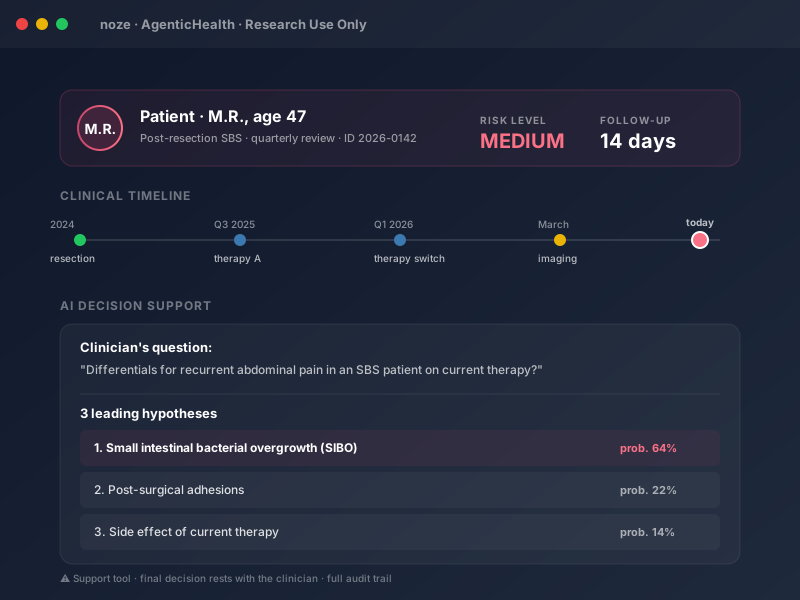
On-premise or encrypted hybrid cloud deployment, with LLMs run locally. Clinical data does not leave the organisation’s perimeter: data control is in the architecture, not in a promise.
AgenticHealth’s agents propose, document and cite sources. The diagnosis, the clinical decision and the signature stay with the doctor: human-in-the-loop and clinical accountability by design.
Full audit trail of every interaction: which document was retrieved, which source cited, what the model answered and who validated. Ready for clinical validation and the MDR pathway.
Diagnosis support is a Software as a Medical Device function: development follows the MDR pathway (Reg. EU 2017/745). The launch is in Research Use Only (RUO) mode, pre-CE.
Special-category health data processed under GDPR (arts. 9 and 28) and professional secrecy. Patient data is not used to train shared models.
EHR/HIS connectors and open standards: HL7 FHIR, DICOM, terminologies SNOMED CT, ICD-10 and LOINC. Data stays interoperable and traceable to its sources.
No. AgenticHealth is built for on-premise or encrypted hybrid cloud deployment, with LLMs run locally (including medical models). Clinical data stays inside the organisation’s perimeter: no calls out to external services.
No. It proposes differential diagnoses with the rationale and cited sources, as support. The diagnosis, the clinical decision and the signature stay with the doctor: it is designed human-in-the-loop, with clinical accountability held by the professional.
No. Patient data serves to answer on that patient’s case and to build their digital twin, not to train shared models. Processing under GDPR and professional secrecy.
Not yet. Diagnosis support is classifiable as Software as a Medical Device and development follows the MDR pathway (Reg. EU 2017/745). The launch is in Research Use Only (RUO) mode, pre-CE.
From your own data and documents: reports, lab results, discharge letters and imaging reports indexed via RAG (HL7 FHIR, DICOM, clinical PDFs), and from guidelines and literature for diagnosis support. Every answer links back to the sources it is drawn from.
Yes. EHR/HIS connectors and open standards (HL7 FHIR, DICOM) with SNOMED CT, ICD-10 and LOINC terminologies. Integrations are mapped to your case during activation.
Post-discharge follow-up uses AI-guided questionnaires and IoMT data, with alerts to the clinician on worsening parameters. The digital twin is a longitudinal patient model on which to simulate therapy scenarios and estimate outcomes, always as decision support.
With licences for healthcare facilities and research centres, tailored to facility, volumes and add-ons (digital twin, follow-up). Quote on request. We start from a conversation about your clinical and organisational case.