
The clinician opens several systems to reconstruct the picture: EHR, LIS, PACS, discharge letters. The information is there, but scattered, and every search is manual.
AgenticHealth
Clinical chatbot over FHIR and DICOM, diagnosis support with cited sources, remote follow-up and digital twin: clinical data stays in the organisation and AI works by the doctor's side.
Use case · Research Use Only (RUO)Today With AgenticHealth
Clinical chatbot over FHIR and DICOM
Query reports, labs and imaging in natural language, without the data leaving your perimeter.
No data leaves the perimeterlocal LLMs, RAG over your clinical data
AgenticHealth answers in natural language over the organisation’s clinical data, with the sources in view: every answer links back to the documents (report, lab result, imaging report) it is drawn from.
What it is
The patient history is fragmented across reports, lab results, discharge letters and imaging reports. AgenticHealth indexes these documents (HL7 FHIR, DICOM, clinical PDFs) and makes them queryable with open-weight LLMs run locally, including medical models.
References
Interoperability standards: HL7 FHIR, DICOM. Terminologies: SNOMED CT, ICD-10, LOINC. Open-weight models run locally (Llama, Mistral, Qwen, medical models). Status: Research Use Only (RUO), pre-CE.
What AgenticHealth surfaces
indexed reportslab resultsdischarge lettersimaging reports (DICOM)sources cited per answer
Use case · Research Use Only (RUO)Today With AgenticHealth
Diagnosis support with cited sources
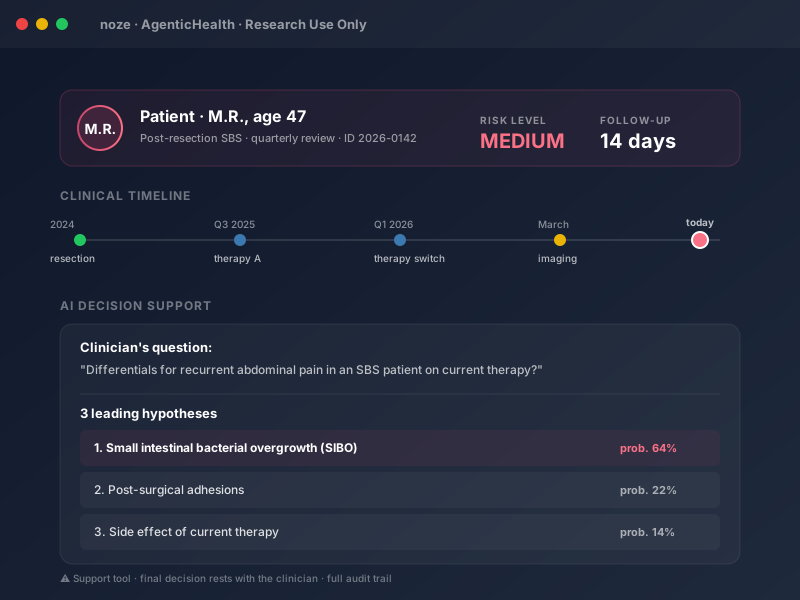
Differential diagnoses over guidelines and literature, with source citations. By the doctor’s side, never in their place.
SaMD pathway (MDR)development planned under Reg. (EU) 2017/745, today in RUO
The clinician cross-checks symptoms, tests and guidelines by hand. The literature is vast, and keeping up on every case takes time a ward often does not have.
AgenticHealth proposes a range of differential diagnoses with the rationale and cited sources. The doctor reads, verifies and decides: the hypothesis is a traceable starting point, not a verdict.
What it is
Diagnosis support proposes differential diagnoses from clinical guidelines and medical literature, backing each hypothesis with cited sources. It is a function classifiable as Software as a Medical Device (SaMD): its development follows the MDR pathway.
References
Regulatory framework: Reg. (EU) 2017/745 (MDR), Software as a Medical Device classification. Clinical terminologies: SNOMED CT, ICD-10, LOINC. Status: Research Use Only (RUO), pre-CE.
What AgenticHealth surfaces
differential diagnosesrationale per hypothesiscited sources (guidelines, literature)ICD-10 / SNOMED CT codingdecision left to the doctor
Use case · Research Use Only (RUO)Today With AgenticHealth
Remote follow-up and digital twin
Post-discharge monitoring and a longitudinal patient model to anticipate deterioration.
Alerts on worsening parametersAI-guided questionnaires and IoMT parameters under watch
Follow-up relies on phone calls and scheduled check-ups. Between one contact and the next, a deterioration in parameters can go unnoticed.
AgenticHealth collects questionnaires and IoMT data over time, flags worsening parameters with alerts to the clinician and uses the digital twin to compare therapy scenarios for the individual patient.
What it is
After discharge, the patient leaves the ward’s field of view. AgenticHealth keeps the follow-up going with AI-guided questionnaires and IoMT device integration, and builds a digital twin: a longitudinal digital model on which to simulate therapy scenarios and estimate outcomes.
References
IoMT integration and longitudinal data via HL7 FHIR. Simulation as support, not prescriptive: the clinical judgement stays with the doctor. Status: Research Use Only (RUO), pre-CE.
What AgenticHealth surfaces
AI-guided questionnairesdeterioration alertsIoMT data over timesimulated therapy scenariosoutcome estimation
AgenticHealth works by the doctor's side and keeps clinical data inside the organisation's perimeter. Clinical scope, integrations and MDR pathway are agreed on your case; the launch is in Research Use Only (RUO) mode, pre-CE.