
Article

Artificial Intelligence
On-premise AI architectures, local LLMs, RAG, autonomous agents. Intelligence you cannot afford to see switched off must be owned.
Explore →
Admina
Open Source AI governance: audit trail, PII redaction, bidirectional ALLOW/BLOCK/REDACT policies on any model, local or remote.
Explore Admina →
Research & Development
Applied research and prototyping, from AI to infrastructure, in collaboration with universities and research centres.
Explore →
Linux Services & Systems
Design, deployment and management of on-premise Linux infrastructure: from servers to AI hardware, with data that stays yours.
Explore →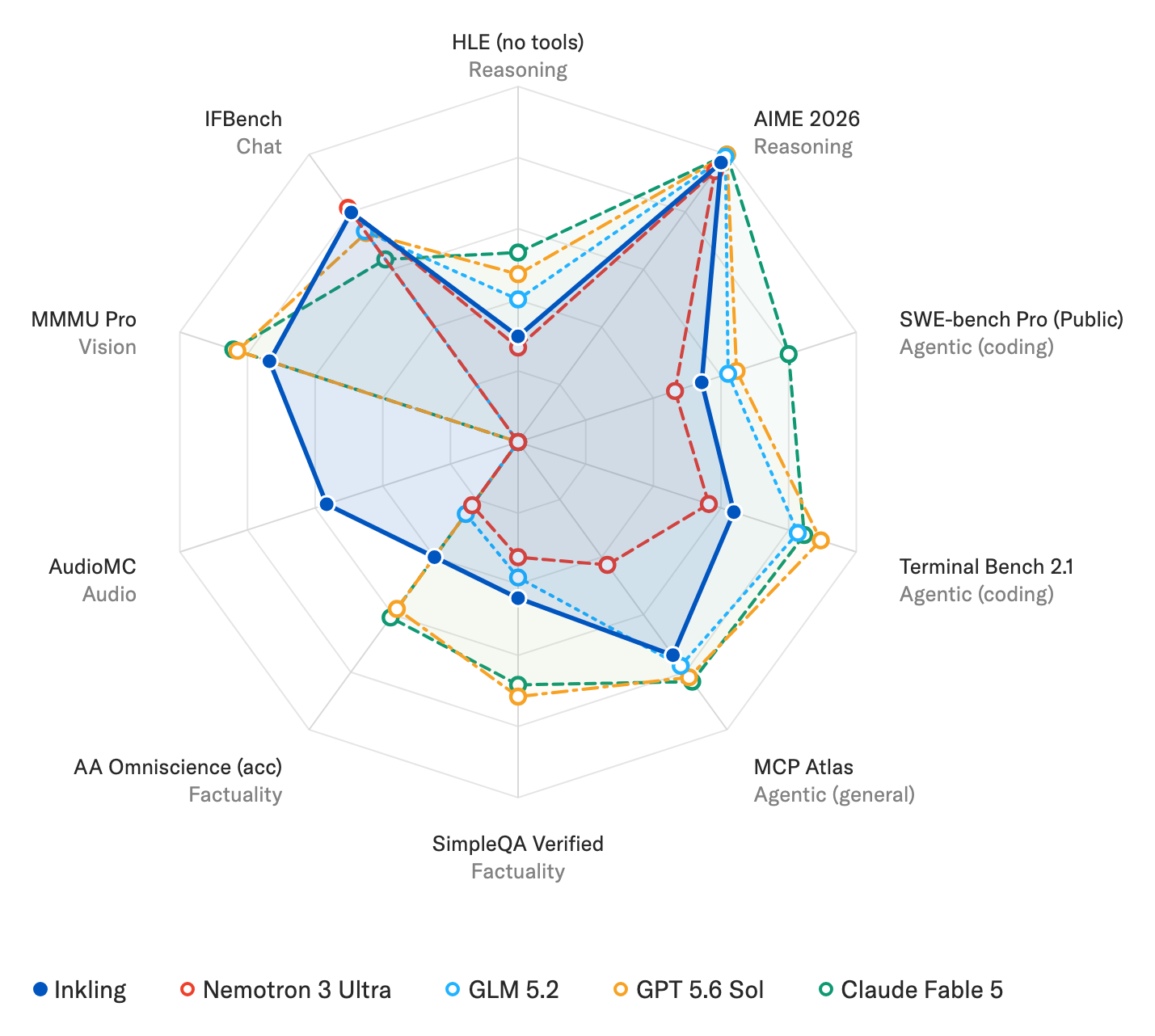
What Inkling is
Thinking Machines Lab, the lab founded by Mira Murati (former CTO of OpenAI), released its first model on 15 July 2026: Inkling. It is open-weights: the full weights are downloadable from Hugging Face and anyone can run and customise it, without seeing the training data or the source code.
The architecture is a Mixture of Experts with 975 billion total parameters, of which only about 41 billion are active per token, and a context window of 1 million tokens. It is natively multimodal: it reasons over text, images and audio in the same model, not through separate components bolted together. Pretraining ran on 45 trillion tokens of text, images, audio and video.
The bet: not the strongest, the most customisable
Thinking Machines is explicit: “Inkling is not the strongest overall model available today, open or closed.” The choice is deliberate. Instead of chasing the benchmark, the lab bets on a different set of qualities: multimodal capabilities, efficient thinking and availability on Tinker for fine-tuning. The stated goal is a good open-weights base to adapt to your own domain.
The chosen demonstration is telling: the model is fine-tuned to write as a lipogram, avoiding one letter entirely. The value is in how readily it bends to a specific task through post-training. It is the same logic as Ornith 1.0 and the open-weights line we have been tracking for a while, now applied to a model at nearly the trillion-parameter scale.
Under the hood
The architecture combines several recent design choices:
- MoE with 256 routed experts + 2 shared, 6 routed active per token, sigmoid routing with auxiliary-loss-free load balancing.
- Interleaved sliding-window and global attention at a 5:1 ratio, with 8 KV heads.
- Learned relative positional embeddings instead of RoPE, for better extrapolation to long sequences.
- Short convolutions after the key/value projections and on the residual branches.
- Hybrid optimisation: Muon for matrix weights, Adam for the other parameters.
- Encoder-free multimodality: dMel spectrograms for audio, 40×40 pixel patches for images.
Efficiency, agents and benchmarks
Two traits are designed for real use. The first is controllable thinking effort: you tune the compute budget case by case. According to Thinking Machines, to hit the same targets Inkling uses about one third of the tokens of comparable models like Nemotron 3 Ultra, which matters a great deal when the model runs on your own hardware and every token is a cost. The second is agentic tool use, trained across multiple coding and agent harnesses with randomised tool schemas, so it does not depend on a single implementation.
The benchmarks reported by the lab (at maximum effort, 0.99) are high: AIME 2026 at 97.1%, GPQA Diamond at 87.2%, SWE-Bench Verified at 77.6%, MMMU Pro at 73.5%, VoiceBench at 91.4%. Post-training uses large-scale asynchronous RL, over 30 million rollouts. One emergent effect stood out: the reasoning chains compressed on their own, dropping grammatical overhead while staying comprehensible, without being explicitly optimised for brevity.
Alongside the large model comes a preview of Inkling-Small, at 276 billion parameters (12 active), with near-parity performance on many benchmarks at lower latency and cost; its weights will be released after testing. The full weights are on Hugging Face, with an NVFP4 checkpoint for NVIDIA Blackwell systems, and inference is supported by SGLang, vLLM and llama.cpp, alongside the deployment partners. Fine-tuning goes through Tinker, the lab’s own customisation platform.
From the model you rent to the model you customise
This is where Inkling counts for those who work as we do. The most common path today is to rent intelligence from a handful of frontier labs: a generalist API, the same for everyone, that someone else governs and can change. Inkling proposes the opposite: weights you download, customise on your data and run wherever you want.
The pieces to walk that path already exist, and we have covered them one by one. Engines like colibri, which streams the experts of a huge MoE from disk, and DwarfStar 4 make models that used to need a cluster runnable locally; “AI on the desk” hardware like the NVIDIA GB10 workstations brings the power next to the data; open-weights models like GLM 5.2 give the frontier without dependencies. Inkling adds the fine-tuning piece: not just running a model, but verticalising it company by company, which is exactly how we think about products like DataGovern, configurable to the single case.
And the operational floor, once owned, has to be governed: Admina brings an audit trail and ALLOW/BLOCK/REDACT policies to any model, local or remote. That is the sense of Open Intelligence, Secure Governance: own the intelligence and keep control of it.
What we think
Inkling is interesting less for its place on the leaderboard than for the thesis it carries: a frontier model is worth more as a base to customise than as a generalist service to consume. It is the same thing we have been saying for a while, now stated by a new lab and backed by an open-weights model you can download today.
The limits are worth not hiding. The “official” fine-tuning goes through Tinker, the lab’s cloud platform; running a nearly trillion-parameter MoE in-house still needs serious hardware or streaming engines like colibri, with their speed trade-offs; and the Inkling-Small weights are not public yet. But the direction is the right one, and it is the one we work in: on-premise AI, customised on your data and governed, on Linux infrastructure that stays yours. That is, a model adapted to the company’s own data and constraints.