
Article
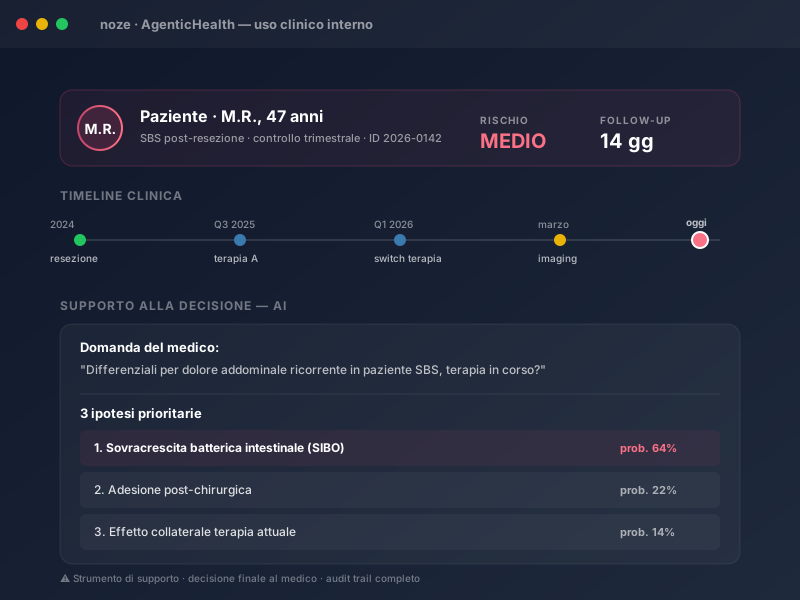
AgenticHealth
On-premise AI for clinical research: source-cited research, draft study and quality documents, data redaction. It is not medical software: it does not support diagnosis or patient-care decisions.
Discover AgenticHealth →
Digital Health
Medical software development compliant with CE and MDR regulatory standards. Clinical decision support systems, AI integration in clinical workflows.
Discover →A language for statistics, open
The R language — derived from the historic S of Bell Labs — was created in 1993 by Ross Ihaka and Robert Gentleman at the University of Auckland (New Zealand) as a free alternative to the main proprietary applied-statistics environments (S-PLUS, SAS, SPSS). Distributed by the R Core Team under the GNU General Public License, R reached the maturity of version 1.0 in February 2000; the current release 1.3.1 of August 2001 consolidates the language as a fully usable environment for productive statistical analysis.
The technical strengths are a functional language with vectors and dataframes as native types, a mature graphics system for publication-quality figures, integration with C and Fortran for compute kernels, and a central package archive — CRAN (Comprehensive R Archive Network) — distributing hundreds of extensions maintained by academic and industrial contributors.
From statistics to computational biology
R’s move from the statistical to the biomedical world has been swift. Recent molecular biology — in particular the spread of microarray platforms for gene expression — has produced high-dimensional datasets (thousands of variables, a few dozen or hundred samples) for which classical statistical tools were inadequate. The community has started developing dedicated R libraries: hybridisation artefact correction, inter-array normalisation, differential analysis, classification of clinical samples.
On this ground was born, in 2001, the Bioconductor project. Coordinated by Robert Gentleman — now at the Dana-Farber Cancer Institute and the Harvard School of Public Health — Bioconductor brings together in a single distribution infrastructure the R libraries dedicated to biological data analysis, with a community governance model, coordinated releases and rigorous quality standards for published packages.
The first official release (Bioconductor 1.0) is expected in spring 2002, accompanied by the publication of a project description in the peer-reviewed literature. Packages under development at this stage focus on:
- Biobase — common data structures to represent expression profiling experiments, with clinical metadata associated with samples
- affy — reading and normalisation of Affymetrix GeneChip platform data (CEL/CDF), RMA and background correction algorithms
- marray — support for two-colour (spotted) microarrays, common in oncology projects
- Genome annotation packages — mapping of probes to genes, links to UniGene, GenBank, LocusLink
The clinical context
Bioconductor users are, to a large extent, researchers in clinical oncology, medical genetics and immunology — disciplines in which differential gene-expression analysis is producing the first molecular patterns associated with tumour subtypes, treatment response and prognosis. The Alizadeh et al. work on diffuse large B-cell lymphoma published in 2000 is one of the early examples of molecular sub-typing driven by microarrays — analogous applications are multiplying on breast, colon, leukaemias.
R and Bioconductor enable this work at no licensing cost, with inspectable and reproducible code. The analysis → publication → package-release cycle becomes integral to a research group’s scientific output — an open science model different from that of proprietary software, where the analytical pipeline typically remains hidden.
R in broader healthcare
Beyond bioinformatics, R is increasingly used in other clinical domains:
- Classical biomedical statistics — clinical trials, survival analysis (Terry Therneau’s
survivalpackage), case-control studies, meta-analyses - Epidemiological biostatistics — generalised linear models, mixed-effects models (
nlme,lme4in development) - Laboratory data — quality control, time series, control charts
- Small-scale health informatics — clinical record extraction and transformation for retrospective studies
The adoption limit in regulated clinical settings (phase III clinical trials, regulatory filings for FDA/EMA) is still the preference for validated platforms like SAS — the question of R’s validation-readiness for regulatory use is an open sectoral discussion, with the R community working on dedicated packages and qualification documentation.
An ecosystem under construction
Bioconductor emerges in the same years as other Open Source projects for computational biology: BioPerl (started in the late 1990s, mature around 2001), BioJava (first release 2001), BioPython (development begun 2000). Together these projects compose an Open Source stack for bioinformatics alongside historically proprietary tools (GCG Wisconsin Package, Vector NTI, Genomatix).
The fact that R is written in a language dedicated to statistics — rather than being a library inside a general-purpose language — gives Bioconductor a specific advantage: the syntax of tests and statistical models is the domain-native one, not a late translation.
Outlook
Publication of Bioconductor 1.0 is expected in 2002. Developments in the following months will tell whether R becomes the reference analytical platform for clinical molecular data or remains an academic niche tool. The technical quality of early packages — in particular affy and the annotation infrastructure — and the consistency of Bioconductor governance are the main factors to watch.
For European biomedical research groups — including Italian ones — the project represents a significant option. It avoids often onerous commercial platform licences for single laboratories, gives access to the same techniques used by leading international groups, and contributes to building a reproducible analytical pipeline. Reproducibility, in quantitative clinical science, is a value growing measurably: recent publications are beginning to require code and data to be available as a condition for publication.
References: R Project for Statistical Computing (www.r-project.org), R 1.3.1 (August 2001). Bioconductor Project (www.bioconductor.org), announced 2001, first release expected in 2002. R Core Team, GNU GPL. CRAN — Comprehensive R Archive Network. Robert Gentleman (Dana-Farber Cancer Institute / Harvard School of Public Health) as Bioconductor coordinator.