
Article
How We Work
Innovation management, technology roadmaps, change management and agile methodologies: our natural way of bringing innovation.
Discover our method →
Research & Development
Quantum Computing, Blockchain, IoT & Industry 4.0, Robotics, Energy & Sustainability. Prototypes and proof-of-concepts to validate emerging technologies.
Discover our research areas →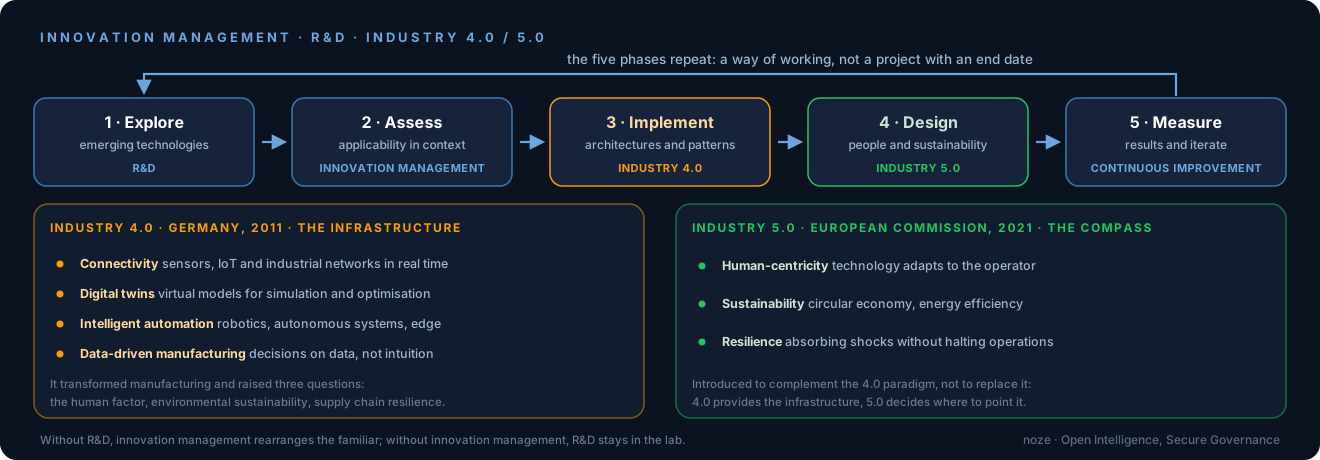
Innovation management: a discipline, not a service
The term innovation management gained traction in the 2000s to describe a set of practices — technology scouting, strategic roadmaps, organisational change management — that some companies had already been applying for years without giving it a name. The discipline formalises a process that goes from identifying relevant technologies to their concrete adoption, through impact assessment, planning and guiding people through the transition.
The key point is that innovation management is not a project with a beginning and an end: it is a way of working. Organisations that practise it continuously — not as a one-off initiative — develop a structural ability to absorb technological change and translate it into value.
The link with Research & Development
If innovation management is the how, Research & Development is the what. R&D generates knowledge: it explores emerging technologies, builds prototypes, validates technical hypotheses. Innovation management takes that knowledge and brings it into the organisational context — setting priorities, building roadmaps, managing adoption.
Without R&D, innovation management risks merely rearranging the familiar. Without innovation management, R&D risks producing results that stay in the lab. The two disciplines are complementary and, in the most effective organisations, operate in an integrated way.
Active research areas — from quantum computing to blockchain, from IoT to robotics, from renewable energy to climate monitoring — represent the pool from which innovation management draws to identify the technologies with the greatest potential impact for each specific context.
Industry 4.0: the connected factory
The Industry 4.0 paradigm, formalised in Germany in 2011 and adopted at the European level, describes the fourth industrial revolution: the integration of cyber-physical systems, IoT, cloud computing and analytics into manufacturing. The pillars are:
- Connectivity: sensors, IoT devices and industrial networks generating real-time data
- Digital twins: virtual models of physical processes for simulation and predictive optimisation
- Intelligent automation: advanced robotics, autonomous systems, edge computing
- Data-driven manufacturing: decisions based on data, not intuition
Industry 4.0 has transformed manufacturing, but it has also raised questions: the risk of marginalising the human factor, the environmental sustainability of increasingly intensive production, the resilience of interconnected supply chains.
Industry 5.0: putting people back at the centre
The European Commission introduced the concept of Industry 5.0 in 2021 to complement — not replace — the 4.0 paradigm with three pillars:
- Human-centricity: technology adapts to the operator, not the other way around. Cobots, intuitive interfaces, systems that augment human capabilities instead of replacing them
- Sustainability: circular economy, energy efficiency, environmental impact reduction as a design criterion, not a regulatory constraint
- Resilience: the ability to adapt to external shocks — pandemics, energy crises, supply chain disruptions — without losing operational capability
In practical terms, Industry 5.0 means designing robotic systems that collaborate with operators, developing sustainable energy technologies and building architectures that are resilient by design.
An integrated approach
The convergence of these elements — innovation management as a method, R&D as an exploration engine, Industry 4.0 as technological infrastructure, Industry 5.0 as a value compass — defines an integrated approach to technological transformation:
- Explore emerging technologies with scientific rigour (R&D)
- Assess their applicability in the specific context (innovation management)
- Implement using Industry 4.0 architectures and patterns (IoT, digital twins, automation)
- Design with people, sustainability and resilience at the centre (Industry 5.0)
- Measure results and iterate (continuous improvement)
It is the way we work every day with our clients and partners. Innovation management is embedded in how we work, and R&D is one of our active areas of expertise.
The approach described in this article reflects the way noze works. To learn more: How We Work and Research & Development.