
Article

A number, not a revolution
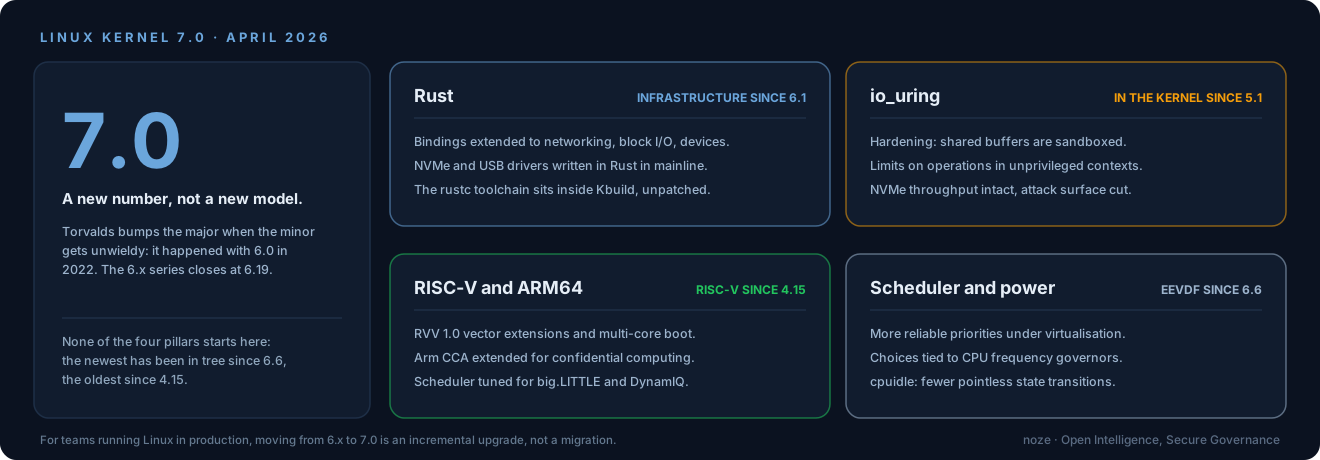
Linus Torvalds announced the move to version 7.0 of the Linux kernel with his customary pragmatism: when the minor version becomes unwieldy, the major increments. It happened with the jump from 5.x to 6.0 in 2022, and it happens again now. There is no single feature that justifies the version bump — there is the sum of four years of continuous development across the 6.x series.
Rust: from experimentation to production drivers
Rust support, introduced as experimental infrastructure in kernel 6.1, has reached operational maturity. The bindings to the kernel’s C APIs have been extended to cover networking, block I/O and device management subsystems. Several drivers — including NVMe drivers and USB device drivers — have been written or rewritten in Rust and accepted into the mainline tree.
The approach remains the one stated from the beginning: existing C code is not rewritten, but new drivers can be developed in Rust with compile-time memory safety guarantees. The number of Rust contributors in the kernel has grown steadily, and the rustc toolchain has been integrated into the Kbuild system without requiring external patches.
io_uring: maturation and hardening
io_uring, the asynchronous I/O subsystem introduced in kernel 5.1, has gone through a significant maturation cycle. The early releases were optimised for performance at the expense of attack surface — io_uring was responsible for several critical vulnerabilities in the 5.x and 6.x series.
In the 7.0 cycle the subsystem has undergone systematic hardening: sandboxing of shared buffers, restrictions on operations allowed in unprivileged contexts, and formal audit of allocation paths. The result is an interface that retains the performance advantages — throughput close to hardware limits on NVMe — with a reduced attack surface.
Architectures: RISC-V and ARM64
RISC-V support has moved from emerging architecture status to a first-class platform. Kernel 7.0 includes support for RISC-V vector extensions (RVV 1.0), booting on multi-core RISC-V hardware, and integration with the main commercially available SoCs.
ARM64 continues to receive optimisations for server and cloud workloads. Support for Confidential Computing on ARM (CCA — Arm Confidential Compute Architecture) has been extended, and critical scheduler paths have been optimised for big.LITTLE and DynamIQ topologies.
Scheduler and energy efficiency
EEVDF (Earliest Eligible Virtual Deadline First), the scheduler introduced in kernel 6.6 as a replacement for CFS, has received further refinements. Priority handling in virtualised environments has been improved, and integration with CPU frequency governors enables more energy-aware scheduling decisions.
For mobile devices and energy-constrained servers, kernel 7.0 introduces improvements to the cpuidle subsystem that reduce unnecessary state transitions, with measurable benefits on idle power consumption.
What this means in practice
Linux 7.0 does not introduce a new paradigm. It consolidates directions already traced: Rust for the safety of new code, io_uring for high-performance I/O, RISC-V as a first-class architecture, and finer-grained energy management. For those managing Linux infrastructure in production, the move from the 6.x series to 7.0 is an incremental upgrade — not a migration.