
Contents
Article

Cybersecurity
CISO-as-a-service consulting: posture, remediation roadmap, ongoing support.
Discover →
Linux Services & Systems
Domains, hosting, PEC, email infrastructure, network services and Linux systems. Open Source infrastructure support and management.
Discover →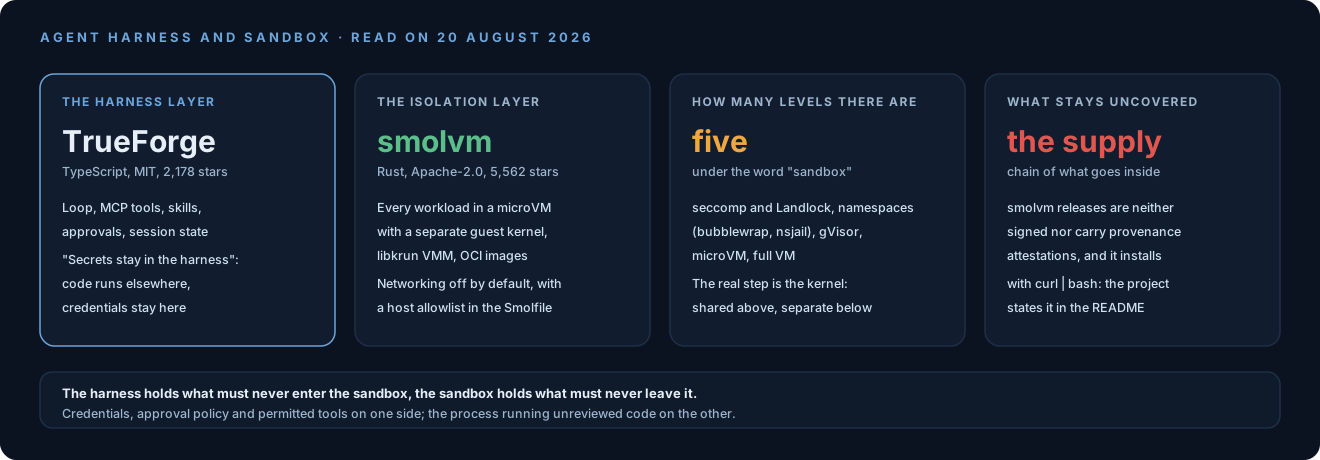
An agent working on its own touches two layers that need designing separately. Above sits the harness, which holds the loop, the tools, the secrets and the approvals, and which we wrote about in harness engineering. Below sits confinement, meaning where the code actually runs.
TrueForge works on the harness, smolvm on confinement.
TrueForge, the harness
TrueForge comes from TrueFoundry, in TypeScript, MIT licence, repository opened on 23 July 2026, with 2,178 stars as read on 20 August. It describes itself as “the open-source agent harness - the runtime layer that turns an LLM into a working agent”.
What it holds is in the list: model calls, MCP tools, skills, sandboxing, approvals, context management and session state. It exposes a chat UI, an HTTP API with a TypeScript SDK and an embeddable UI SDK.
Human checkpoints sit in the harness execution loop: tool approval, ask-user-questions and generative UI inside the chat. Asking for confirmation before an irreversible action is easier to sustain when the loop provides for it.
The sandbox is a tool, provisioned only when needed, and the provider today is Daytona. On the same line the README says “Secrets stay in the harness”: code runs elsewhere, credentials remain in the layer that decides.
Configuration starts from YAML catalogs for models, MCP servers, skills and sandbox. A declared list of what an agent may use is also the list to review in an audit.
The rest is context engineering, with subagents, deferred tool loading, offloading of large results and compaction, plus two operating modes: local single process with SQLite, or Postgres and Redis through Docker Compose or Helm.
smolvm, the microVMs
smolvm is in Rust, Apache-2.0 licence, repository opened on 18 December 2025, with 5,562 stars on 20 August. The README opens with “Ship and run software with isolation by default”.
Every workload runs in a VM with a separate guest kernel, on Hypervisor.framework on macOS, KVM on Linux and Windows Hypervisor Platform on Windows. The VMM is libkrun and the guest kernel comes from libkrunfw. Images are OCI, so any image on Docker Hub or ghcr.io boots without a Docker daemon.
Defaults are 4 vCPUs and 8 GiB of RAM, with elastic memory through a virtio balloon: the host commits what the guest actually uses and reclaims the rest. vCPU threads sleep in the hypervisor while idle.
The machine is declared in a Smolfile in TOML, with image, resources, mounts, ports and setup commands.
Networking is off by default, and when switched on there is an explicit allowlist:
[network]
allow_hosts = ["api.stripe.com", "pypi.org"]
For an agent running code a model just generated, the allowlist decides which hosts that code can reach, and having it declared in a file that lives in the repository makes it reviewable like any other configuration.
Unknown keys are rejected rather than ignored: a typo makes machine creation fail instead of staying silent until runtime.
Then there is the snapshot: a machine configured by hand can be packed into a .smolmachine file and pushed to an OCI registry, with no Dockerfile to write.
The isolation levels
The word sandbox covers very different things. Ordered by how much they isolate, and by what they cost.
| Level | Tools | What it separates |
|---|---|---|
| System filter | seccomp-bpf, Landlock | seccomp-bpf filters syscalls, Landlock limits path and network access, shared kernel |
| Namespaces | bubblewrap, nsjail | Isolates filesystem, network and PID views, shared kernel |
| Application kernel | gVisor | Intercepts syscalls in userspace |
| microVM | libkrun, Firecracker, microsandbox | Separate guest kernel, hardware boundary |
| Container runtime on VMs | Kata Containers | Containers and pods in lightweight VMs, on QEMU, Cloud Hypervisor, Firecracker or Dragonball |
On the gVisor row the project README states, under What isn’t gVisor?: “gVisor is not a syscall filter (e.g. seccomp-bpf), nor a wrapper over Linux isolation primitives (e.g. firejail, AppArmor, etc.)”. It is an application kernel written in Go running in userspace and implementing the Linux interface, so the host kernel sees only what gVisor passes it.
The real step sits between the third and fourth rows. Above, an escape aims at the host kernel, which is shared. Below, the guest has its own kernel and reaching the host means going through the hypervisor. It is the same reasoning behind AWS building Firecracker, today at 36,165 stars, to run different customers’ code on the same machine.
For agents the choice narrows quickly. An agent that compiles, installs packages and launches processes needs a wide Linux surface, and over that surface system filters alone leave too much uncovered. microVMs cost more in memory and startup, and in exchange they move the boundary onto a much narrower surface.
Among managed services, E2B is Apache-2.0 with 13,486 stars and was built as a cloud sandbox for agents, while Daytona, the one TrueForge uses today, sits at 71,955.
The smolvm security model
The smolvm README carries a Security Model section that lists the limits the project declares.
The CLI and the VMM processes run with the permissions of the invoking user, and that account, the host, the hypervisor, libkrun and smolvm itself sit in the trusted computing base. Directories passed with --volume are exposed to the guest on purpose, and the project warns against mounting secrets there. SSH agent forwarding does not copy private keys into the guest, but it lets the guest request signatures while the VM is alive.
There is also a point about distribution: release archives publish SHA-256 checksums and the installer rejects a mismatch when the checksum file is available, but at present releases are neither signed nor accompanied by provenance attestations, and the installer proceeds if the checksum file cannot be downloaded. The recommended installation is a curl | bash, so anyone bringing smolvm into a working environment downloads the binary from releases and verifies the checksum by hand.
The split between the two layers
The division of labour these two projects suggest is clean, and it holds when the tools change.
The harness holds what must never enter the sandbox: credentials, approval policy, the list of permitted tools, session history. The sandbox holds what must never leave: the process running unreviewed code, the filesystem it writes to, and its network.
The boundary between them is the surface to design, and drawing it raises the same question we asked looking at DeepSeek Harness, where plugins arrive from a GitHub reference resolved by pnpm, with no registry, signing or allowlist documented, and in security and governance of the agentic loop.
What we think
Writing “sandbox” in a requirement does not say which level of isolation is in use, and the five in the table differ in what an escape has to get through: the syscalls left permitted on a shared kernel, or the hypervisor beneath a separate guest kernel.
The practical criterion we take from this is to start from what the agent runs. If it only runs tools you wrote yourself, namespace confinement with an egress allowlist already covers a lot. If it runs code the model has just generated, or packages pulled from a public registry, the shared kernel becomes the weak point and the microVM is the right level.
On networking the rule is to deny by default and declare destinations in a versioned file. An agent able to resolve any host has an exfiltration channel, however isolated its filesystem is.
And the part neither layer solves is the supply chain of what gets put inside them. A binary installed with curl | bash from unsigned releases, or a plugin resolved from a repository reference, enters the trusted base before the sandbox even starts.