
Contents
Article
AgenticHealth
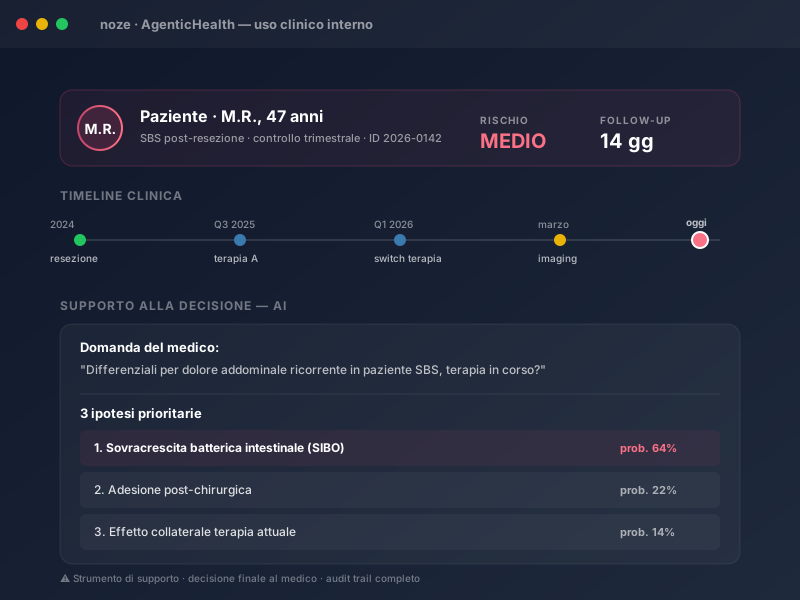
On-premise AI for clinical research: source-cited research, draft study and quality documents, data redaction. Research Use Only (RUO): it is not a medical device and does not support decisions on patient care; MDR pathway planned.
Discover AgenticHealth →
Digital Health
Medical software development compliant with CE and MDR. Technical support for European SaMD certification, risk management, IEC 62304 validation.
Discover →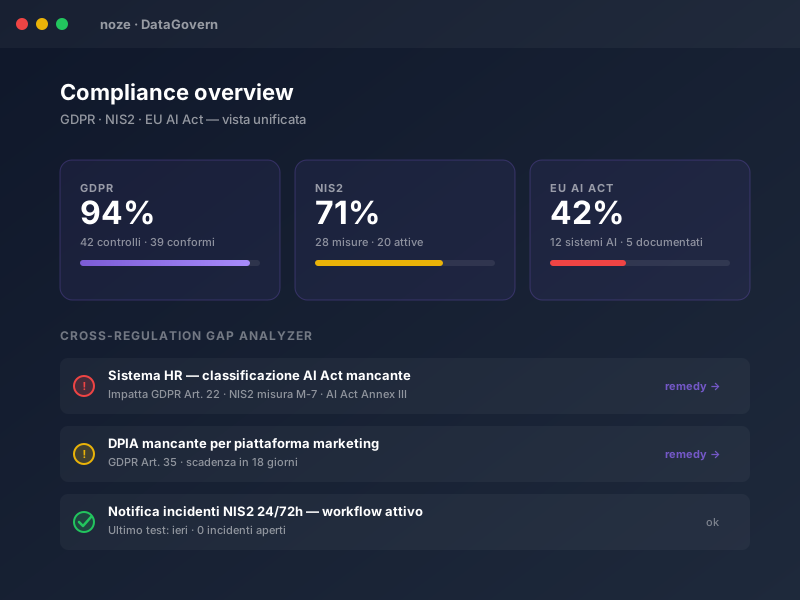
DataGovern
Integrated compliance platform for GDPR + NIS2 + EU AI Act. Cross-Regulation Gap analysis, board-ready dashboard, fully on-premise.
Discover DataGovern →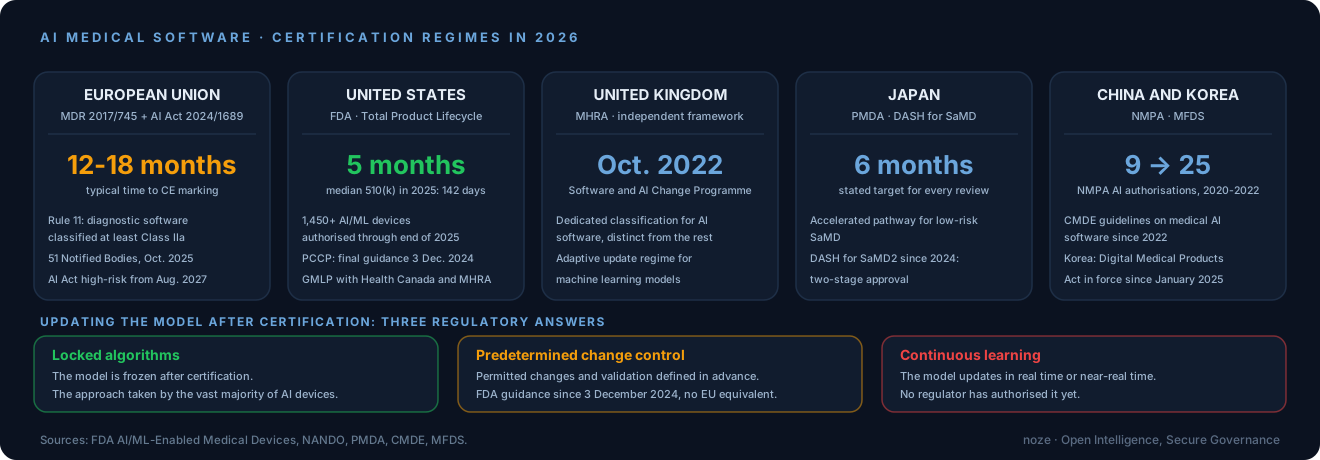
A market accelerating, a regulatory framework catching up
The number of artificial intelligence-based medical devices authorised for the market is growing exponentially. The US FDA has authorised over 1,450 AI/ML-enabled devices through the end of 2025, with a marked acceleration in recent years: from 91 in 2022 to 221 in 2023, to 253 in 2024 and 295 in 2025. Radiology remains the dominant domain (76% of cumulative authorisations, declining slightly from 80% in 2023 to 73% in 2024), followed by cardiology, ophthalmology and digital pathology.
In Europe, the picture is more fragmented. MDR Regulation 2017/745, fully applicable since May 2021, raised requirements for all medical devices — but was not designed for a market where software evolves on update cycles incompatible with traditional certification timelines. The result is a regulatory bottleneck: the time to obtain CE marking for a SaMD with AI components typically ranges between 12 and 18 months, compared to a median of approximately 5 months for an FDA 510(k) device.
The main regulatory frameworks
FDA — United States
The FDA has adopted a pragmatic approach with the Total Product Lifecycle (TPLC) and the AI/ML-Based SaMD Action Plan (2021). Key points:
- Predetermined Change Control Plan (PCCP): allows manufacturers to define in advance the expected algorithmic modifications, avoiding a new regulatory submission for every model update. The final guidance was published on 3 December 2024
- Good Machine Learning Practice (GMLP): ten guiding principles jointly developed with Health Canada and MHRA in October 2021, consolidated into the final IMDRF document in January 2025
- Continuous performance monitoring: the FDA is moving towards a real-time surveillance model for post-market AI device performance
MDR — European Union
The MDR Regulation imposes structural requirements that interact with AI in complex ways:
- Rule 11 classifies diagnostic software at least as Class IIa, with direct implications for every AI-based SaMD that provides information for clinical decisions
- The EU AI Act (Regulation 2024/1689) classifies AI medical devices as high-risk systems under Article 6(1) and Annex I, which lists the MDR among covered product legislation. For devices of Class IIa and above subject to conformity assessment by a Notified Body, the AI Act high-risk requirements apply from August 2027
- The MDR + AI Act overlap creates a dual compliance regime that companies must navigate simultaneously — with documentation, risk management and post-market surveillance requirements that stack rather than replace each other
- The number of Notified Bodies designated under MDR has grown to 51 (October 2025, source: NANDO), a significant improvement over the early transition years but still insufficient to handle the growing volume of applications
MHRA — United Kingdom
Post-Brexit, the Medicines and Healthcare products Regulatory Agency is building an independent framework. The Software and AI as a Medical Device Change Programme, published in October 2022, includes:
- A specific classification for AI software, distinct from general device classification
- An adaptive update regime for machine learning models
- Alignment with the GMLP principles shared with FDA and Health Canada
Asia-Pacific
- Japan (PMDA): the DASH for SaMD programme (Digital Transformation Action Strategies in Healthcare for SaMD) enables accelerated approvals for low-risk SaMD, aiming to complete all reviews within six months. In 2024 the PMDA launched DASH for SaMD2, which includes a two-stage approval system for AI devices with post-market updates
- China (NMPA): specific guidelines for medical AI software published in 2022 (CMDE, Artificial Intelligence Medical Device Technical Review Guideline). The number of AI authorisations is growing steadily: from 9 in 2020 to 13 in 2021 and 25 in 2022, with an acceleration in subsequent years
- South Korea (MFDS): among the first regulators to introduce a dedicated pathway for AI SaMD, with specific guidelines for big data and artificial intelligence. The Digital Medical Products Act entered into force in January 2025, and the MFDS published guidelines for the approval of medical devices based on generative AI
The adaptive AI challenge
The central issue is the very nature of machine learning: the most advanced models — particularly those based on deep learning — can be designed to update with new data, improving performance over time. This is a clinical advantage but a regulatory problem: a device that changes after certification is, formally, a different device.
Regulatory responses focus on three approaches:
- Locked algorithms: the model is frozen after certification. Every update requires a new submission. This is the most conservative approach and the one adopted by the vast majority of currently authorised AI devices
- Predetermined change control: the manufacturer defines in advance the types of permitted modifications (retraining on new data, weight updates, extension to new populations) and validation conditions. The FDA formalised this approach with the December 2024 PCCP guidance; the EU does not yet have an equivalent guidance
- Continuous learning: the model updates in real time or near-real time. No regulator has yet authorised this approach for medical devices, although academic research and regulatory sandboxes are actively exploring it
Numbers and trends
- 1,450+ AI/ML devices authorised by the FDA through the end of 2025, up from approximately 690 cumulative through the end of 2023 — the rate of new authorisations more than tripled between 2022 and 2025
- 12-18 months typical range for CE marking of an AI SaMD in Europe, versus a median of approximately 5 months (142 days) for an FDA 510(k) in 2025
- 76% of cumulative FDA AI authorisations concentrated in radiology, but cardiology and digital pathology are growing rapidly
- 51 Notified Bodies designated under MDR as of October 2025 (source: NANDO), growing but still under pressure from application volumes
- The global AI in healthcare market is estimated at USD 36.7 billion in 2025 (Grand View Research), with a CAGR of 38.9% through 2033 — the software segment accounts for over 46% of the total
- 62% of FDA-authorised AI devices in 2025 are classified as SaMD, and 63% have a diagnostic intended use
What this means for medical software developers
The growing adoption of AI in medical software is pushing regulators to adapt their frameworks, but at different speeds and with different approaches. For companies developing SaMD, the operational implications are concrete:
- Regulatory strategy must be defined at the design stage, not after development is complete — choosing the target market determines system architecture, documentation and timelines
- In Europe, the MDR + AI Act convergence imposes integrated compliance management requiring both regulatory and technical expertise — with staggered deadlines (MDR already in force, AI Act for medical devices from August 2027)
- Locked algorithms remain the safest route for certification, but limit the clinical potential of adaptive AI — the predetermined change control plan is the emerging compromise
- Medical device cybersecurity is an explicit requirement across all jurisdictions — information security risk management is an integral part of device risk management
- Post-market surveillance for AI devices requires specific performance metrics: drift detection, bias monitoring, performance across subpopulations
noze integrates machine learning, cybersecurity and regulatory compliance expertise within a single team — the same combination that enabled the Class I certification for SleepActa and that today applies to the design of AgenticHealth with a planned MDR pathway.
Sources: FDA AI/ML-Enabled Medical Devices (database updated through 2025), Regulation (EU) 2017/745, Regulation (EU) 2024/1689 (AI Act), FDA PCCP Final Guidance 3 December 2024, IMDRF GMLP Final Document January 2025, NANDO — Notified Bodies database, Grand View Research AI in Healthcare Report 2025.