
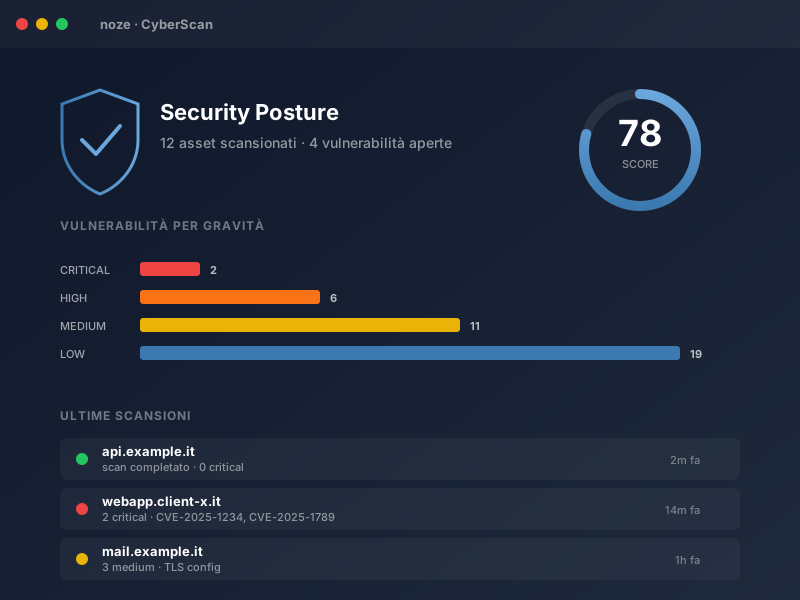
CyberScan
Vulnerability assessment and automated pentest. Continuous asset discovery, AI risk prioritisation, integrated NIS2 compliance manager.
Discover CyberScan →
Cyber Security
CISO-as-a-service consulting: posture, remediation roadmap, ongoing support.
Discover →“The operating system is a database”
In 2014 Mike Arpaia and Teddy Reed, in Facebook’s Security Infrastructure team, release osquery: a tool that exposes the operating system state as a SQL database. Virtual tables represent processes, users, network connections, file system, kernel configuration, installed packages.
A query like:
SELECT pid, name, path FROM processes WHERE on_disk = 0;returns running processes whose on-disk image no longer exists (a classic indicator of in-memory malware).
The open-source release happens on 29 October 2014 under Apache 2.0 licence (originally BSD-3; the project later moved to Apache 2.0). osquery supports Linux, macOS, Windows, FreeBSD.
From Facebook team to Linux Foundation
In 2019 Facebook hands osquery governance to the Linux Foundation under Linux Foundation Projects, with open steering committee and distributed maintainers. This transition removes single-vendor dependency risk.
Architecture
Two main components:
- osqueryi — interactive REPL for ad hoc queries
- osqueryd — daemon scheduling queries on defined packs (periodic queries, e.g. every 60s) and emitting JSON log results
Logs can be sent to local file, syslog, TLS endpoint, Kafka, Kinesis, AWS Firehose via logger plugins.
Security-relevant tables
processes,process_events— process auditingusers,logged_in_users,last— user and session managementfile_events,yara_events— integrity monitoring with integrated YARAlistening_ports,process_open_sockets— network posturecrontab,launchd,systemd_units— persistencekernel_modules,kernel_extensions— rootkit detectionosquery_info,osquery_extensions— self-monitoring
Query packs and ATT&CK
Query packs are collections of queries targeted at a purpose (CIS compliance, ATT&CK detection, vulnerability management). Reference public packs: Facebook Threat Hunting, Palantir osquery-configuration, BSidesLV pack.
Fleet management
For fleets beyond a handful of machines, osquery needs a controller:
- Kolide Fleet (later Fleet by Fleet DM) — open source, dashboard for querying thousands of endpoints
- osctrl, Doorman, Zentral — open alternatives
- Uptycs, Kolide K2 — commercial, osquery-based
Integration with SIEM and SOAR
osquery integrates naturally with SIEMs (Elastic Agent includes an osquery beats, Splunk has TA-osquery, Sentinel receives logs via TLS logger) and with SOAR playbooks (hunt an IoC across the whole fleet in seconds).
In the Italian context
osquery is used in:
- Companies with heterogeneous IT — Linux/macOS/Windows unified via SQL
- DevSecOps — compliance automation, drift detection
- University Blue teams — threat hunting teaching
- MSSPs — EDR-lite on endpoints without budget for commercial agents
The simplicity of the SQL model, cross-platform support and neutral governance make it a stable tool in open source endpoint visibility strategies.
References: osquery, open source release 29 October 2014 from Facebook (Mike Arpaia, Teddy Reed). Apache 2.0 licence. Governance handed to Linux Foundation in 2019. Supports Linux, macOS, Windows, FreeBSD. Fleet (Fleet DM) as open controller. Site: https://osquery.io.