
Article

Confirming an approach
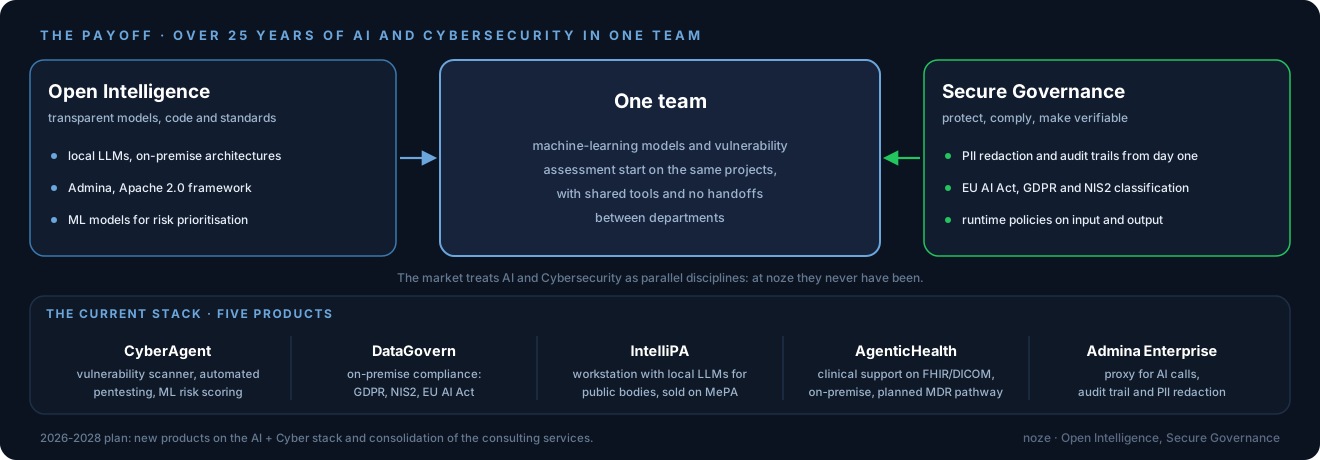
Open Intelligence, Secure Governance is the decision to give a name to what noze has been doing for over twenty-five years. Not a new positioning, but the choice to communicate it clearly — because an identity built over time deserves to be told.
Two principles that have always been inseparable at noze: open intelligence — built on transparent models, code and standards — and secure governance — designed from the outset to protect, comply and make every system verifiable.
One multidisciplinary team, not two departments
Today the market treats AI and Cybersecurity as parallel disciplines: AI teams try to bolt on security after the fact; security teams try to integrate AI as an accelerator. At noze the two competences have never been separated.
The reason is organisational: the people who design machine-learning models and the people who analyse vulnerabilities and configure pentests are used to working together — on-site and remotely — on the same projects, with shared tools and no handoffs between departments. In practice:
- Every model is designed with PII redaction, audit trails and access policies from the first prototype — not as a layer added after deployment.
- Vulnerability assessment uses risk-prioritisation models, not just static rules. The compliance engine automatically classifies AI systems under the EU AI Act.
- Governance policies apply in real time to both AI output and user input — ALLOW, BLOCK, REDACT.
Where the products come from
On-premise architectures with local LLMs grew out of years of work on clinical data that could not leave the hospital perimeter. The AI risk classifier is the direct result of compliance projects already under way with clients. Continuous vulnerability monitoring consolidated while addressing concrete needs of SMEs and public bodies.
The tools came out of a daily practice of working on AI and security, and reached maturity as regulation and the market made them necessary.
The current stack
Five products, each with a specific technical scope:
- CyberAgent — vulnerability scanner with continuous asset discovery, automated pentesting and ML-based risk prioritisation. Output: technical reports, CVSS scoring, remediation plans.
- DataGovern — on-premise compliance platform. Covers GDPR (processing register, DPIA, automated DSARs), NIS2 (gap analysis, remediation plan) and EU AI Act (AI risk classification, technical documentation). Data stays inside the organisation’s perimeter.
- IntelliPA — workstation with local LLMs for Public Administration. RAG over internal documents, chatbot over the entity’s regulations, no data transmitted to external services. MePA-purchasable.
- AgenticHealth — on-premise AI for clinical research: source-cited research, draft study and quality documents, data redaction. Research Use Only (RUO): it is not a medical device and does not support decisions on patient care; MDR pathway planned. Developed with experience from the Meyer and CNR projects.
- Admina Enterprise — enterprise version of the Open Source Admina framework (Apache 2.0). Proxy for AI calls with audit trail, PII redaction and bidirectional policies. Written in Python and Rust.
Strategic plan 2026–2028
The three-year plan includes the development of new products extending the AI + Cyber stack and the consolidation of existing consulting services — CISO-as-a-service, cloud-native architectures, AI governance, applied R&D — within the same positioning.