
Connect and verify targets
Add domains, IPs and web apps. Before it starts, the agent verifies domain control via DNS record or file, like Search Console or an SSL certificate.
From verified targets to evidence in 5 steps. CyberAgent watches the surface and validates the risks; the decision on what to fix stays with your team.
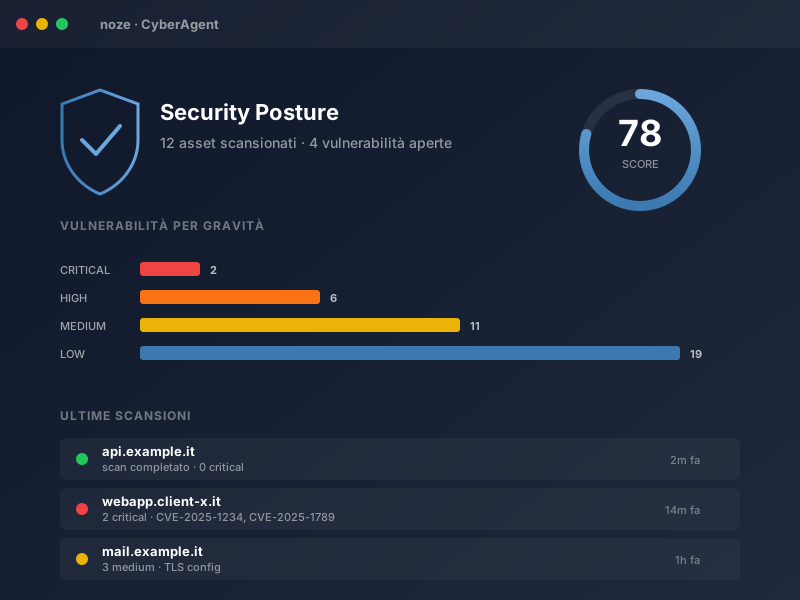
Add domains, IPs and web apps. Before it starts, the agent verifies domain control via DNS record or file, like Search Console or an SSL certificate.
Automatic asset discovery and continuous vulnerability assessment across network, web apps and APIs, with a real-time CVE database.
Correlates vulnerabilities with EPSS and CISA KEV and uses automated pentest to confirm what is actually exploitable in your environment.
AI triage ranks risks by real business impact, with alerts via email, Slack or webhook when something exploitable surfaces.
NIS2, DORA and ISO 27001 reports and checklists ready for board and auditors. The agent prepares the work: the decision on what and when to fix stays with your team.
Each part of the agent has a job: discover assets, scan, correlate vulnerabilities with EPSS and CISA KEV, validate exploitability with automated pentest, prioritize and prepare the evidence. Findings come from real scans and validated exploitation, not from a model's guess. The output is a prioritized, evidence-backed list of risks, not a text answer to copy.
Before flagging a risk as critical, the automated pentest verifies its real exploitability. Less noise, more signal.
Correlation with EPSS and CISA KEV reflects the exploitation probability observed in the field, not just the theoretical CVSS score.
Asset reachability and business impact factor into priority: an unexposed “critical” weighs less than a reachable “medium”.
Scans run only on domains you have proven you control. It is a product constraint, not an option to remember.
| Approach | What it does | Coverage | Limit |
|---|---|---|---|
| Periodic scan / one-off VA | Snapshot of the surface | At intervals | Blind between scans, priority by CVSS only |
| External red team | Deep, point-in-time test | Once or twice a year | Costly, not continuous, hard to repeat between engagements |
| Generic CVE scanner | List of CVEs | On-demand | No exploitability validation, high noise, no compliance evidence |
| Security chatbot | Helps analyse or write text | On-demand | No connectors to assets, no real scanning, no audit trail |
| CyberAgent | AI agent: watches, validates, prioritizes, prepares evidence | Continuous | Requires domain-control verification |