
The project
RI.P.E.G. is an industrial-research and experimental-development project funded by the POR FESR 2007–2013 programme (Tuscany Region, POR CREO, PRSE Action 1.1). The goal: build an innovative portable system for real-time monitoring of urban air pollution.
What it measures
- Ultrafine particulate (PM)
- Ozone (O₃)
- Carbon monoxide (CO)
- Nitrogen oxides (NOx)
The innovation
The system integrates innovative sensors mounted on mobile vehicles, collecting measurements while moving and streaming data in real time to a central server via GPS, UMTS, WiFi or WiMAX. Data is archived and processed for geographic air-quality monitoring.
The consortium
Three Tuscan SMEs developed the project together: Alitec Srl, noze Srl and SICE Telecomunicazioni Srl.
noze’s role
noze’s contribution to RIPEG was wide-ranging and spanned the whole project life cycle, with Stefano Noferi as software architect of the system.
Ideation, design and overall architecture
From the very early stages noze took part in the ideation of the system and in the design of the overall architecture, working with all consortium partners — Alitec on the sensors, SICE Telecomunicazioni on networking — to define specifications and integration points between the hardware and software layers. Stefano Noferi designed the architecture of the whole RIPEG system.
In parallel, noze ran the project website (ripeg.it, still online today) and the consortium’s collaboration platform.
The four components of the Control Panel
noze built the four software components that together make up the RIPEG Control Panel, presented by Stefano Noferi at the project’s final conference on 30 March 2012:
-
RIPEG Server — an extensible and reliable data-acquisition server that supports the main IoT protocols of the time and is also able to work in ACK-less mode — essential for handling the intermittent mobile connections of the sensor-equipped vehicles. Multi-backend, multi-database, independent of Manager and Status Viewport.
-
RIPEG Manager — multi-channel (web and mobile), multi-user back-office for full system configuration via web. Self-configuring access levels, a single unified entry point.
-
RIPEG Status Viewport — real-time monitoring interface with a visual, intuitive approach, self-configuring per user, fully HTML5, easy to install on touch systems and navigable in note mode. Displays sensor data on Google Maps (particulate, ozone, CO, NO/NO₂, SO₂, temperature, humidity) with gauge-style indicators for each measurement.
-
RIPEG GeoBI / OpenDataBI — a geographic business-intelligence tool for complex analysis, with Google Maps and GIS support, linking of data both internal and external to the institution, and Linked Open Data support (Gov.it, ISTAT datasets). Designed as a decision-support tool for public administrations: traffic-routing changes, installation of monuments / exhibitions / events, ZTL and pedestrian-area management, eco-day planning, design of cycle paths and green areas.
The two sensor types in production
During the trials, the Status Viewport handled two complementary types of sensors:
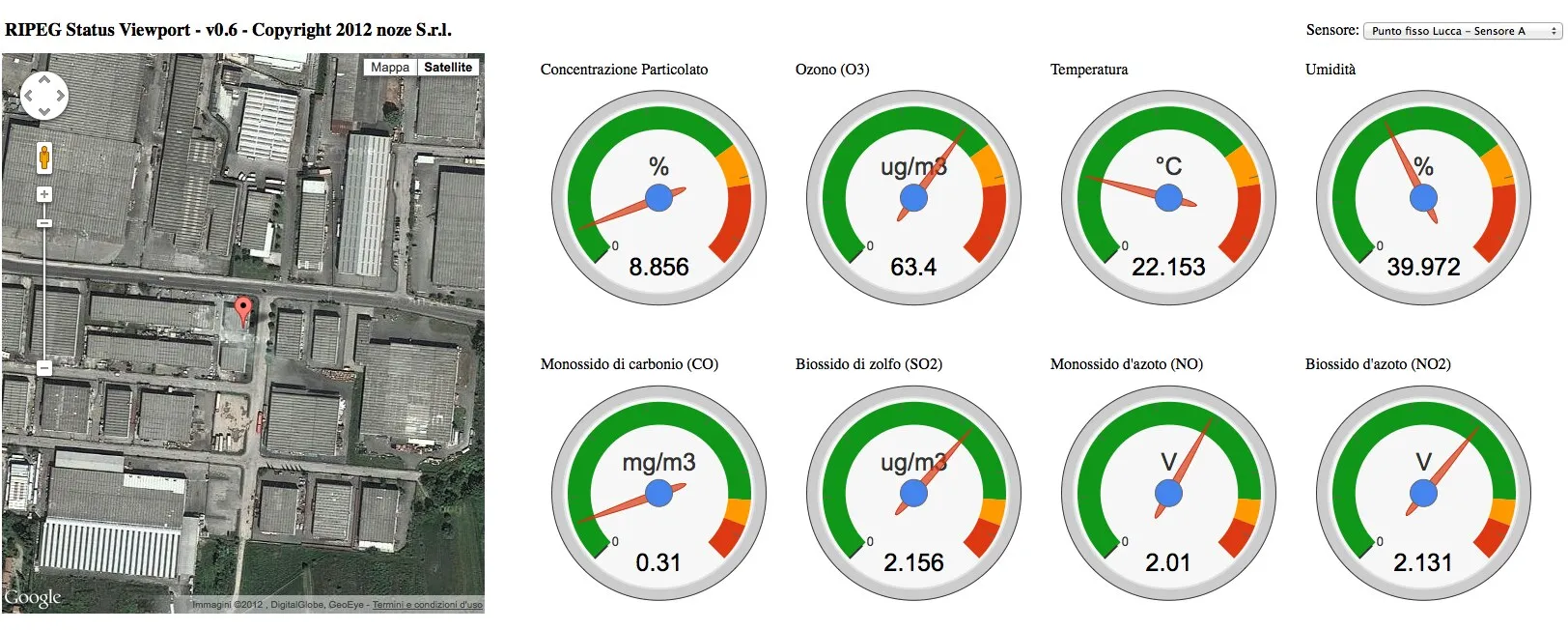
Sensor A — Fixed point in Lucca: Status Viewport showing the position of the stationary sensor on a satellite map and the gauges of the measured values (particulate, ozone, CO, NO/NO₂, SO₂, temperature, humidity).
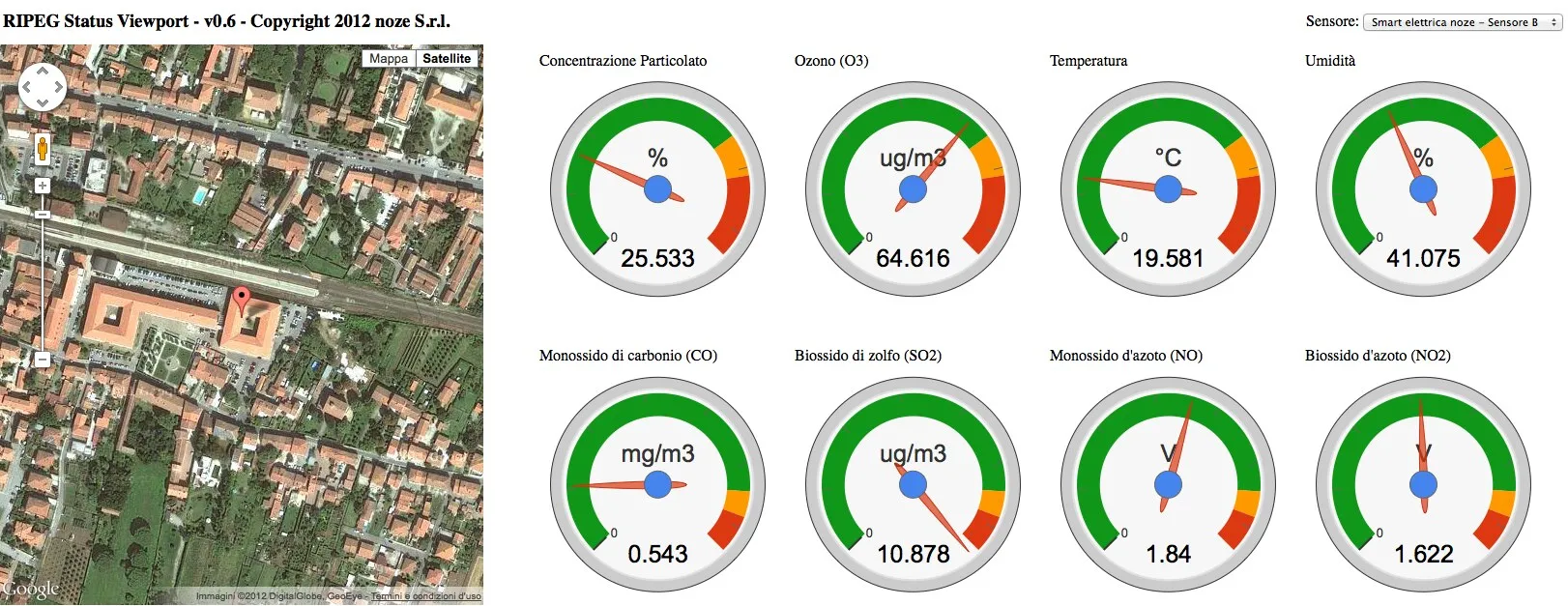
Sensor B — noze electric Smart in motion: same interface, this time with the mobile sensor mounted on a noze electric Smart car; the position changes as the vehicle moves around the city, and the values are streamed in real time over UMTS/WiFi back to the RIPEG hub.
Technology stack
The whole control panel was built with web, Open Source and open data technologies: HTML5, AJAX, Python, PHP, PostgreSQL, SpagoBI, Google Maps API. The Open Source choice was made to maximise portability and reusability of the system across different contexts.
From RIPEG to Dake
The experience noze gained on RIPEG — sensors, IoT, environmental energy and distributed data analytics — led to the birth of the Dake spinoff, which Stefano Noferi announced in the “future prospects” slides of the 2012 final conference, and which is today active on AI optimisation of energy networks.