
DataGovern
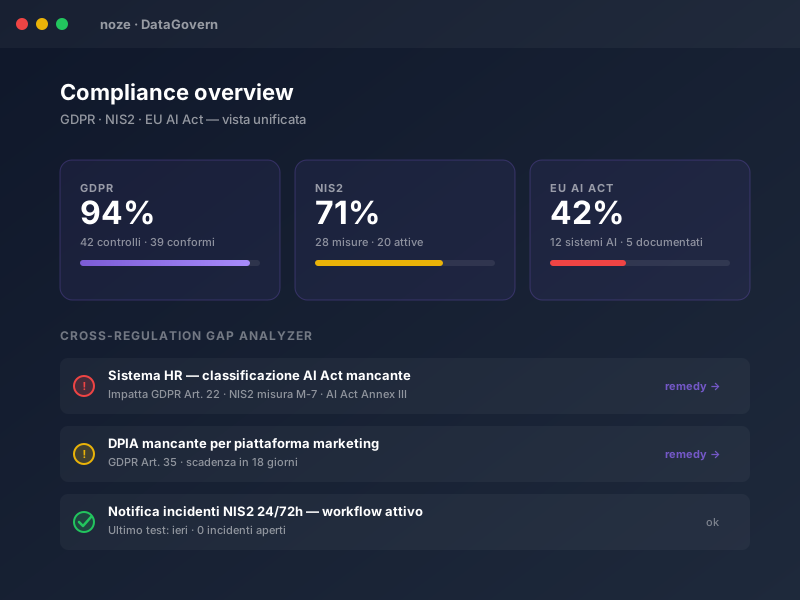
GDPR + NIS2 + EU AI Act in one on-premise platform. Native AI risk classifier, automated DSAR management.
Discover DataGovern →Admina Enterprise
Open AI governance: automatic PII redaction, full audit trail, bidirectional policies (ALLOW, BLOCK, REDACT).
Discover Admina Enterprise →
Artificial Intelligence
EU AI Act consulting: system classification, policy definition, AI governance, training.
Discover →
Cyber Security
NIS2 consulting: gap analysis, remediation plan, integrated compliance support.
Discover →The context: three regulations, one DPO
The DPO role has changed radically. It is no longer just about GDPR: with the EU AI Act in force (fines up to 7% of global turnover for prohibited AI practices) and NIS2 (up to EUR 10 million or 2% of turnover), the DPO has become the convergence point for three overlapping regulations.
Cumulative GDPR fines have exceeded EUR 4.5 billion since 2018 (CMS Enforcement Tracker), with a year-on-year growth trend of roughly 40%. The single largest fine: EUR 1.2 billion against Meta in 2023.
McKinsey (2024) estimates that organisations subject to all three regimes face a 40-60% increase in compliance costs if managed in silos, but only 10-15% incremental cost with an integrated platform.
The cost of manual compliance
According to a DataGrail (2024) study, the average cost of processing a single DSAR (Data Subject Access Request) manually is around USD 1,400-1,500. With automated tools it drops to USD 200-300 — an 80% reduction.
The IAPP-EY Annual Privacy Governance Report 2024 confirms: organisations with automated privacy tools report 50% fewer compliance incidents and 30-40% lower operational costs.
Forrester TEI studies for privacy management platforms consistently show ROI of 150-300% over 3 years, with payback in under 12 months.
AI Act readiness
The AI Act entered into force on 1 August 2024. Main obligations for high-risk AI systems apply from 2 August 2026. Yet:
- Only 15-20% of organisations have a structured AI governance framework (PwC, 2024)
- Fewer than 25% have completed an AI systems inventory (Deloitte, 2024)
- Approximately 80% lack a clear roadmap for AI Act compliance (Accenture/HFS Research)
What a DPO can do today
- Integrate compliance streams: GDPR, NIS2 and AI Act should not be managed in separate silos.
- Automate DSARs: volume is growing, manual costs are unsustainable.
- Inventory AI systems: the mandatory first step for the AI Act.
- Classify AI risk: map each system to the prohibited/high/limited/minimal scale.
Sources: CMS GDPR Enforcement Tracker, IAPP-EY Privacy Governance Report 2024, DataGrail DSAR Benchmarking 2024, PwC EU AI Act Survey 2024, Deloitte State of AI 2024, McKinsey “The compliance convergence” 2024, Forrester TEI studies.